Needs attention
How to care for it, step by step
Care guide checked on
Is it for you?
A tropical tree for a bright room or greenhouse; allow for upward growth and protect it from frost. [2][1]
Where to put it
Bright filtered light, a stable temperature above 13 °C and no cold draughts; avoid strong summer sunlight through glass. [2][1]
Step by step
Check light, available height and temperature before choosing a position. [2]
Check compost moisture before adding water; do not leave water standing in the outer pot. [2]
Support air humidity with damp pebbles beneath the container, keeping the pot base above the water. [2]
Wear gloves when pruning or doing work that may release sap, which can irritate skin. [2]
If something looks wrong
Sudden leaf drop.
Check
Check excess water, cold, insufficient light and draughts: the symptom does not identify a single cause. [2]
What to do
Correct the condition you find and check the compost before watering again. [2]
Yellow leaves or dark spots.
Check
Check compost moisture: excess water can cause these signs, while some lower leaves may age naturally. [2]
What to do
Reduce watering if the compost stays too wet and make sure the container can drain. [2]
Read the sources (2)
- Ficus lyrata — fiddle-leaf fig Royal Horticultural Society · accessed 15 Nov 2026
- How to grow ornamental figs Royal Horticultural Society · accessed 15 Nov 2026
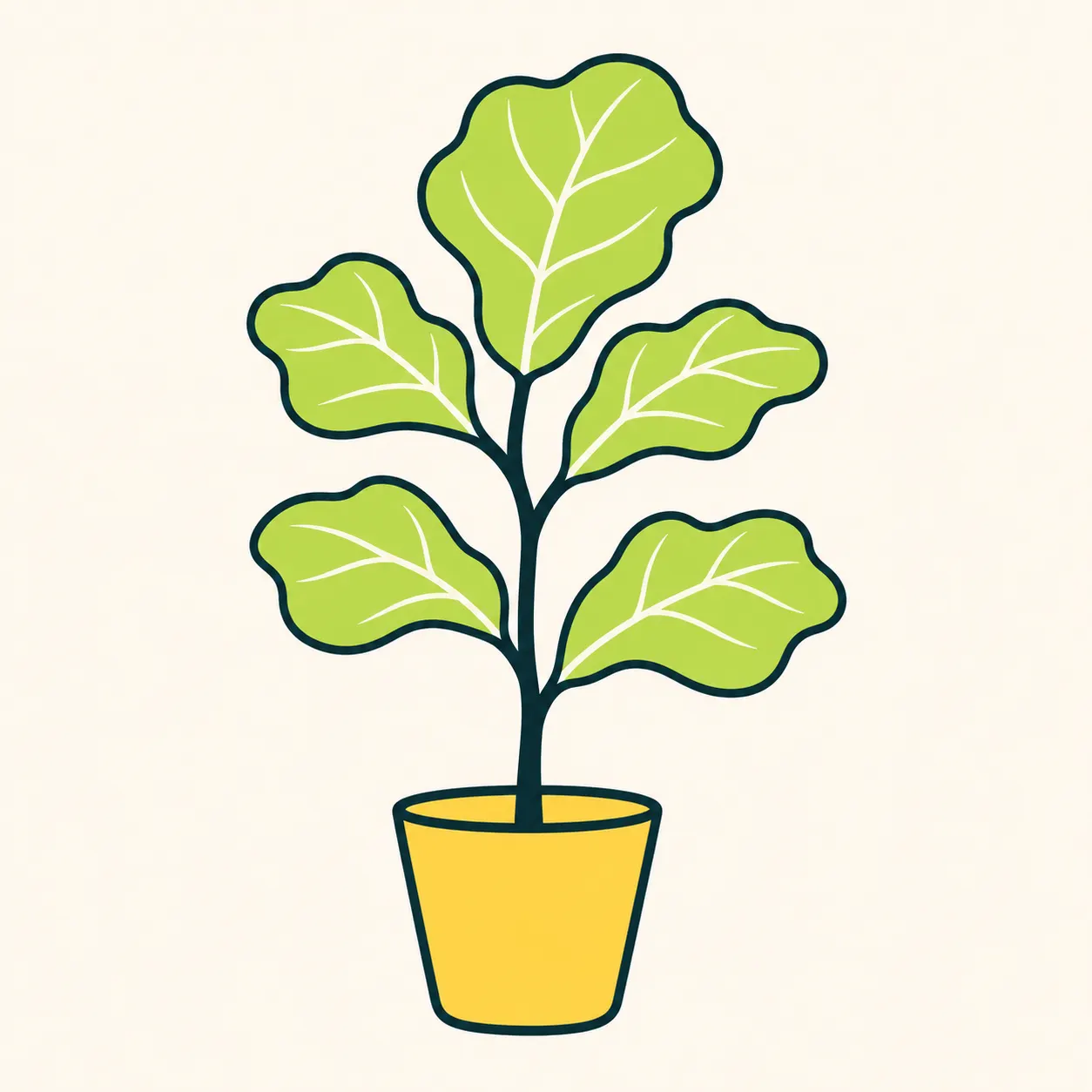
A leaf can resemble a violin without having strings or making music. Ficus lyrata is known in English as the fiddle-leaf fig because of the outline of its large leaves. The Royal Horticultural Society describes them as glossy and dark green, obovate or fiddle-shaped, with impressed veins on the upper surface. The comparison helps us notice the outline; it does not explain why the plant developed that shape. A resemblance is not a cause, even when the name is memorable. [1]
The botanical record places this species in the Moraceae family and gives its native range as tropical western and central Africa. It is an evergreen tree, rather than a small ornament by nature: leaves can reach forty-five centimetres, and the plant can grow several metres tall. A potted specimen shows one stage and set of growing conditions, not the final size of every individual. Looking only at the container can therefore hide an important part of its story. [1]
In its guide to ornamental figs, the RHS distinguishes Ficus lyrata by its upright growth and broad leaves. The space it needs is not just the patch of floor occupied by the pot: height and canopy growth also matter. The general guide recommends bright indirect light, a reasonably steady temperature and humid air. The species profile also specifies moist but well-drained growing conditions. These are conditions to observe, not a promise that any apparently bright corner will automatically suit the plant. [2]
Try an editorial exercise: choose a leaf without removing it and follow its edge with your eyes, then its central vein and the smaller veins branching away. Compare the real outline with the violin you imagine. Which parts match, and which do not? Finally, look at a second leaf on the same plant. The metaphor does not require identical copies. It is a way of noticing variation, rather than turning a common name into a rigid template against which everything must be judged. [1][2]
The name Ficus may immediately suggest an edible fig, but the RHS profile notes that flowers and fruits are not normally seen on container-grown specimens. Here, the discovery remains in the foliage and the tree’s form. We do not give the windowsill special powers to purify a room, or infer food uses from membership of the genus. Good botanical observation can stop at what it actually recognises: shape, surface, veins and growing conditions, without adding imaginary superpowers to the pot. [1]
Take this with youFollow a leaf with your eyes before naming it: the violin comparison is a clue, rather than a complete explanation.
One idea, in simple words
Ficus lyrata is an evergreen tree from tropical western and central Africa. It is also grown in pots. Its leaves are large, shiny and green, with visible veins. Some have an outline that resembles a violin, which explains the English name fiddle-leaf fig. The resemblance helps us notice the shape, but it does not explain why the leaf has that form. It does not make music! Imagine following the edge of a leaf with an invisible pencil, without touching it. Then look at the lines branching from the main vein. Compare two leaves: they can be similar without being identical. At home, light, warmth and space matter, because a small plant in a pot may eventually grow much larger. [1][2]
A little discovery to keep
What did you discover?
Read the sources (2)
- Ficus lyrata — fiddle-leaf fig Royal Horticultural Society · accessed 15 Nov 2026
- How to grow ornamental figs Royal Horticultural Society · accessed 15 Nov 2026
Original writing and illustration made with AI assistance. Our editorial method
More in Plants