Needs attention
How to care for it, step by step
Care guide checked on
Is it for you?
Suitable for someone who can check a small houseplant regularly and provide humid surroundings; a terrarium can help. Unsuitable for strong direct sun or cold rooms. [1][2]
Where to put it
Choose bright indirect light and temperatures above 17°C; avoid cold draughts and strong sun on the leaves. [1][2]
Step by step
Choose a bright position away from strong direct sunlight and cold draughts. [1][2][3]
Check compost moisture before adding water; do not treat every drooping leaf as thirst. [1][2][3]
After watering, let the pot drain and empty water collected in the saucer. [1][2][3]
Provide humid surroundings; if using a terrarium, keep checking leaves and compost. [1][2][3]
If something looks wrong
Drooping leaves
Check
Check whether the compost is dry or already very wet, and whether draughts or dry air are present. [3]
What to do
If dry, gradually restore light moisture; if wet, add no water and check drainage and conditions. [3][1]
Yellowing leaves and very wet compost
Check
Excess water is one possible cause: check for standing water and blocked holes rather than diagnosing from colour alone. [3]
What to do
Remove standing water and adjust watering; if decline continues, ask a nursery to assess the roots and plant. [3][1]
Read the sources (3)
- Fittonia Royal Horticultural Society · accessed 3 Nov 2026
- Fittonia albivenis Argyroneura Group Royal Horticultural Society · accessed 3 Nov 2026
- Fittonia albivenis NC State Extension · accessed 3 Nov 2026
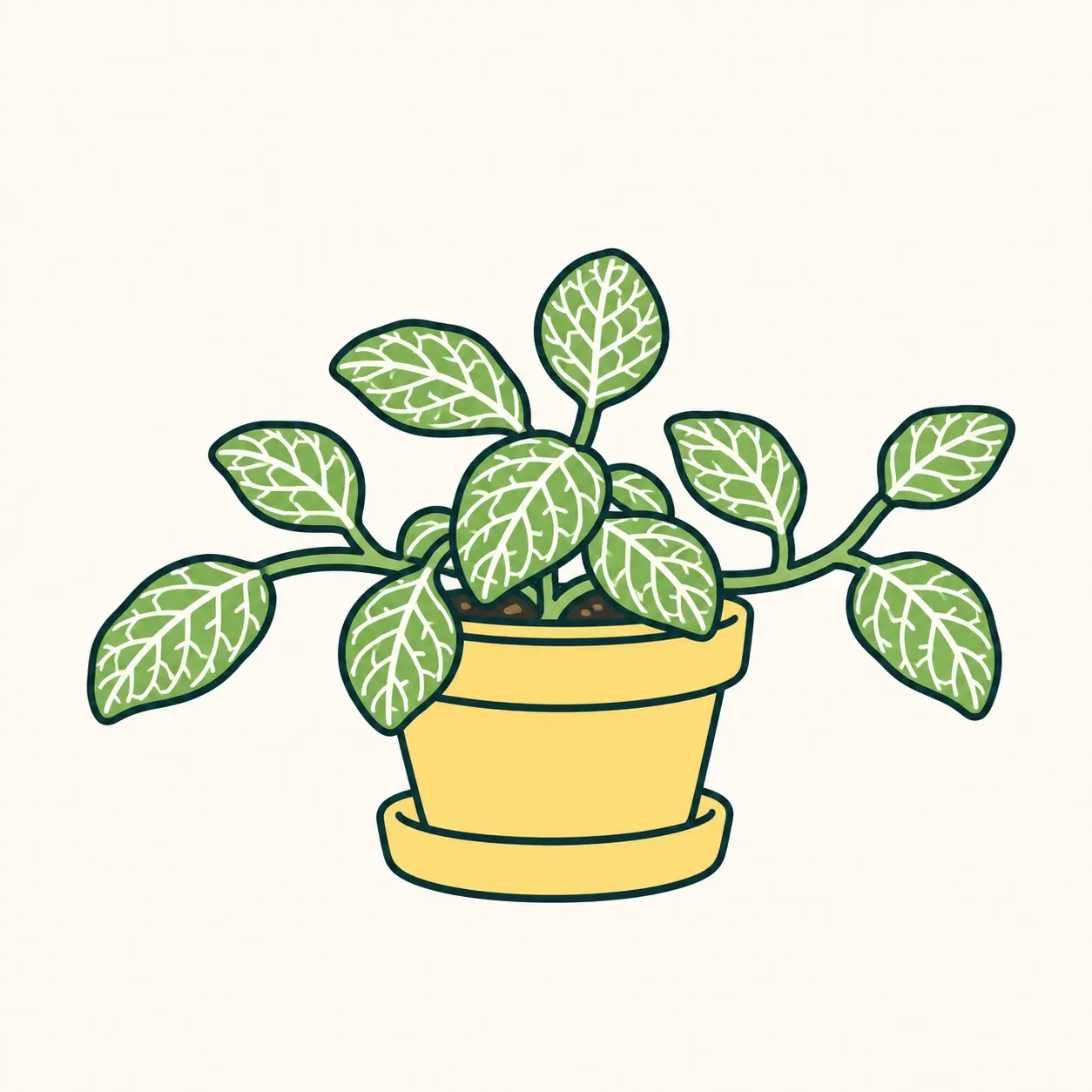
A pale network appears on a small green leaf, as though someone had drawn a map. In Fittonia albivenis Argyroneura Group, white veins create this contrast. The oval leaves have unbroken margins and grow in opposite pairs along low, creeping stems. The resemblance to a street map is simply an editorial image. There is no hidden city to decode inside the plant pot, however tempting the comparison might be. [2][3]
The useful discovery is less conspicuous than the pattern: humid air and waterlogged compost are not equivalent. The RHS recommends a humid environment, while NC State warns that excessive watering can contribute to root rot. These are different conditions, one surrounding the leaves and the other inside the container. Trying to compensate for dry air by leaving water in the saucer confuses precisely the two things we need to separate. [1][3]
NC State describes fittonia as native to South American tropical rainforests, with a low, creeping habit. That provides context, not a guarantee that any warm room will suit it. A home with windows, radiators and draughts does not automatically reproduce a forest. Nor does the commercial name on a small plant tell us, by itself, how that specimen is being grown. Observing its pot remains different from knowing its native environment. [3]
For placement, the RHS recommends bright indirect light, temperatures above 17°C and protection from cold draughts. A terrarium can be suitable because it helps maintain humidity. It does not become a maintenance-free device: observing the plant and its growing medium remains necessary. The guidance includes a practical distinction: keep the compost just moist during growth, and use greater restraint in winter. [1][2]
Drooping leaves are not an instruction to pour in a predetermined dose of water immediately. NC State connects wilting with dehydration but also describes problems associated with excess water and unsuitable conditions. Our editorial example is a short pause before reaching for the watering can: inspect the compost, drainage and anything that has changed in the room. One symptom cannot replace observation, especially when the pot is already wet. [3]
To look more closely, choose a leaf without removing it and follow a vein from its centre towards the edge. Then notice the next pair of leaves. The plant need not become a domestic jungle to reward attention: fittonia offers a readable detail in very little space. Its small botanical theatre works best when the protagonist remains a plant, rather than an experiment in permanent irrigation. [1][2]
Take this with youObserve air, light and compost separately: the leaf network is striking, but good care begins with concrete conditions that are not interchangeable.
One idea, in simple words
Fittonia is a small plant with very visible veins across its leaves. In Argyroneura Group, these lines are white. Its leaves grow in opposite pairs, meaning one faces another along the stem. The species comes from tropical South America. It likes humid surroundings and indirect light, without strong sunlight on its leaves. Remember: humid air does not mean a pot full of water. The compost should stay slightly moist, but excess water must be able to drain away. Too much water can damage the roots. Imagine two separate checks: look at where the plant stands and gently check its compost. If the leaves droop, do not add water before finding out whether the pot is already wet. [2][3][1]
A little discovery to keep
What did you discover?
Read the sources (3)
- Fittonia Royal Horticultural Society · accessed 3 Nov 2026
- Fittonia albivenis Argyroneura Group Royal Horticultural Society · accessed 3 Nov 2026
- Fittonia albivenis NC State Extension · accessed 3 Nov 2026
Original writing and illustration made with AI assistance. Our editorial method
More in Plants