Needs attention
How to care for it, step by step
Care guide checked on
Is it for you?
Suited to a warm, bright indoor space with high humidity; do not expose it to frost. The RHS requires a constant temperature of at least 16°C. [1]
Where to put it
Choose bright indirect or filtered light, away from draughts and direct heat sources. [1][2]
Step by step
Find a bright position without direct sunshine and check that it remains warm enough at night. [1]
Use a finger to check compost moisture; adjust watering to growth and season rather than a fixed timetable. [1][2]
Provide suitable air humidity, for example by grouping plants or using a tray of damp pebbles without submerging the pot. [1][2]
Remove dead leaves and regularly inspect the undersides of the others: the RHS lists possible glasshouse whitefly and red spider mite. [1]
If something looks wrong
Dry or brown leaf edges
Check
Check for very dry air, dry compost or direct sunlight: one symptom does not identify a certain cause. [2]
What to do
Correct the condition observed, moving the plant out of direct light or improving humidity and watering as needed. [2][1]
Yellowing leaves with persistently wet compost
Check
Check standing water, drainage and watering frequency; yellowing can have several causes. [2]
What to do
Allow excess water to drain and reduce watering when the compost is already moist; check again before watering next time. [2][1]
Read the sources (2)
- Calathea orbifolia — plant profile Royal Horticultural Society · accessed 28 Oct 2026
- How to help a poorly houseplant Royal Horticultural Society · accessed 28 Oct 2026
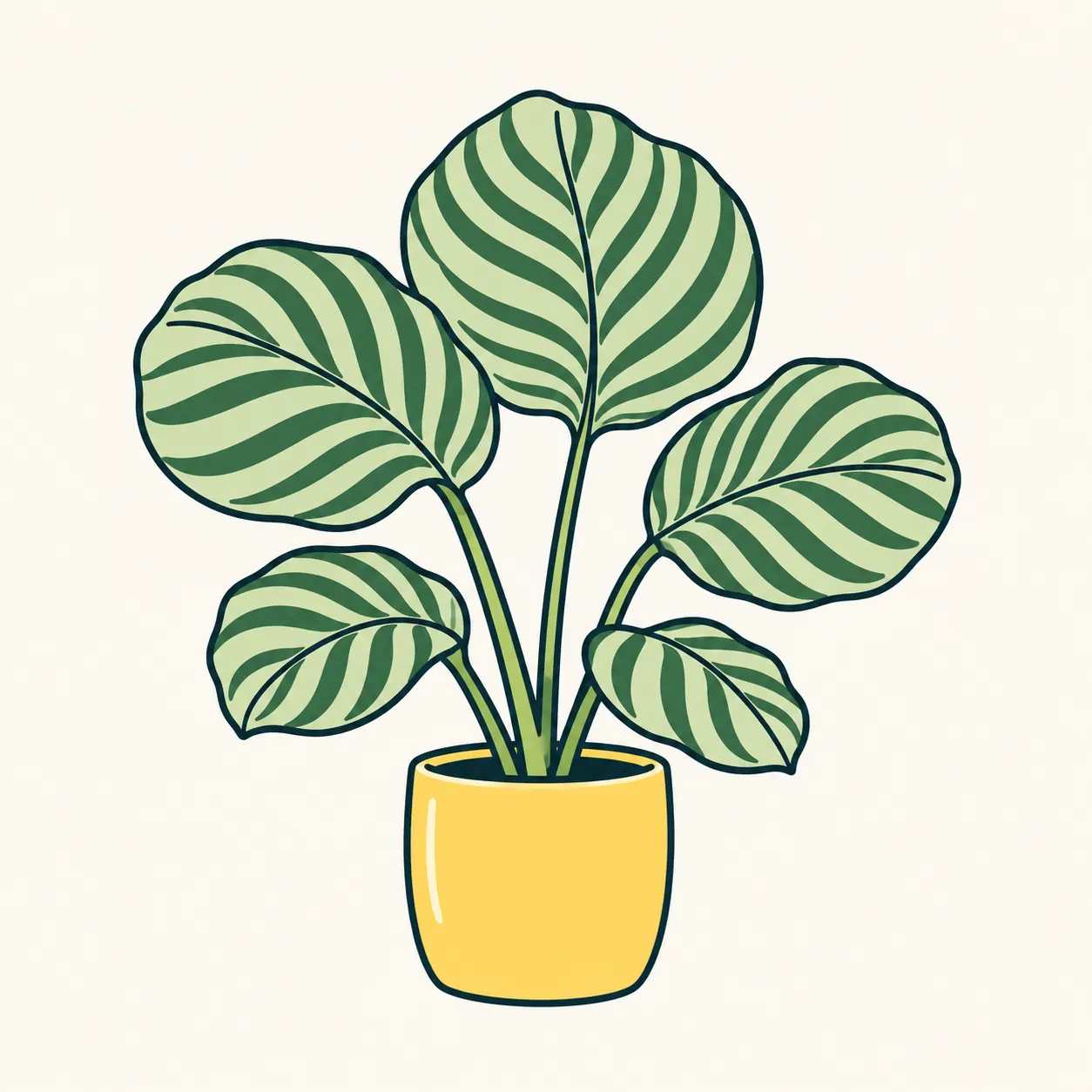
A nearly round green leaf crossed by paler bands: Goeppertia orbifolia has a pattern that catches the eye without requiring showy flowers. The Royal Horticultural Society describes large leaves with silvery-green stripes and a silvery-green underside. The plant grows in clumps and remains evergreen. Its appearance invites attention to details: the rounded outline, alternating colours and the space occupied by each leaf. Not every houseplant needs to tell its story through a conspicuous display of flowers on a windowsill. [2]
The first surprising detail, however, may be on its label. Shops and some profiles use Calathea orbifolia, while Kew’s Plants of the World Online accepts Goeppertia orbifolia. The database lists Calathea orbifolia as a synonym and records the accepted name as first published in 2012. These are not two plants to purchase for a complete collection: in this case both names refer to the same species. A scientific name can change while the plant by the window simply continues growing. [1]
Kew places its native range in eastern Brazil and describes a perennial of the wet tropical biome. That classification is not an automatic recipe for growing it at home. For cultivation, the RHS specifies bright indirect or filtered light, high humidity and a constant temperature of at least 16°C. These conditions help explain why a bright window does not necessarily mean direct sunshine, and why a decorative corner is not suitable merely because a pot looks good in it. [2]
Watering also calls for observation. The RHS distinguishes moderate watering during growth from keeping the compost just moist in winter, and recommends peat-free potting compost. Moist does not mean submerged in water. The organisation’s general guidance encourages checking moisture in the growing medium before acting instead of watering at fixed intervals. A brown edge alone does not tell the whole story: dry air, light and watering need to be considered together. The separate care guide suggests checks, rather than promising an infallible diagnosis. [2][3]
Here is an editorial exercise: imagine two labels beside the same pot, one saying Calathea and the other Goeppertia. Before deciding they describe different plants, look up the complete species name in a botanical database. Then return to the actual leaf. Names help connect information, while observation prevents us reducing a living thing to its label. This reading does not assign an unverified evolutionary purpose to the stripes, nor claim that a single pot can purify the air in a room. [1][2]
Take this with youObserve a leaf without touching it: follow its outline and one pale stripe. Then compare the label with the accepted botanical name.
One idea, in simple words
Goeppertia orbifolia has large round leaves with pale stripes. You may also find it sold as Calathea orbifolia. Kew’s botanical database explains that this is a synonym: another name for the same species. It does not mean there are two different plants in the pot. The species comes from eastern Brazil. For cultivation, the RHS recommends filtered light, humid air and a temperature of at least 16°C. The growing medium should be moist without being flooded. Imagine two different labels on one pot: before getting confused, search for the complete name in a botanical source. Leaves help us observe the plant, while an accurate name helps us find information that belongs to it. [1][2]
A little discovery to keep
What did you discover?
Read the sources (3)
- Goeppertia orbifolia (Linden) Borchs. & S.Suárez Royal Botanic Gardens, Kew · Plants of the World Online · accessed 28 Oct 2026
- Calathea orbifolia — plant profile Royal Horticultural Society · accessed 28 Oct 2026
- How to help a poorly houseplant Royal Horticultural Society · accessed 28 Oct 2026
Original writing and illustration made with AI assistance. Our editorial method
More in Plants