Easy
How to care for it, step by step
Care guide checked on
Is it for you?
A small container succulent suited to a bright interior; it is not frost-tolerant. Easy when light and drainage are appropriate. [1]
Where to put it
Choose bright indirect light. Avoid harsh direct sun, cold draughts and temperatures below about 10 °C; the source gives about 16–27 °C as a favourable range. [1]
When and how to water
Check the potting mix and let it dry between waterings. Avoid fixed intervals, standing water and water left on leaves. [1]
Pot and growing medium
Use a pot with drainage and a freely draining cactus or succulent mix. Water must be able to escape so roots do not remain continuously wet. [1]
Step by step
Check the label: bumps on both leaf surfaces are a character of attenuata, not every plant called zebra plant. [1]
Place the pot in bright indirect light and check that water does not remain in the outer container. [1]
Before watering, check that the mix has dried. Observe the actual conditions in the pot. [1]
Regularly check leaves and the base for changes, scale insects or other abnormalities; compare observations over time. [1]
If something looks wrong
Leaves that look scorched
Check
Check whether the pot receives harsh direct sun, which the source identifies as a possible cause of scorching. [1]
What to do
Move it to bright indirect light and observe changes; appearance alone is insufficient for a diagnosis. [1]
An altered base and persistently wet mix
Check
Check continuing moisture, drainage and watering frequency: excessive water can encourage rot. [1]
What to do
Remove standing water and allow the mix to dry before adding more. If damage continues, ask a nursery professional to assess the plant. [1]
Read the sources (1)
- Haworthiopsis attenuata — Zebra Plant NC State Extension Gardener Plant Toolbox · accessed 12 Nov 2026
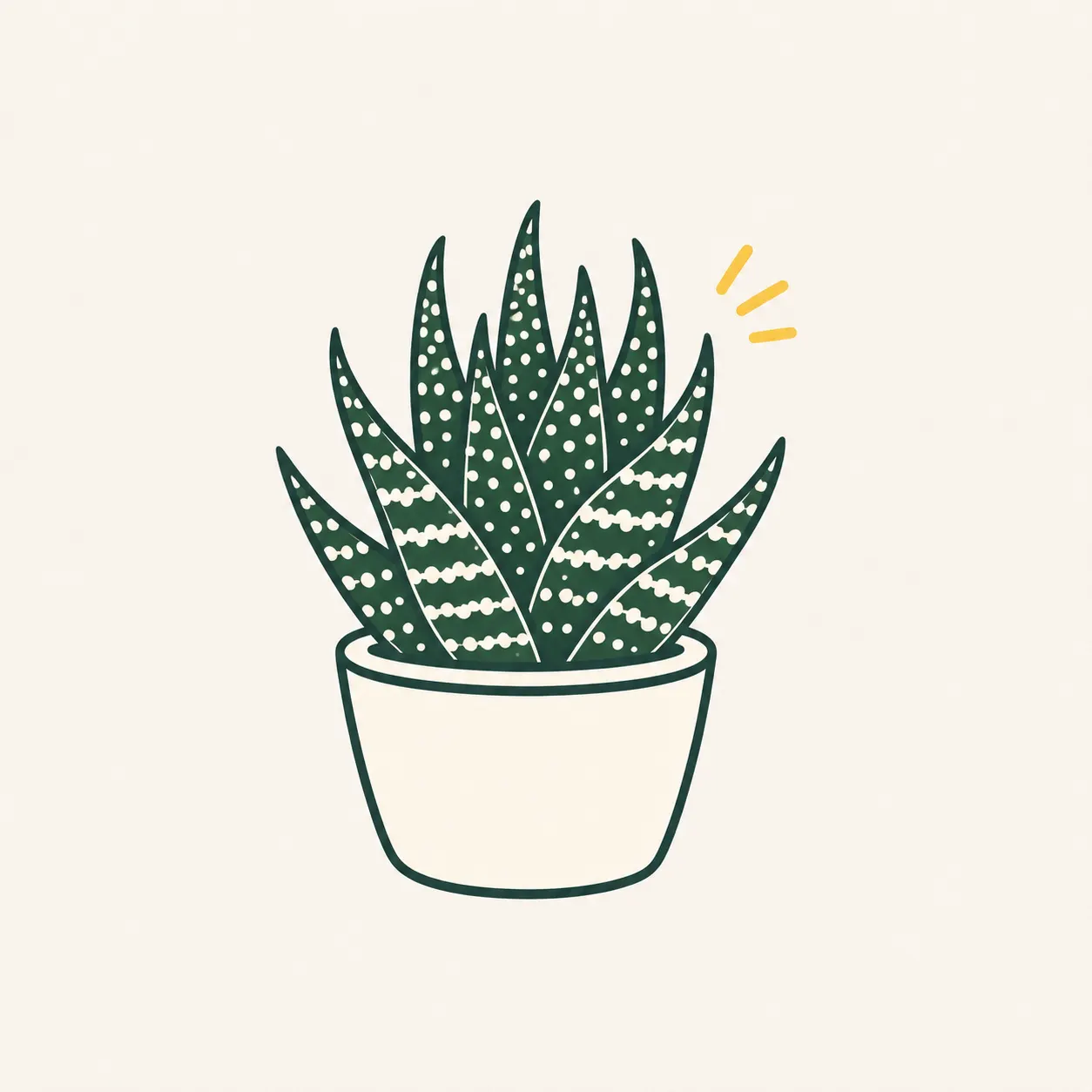
On a windowsill it looks like a miniature striped sculpture: pointed green leaves gather into a rosette, marked by small white bumps. Haworthiopsis attenuata is a succulent native to the Cape Provinces of South Africa. The discovery begins by moving closer without removing anything. Those marks are not simply colour painted onto an otherwise uniform surface. They are tubercles, small raised structures that change the appearance of a leaf depending on which side and angle we observe. [1]
NC State's plant account compares this species with Haworthiopsis fasciata, with which it is sometimes confused. In attenuata, bumps occur on both leaf surfaces; in fasciata, the upper surface is smooth. This is a useful character, not an invitation to identify every succulent from a blurred photograph. The common name “zebra plant” is also given to very different plants. A botanical label and careful observation need to work together rather than replace one another. [1]
Here is an editorial exercise: draw one leaf as a long tapering shape, then separately mark what you can see on its inner and outer faces. The drawing need not be attractive. Its purpose is to prevent a generic memory, “a stripy plant”, from replacing the detail actually present. If one surface is hard to see, leave that part blank. An incomplete observation tells us more than a confident mark added merely because it seems plausible. [1]
Such attention can accompany cultivation. NC State recommends bright indirect light and a cactus or succulent mix that drains freely. The soil should dry between waterings. That does not produce an identical calendar for every home: a particular pot, window and season cannot simply be exchanged for another. Our practical application is to check conditions before repeating an action, instead of allowing the description “easy” to become a promise of care that works entirely automatically. [1]
A small plant does not necessarily have a short life. This species is described as slow-growing and can produce offsets at its base. Its pot therefore offers a place to notice gradual changes. We suggest photographing it from the same position over time, recording only what actually changes. We are not assigning intentions to the plant or promising a deadline. It is an observation diary, not a flowering contract countersigned by the windowsill. [1]
Stripes are not enough to diagnose a problem either. The source warns that direct sun can scorch leaves and excessive watering can encourage rot; a single symptom calls for checks rather than instant conclusions. Compare light, moisture and changes over time before intervening. This little zebra leaves us with a concrete lesson: recognising a form means examining how it is made, while caring for it requires noticing the conditions in which it lives. [1]
Take this with youObserve both faces of a leaf without damaging it. The detail that distinguishes two plants may be less striking than the pattern that makes them look alike.
One idea, in simple words
Haworthiopsis attenuata is a small succulent plant from South Africa. Succulent means that it has fleshy parts able to store water. Its leaves form a rosette: they are arranged around a centre. Small white bumps on the leaves are called tubercles. In this species, they occur on both surfaces. That detail helps distinguish it from Haworthiopsis fasciata, which has a smooth upper surface. The nickname “zebra plant” is not enough because it is used for different plants. At home, it prefers bright indirect light and a draining potting mix, which lets water pass through easily. The soil should dry between waterings. As an exercise, observe both sides of a leaf without removing it and draw only the bumps you can really see. [1]
A little discovery to keep
What did you discover?
Read the sources (1)
- Haworthiopsis attenuata — Zebra Plant NC State Extension Gardener Plant Toolbox · accessed 12 Nov 2026
Original writing and illustration made with AI assistance. Our editorial method
More in Plants