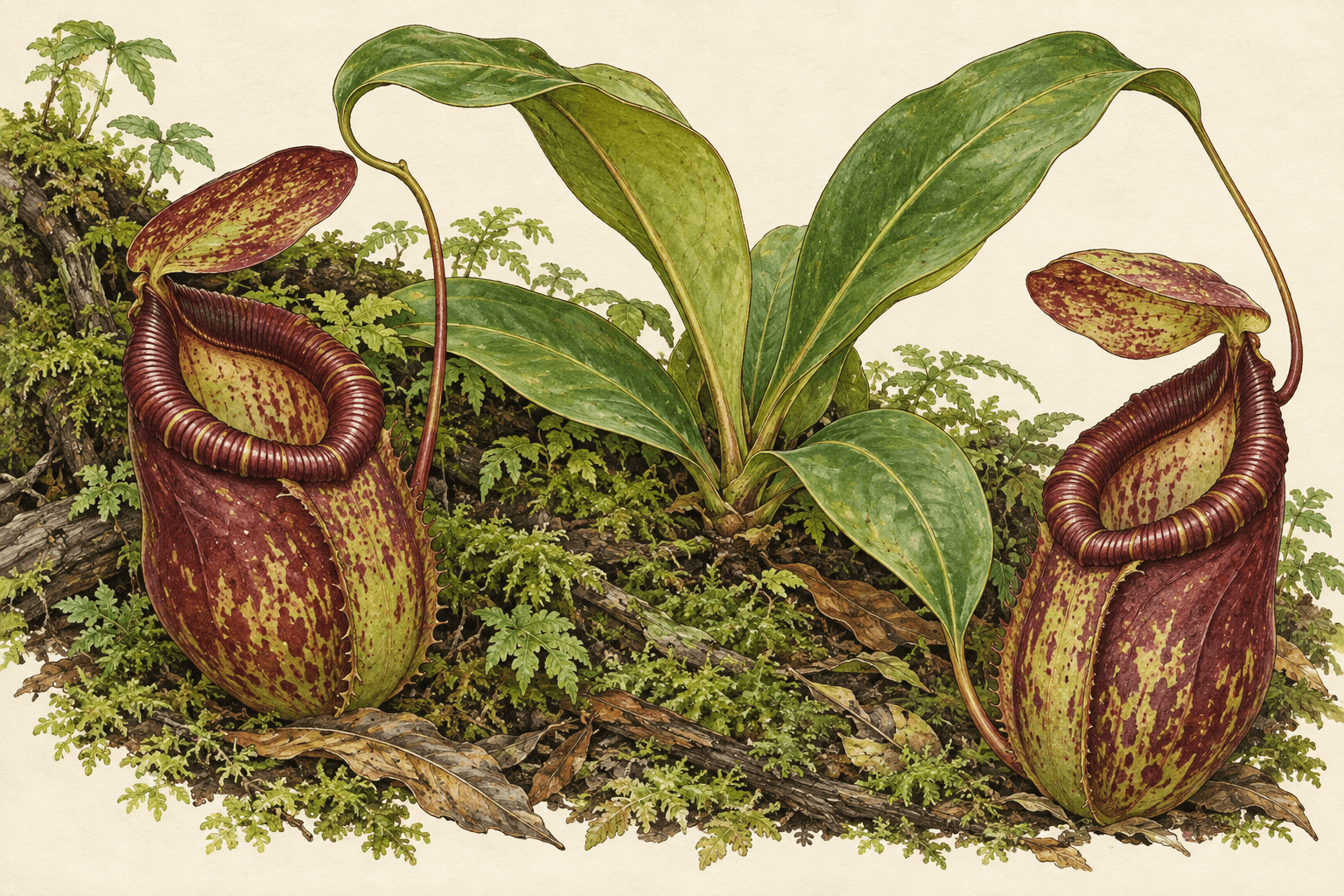
When looking at Nepenthes rajah, the most useful question is not how large its pitcher is, but which part of the plant it belongs to. Kew’s botanical profile describes a modified leaf, connected to the blade by a long tendril. The pitcher is not a flower. That distinction lets us read the whole plant, instead of stopping at the striking object that seems to hang from a branch. [1]
Plants of the World Online accepts Nepenthes rajah as a species native to Sabah, Borneo, associated with tropical mountain habitats. It is a shrub that can scramble or climb. The scientific name also sets the boundaries of our story: not every Nepenthes lives in the same place, and not every carnivorous plant makes the same trap. Visual resemblance can start a useful question, but cannot settle classification on its own. [2]
Kew explains that many carnivorous plants live in soils poor in nutrients: catching animals provides substances that are difficult to obtain from the ground. In Nepenthes, the pitcher works as a pitfall trap. It is therefore not a mouth that chases prey. Calling it carnivorous describes a way of obtaining nutrients; it does not turn the plant into a small animal or give us permission to invent intentions for it. [3]
The story does not end with capture. Another Kew account describes how Nepenthes rajah can also obtain nutrients from the droppings of tree shrews, small mammals visiting the plant for nectar. We should not extend that relationship to every species or conclude that all its nutrients arrive this way. What matters is the variety of relationships: the same container can take part in exchanges beyond a simplified picture of an insect trap. [4]
Here is an editorial exercise to try with a botanical picture, without touching the plant. Start at the broad leaf blade and follow its connection to the pitcher; then look separately for flowers, if any are shown. The gesture resembles following a thread through a drawing. You are not watching a leaf transform in real time: you are reconstructing the relationship between developed parts, separating shape, connection and function. [1]
Take this with youBefore naming an unusual shape, follow its connections. A plant’s pitcher can be part of a leaf: careful observation changes the question as well as the answer.
One idea, in simple words
Nepenthes rajah is a plant from Borneo. It has containers called pitchers that look like little jugs. They are not flowers: they are modified parts of leaves. A thin connection called a tendril links the broad leaf blade to the container. The plant also produces flowers, but those are different structures. Understanding that difference helps us look more carefully. [1]
Many carnivorous plants grow in soil poor in nutrients, substances needed for growth. Catching animals can help provide them. Here is an editorial example: on a photograph, follow the connection between leaf and pitcher with your finger. Do not draw a biting mouth. The container is a pitfall trap, rather than a flower that goes hunting. [3]
A little discovery to keep
What did you discover?
Read the sources (4)
- Nepenthes rajah · General information Royal Botanic Gardens, Kew · accessed 7 Oct 2026
- Nepenthes rajah Hook.f. · accepted name and distribution Plants of the World Online · Kew · accessed 7 Oct 2026
- Carnivorous plants Royal Botanic Gardens, Kew · accessed 7 Oct 2026
- In Pictures: Poo-loving plants Royal Botanic Gardens, Kew · accessed 7 Oct 2026
Original writing and illustration made with AI assistance. Our editorial method
More in Plants