Needs attention
How to care for it, step by step
Care guide checked on
Is it for you?
Suitable for a bright home without strong direct sun. Moderate difficulty is an editorial assessment: watering, temperature and bud development require attention. [2]
Where to put it
Provide bright filtered light, away from cold draughts and direct heat. The RHS advises protection below 10°C and around 18–20°C during growth and flowering. [2]
When and how to water
During growth and flowering, keep the mix moderately moist and allow excess water to drain. During rest periods, water less and allow the top few centimetres to dry, without completely drying the root ball. [2]
Pot and growing medium
Use a pot with drainage holes and a free-draining peat-free mix. Repot when roots fill the container, outside flowering and as growth begins; choose a container only slightly larger. [2]
Step by step
Read the label and inspect stem segments: cultivars and hybrids may have intermediate features. [4]
Check the mix before watering and remove accumulated drainage water. [2]
Keep conditions consistent while buds develop; avoid abrupt moves. [4]
Consider natural night length and temperature: flowering does not depend on the calendar alone. [2]
If something looks wrong
Flower buds drop
Check
Check temperature changes, relocation and a mix that is too wet or too dry. [2]
What to do
Stabilise conditions and adjust watering according to the mix, rather than adding water automatically. [2]
Stems discolour or shrivel
Check
Check strong direct sunshine, heat and root conditions: both too much and too little water can cause problems. [2]
What to do
Move away from strong sunshine and assess the growing medium before changing watering; one symptom alone cannot identify its cause. [2]
Read the sources (4)
- Schlumbergera truncata Royal Horticultural Society · accessed 9 Nov 2026
- How to grow Christmas cactus Royal Horticultural Society · accessed 9 Nov 2026
- Schlumbergera truncata NC State Extension Gardener Plant Toolbox · accessed 9 Nov 2026
- All About Holiday Cacti Iowa State University Extension and Outreach · accessed 9 Nov 2026
Say cactus, and it is easy to picture sand, spines and relentless sunshine. Schlumbergera truncata challenges that summary. It belongs to the cactus family but comes from forests in southeastern Brazil, where it can grow on trees or among rocks. This origin is more than an exotic detail for its label. It helps explain why a trailing houseplant might prefer filtered light rather than prolonged exposure to the strongest sunshine. Belonging to the same family does not mean sharing the same landscape. [3][1]
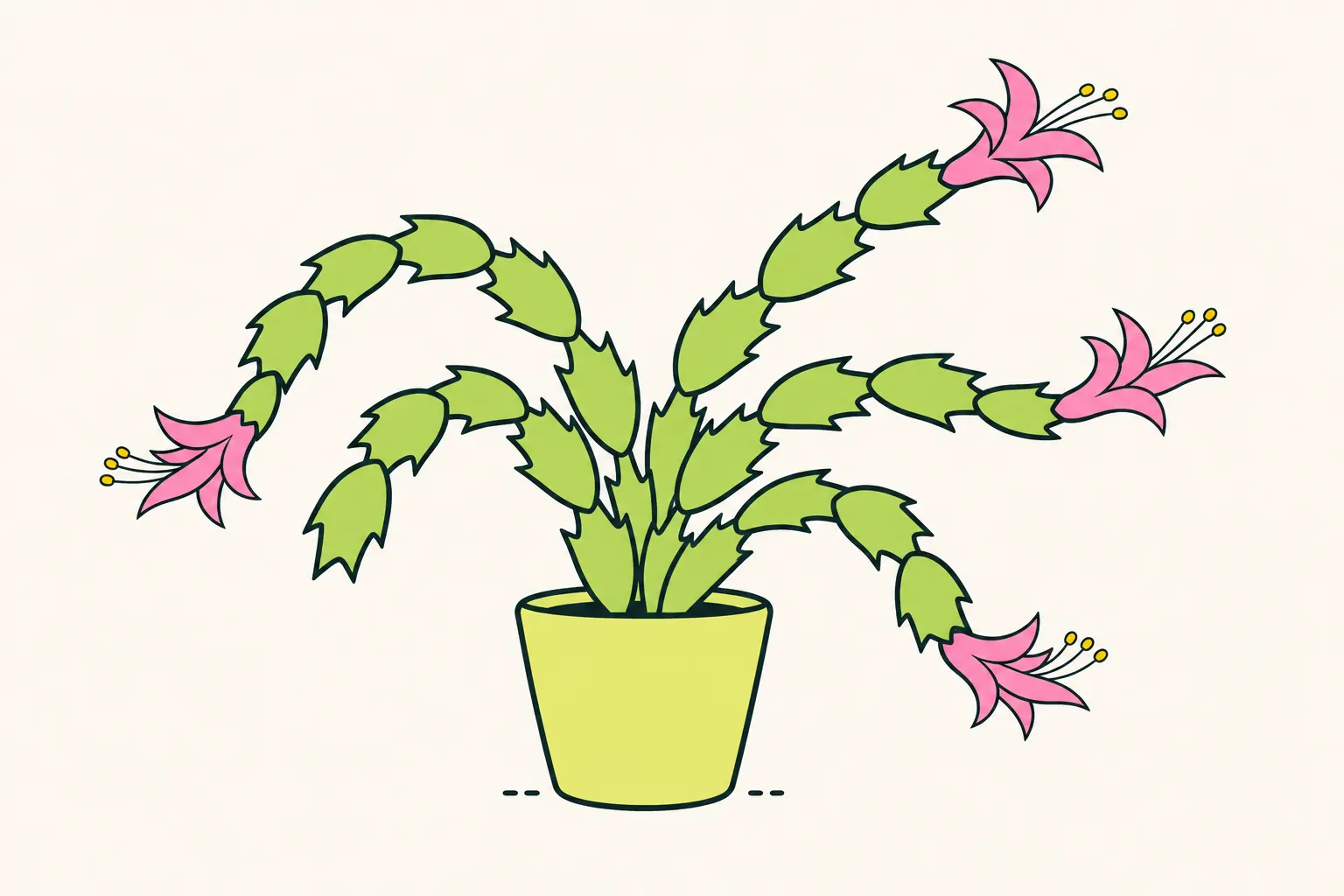
The flattened green parts that resemble leaves are stem segments. In this species their edges have pointed, tooth-like projections, and flowers develop at the tips. Iowa State University explains that these segments perform photosynthesis and that epiphytic cacti use trees for support: epiphyte does not mean parasite. The central discovery therefore corrects two assumptions at once. Not every flat green surface is a leaf, and not every cactus is a desert plant. The familiar category needs a closer look at its members. [4][3]
Retail names can be confusing. Schlumbergera truncata and the hybrid Schlumbergera × buckleyi are often grouped among holiday cacti, and many cultivars have intermediate characteristics. The name “Christmas cactus” alone cannot identify a species or guarantee flowers precisely on December twenty-fifth. To examine a specimen, compare segment edges and the position and shape of its flowers. A calendar date may be convenient when buying a present, but the plant has never signed up to our celebrations schedule or agreed to meet a gift-giving deadline. [4][1]
Watering also needs to reflect the plant’s stage. The RHS recommends bright conditions without strong sunshine, a draining growing medium and protection from cold; during growth and flowering, watering must not become waterlogging. Night length and temperature matter when buds form. The guide’s seasonal calendar reflects a British context: in our own homes, actual conditions and the specimen’s activity matter. No fixed weekday can replace checking the potting mix, and a single symptom does not always reveal one particular cause. [2]
For an editorial observation exercise, choose one stem and follow it with your eyes from its base to its tip. Identify a segment, its junction and any flower bud without removing anything. Recording these details differs from waiting only for a spectacular flower. It helps us understand the structure supporting that flower and avoid calling every changing part a “dry leaf”. Before turning the pot into a miniature indoor desert, we might ask which forest belongs to this particular plant’s natural history. [3][4]
Take this with youLook at the toothed segments: they are stems. Care for this cactus by considering its forest origin and the actual conditions in its pot.
One idea, in simple words
Schlumbergera truncata is a cactus, but it does not come from a desert. It naturally grows in forests in southeastern Brazil and can use trees for support. Using a tree does not mean stealing its food: this kind of plant is called an epiphyte. Its flat green parts look like leaves, but they are stem segments. The edges have small points, and flowers grow at the ends. Imagine following a green chain with your eyes, from the pot to a bud: each piece is a segment. This is an observation exercise, with nothing removed. The cactus prefers filtered light and a growing medium that lets water drain. A holiday name on a shop label cannot identify its species by itself. [2][4][3][1]
A little discovery to keep
What did you discover?
Read the sources (4)
- Schlumbergera truncata Royal Horticultural Society · accessed 9 Nov 2026
- How to grow Christmas cactus Royal Horticultural Society · accessed 9 Nov 2026
- Schlumbergera truncata NC State Extension Gardener Plant Toolbox · accessed 9 Nov 2026
- All About Holiday Cacti Iowa State University Extension and Outreach · accessed 9 Nov 2026
Original writing and illustration made with AI assistance. Our editorial method
More in Plants