Needs attention
How to care for it, step by step
Care guide checked on
Is it for you?
Suitable for someone able to provide light and drainage, leave room for trailing stems and minimise moving the plant. Moderate difficulty is an editorial judgement based chiefly on fragile leaves and the need to manage watering. [1][2]
Where to put it
Choose bright filtered indoor light and a position protected from cold, with clear space below the stems. Avoid busy spots where the plant would often be knocked. [1][2]
Step by step
Before watering, check the moisture in the growing medium and the available light. [1][2]
After watering, let water leave through the drainage holes and do not keep it in the saucer. [1][2]
Inspect the plant regularly without lifting or intertwining its stems. [2]
When moving it, support the pot and minimise contact with the leaves. [2]
If something looks wrong
Leaves fall after moving the plant
Check
Check whether loss followed knocks or handling: these leaves detach readily. [2]
What to do
Choose a quieter position and reduce contact; do not automatically increase watering. [2]
Growing medium stays wet
Check
Check drainage, standing water in the saucer and watering frequency: excess moisture can favour rot. [1][2]
What to do
Remove standing water and allow the medium to dry before watering again; consider whether the growing mix is suitable. [1][2]
Read the sources (2)
- Sedum morganianum — burro’s tail Royal Horticultural Society · accessed 6 Nov 2026
- Sedum morganianum NC State Extension Gardener Plant Toolbox · accessed 6 Nov 2026
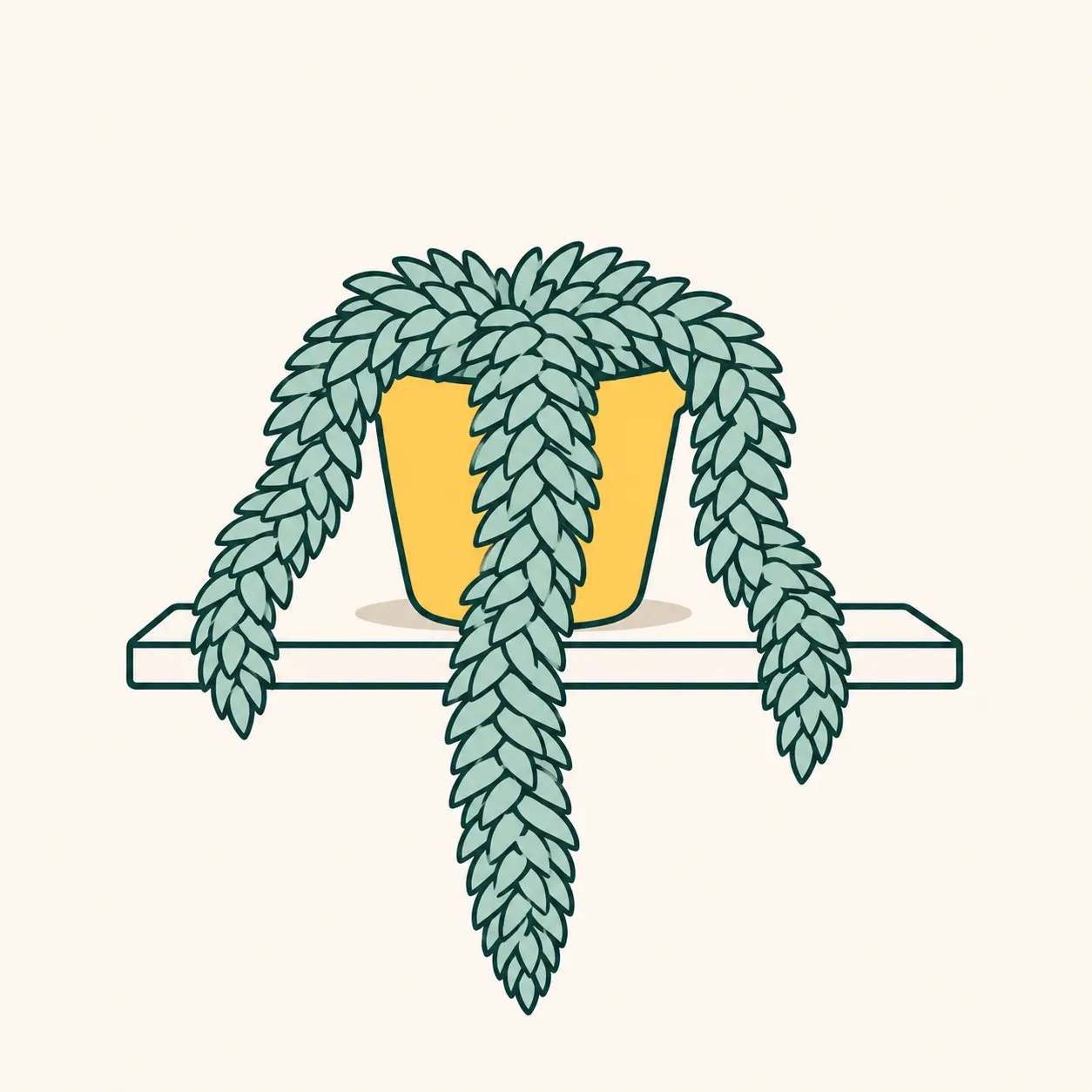
It resembles a green braid spilling over the rim of a pot. Sedum morganianum creates this outline with trailing stems and many overlapping fleshy leaves. The Royal Horticultural Society describes them as lance-shaped and glaucous blue-green: their colour has a softly bluish appearance. Its common name, burro’s tail, suggests a donkey’s tail. Resemblance offers a visual starting point; identifying the plant depends more closely on the shape, arrangement and thickness of its leaves. [1]
The unexpected detail is that a plant looking so compact can shed leaves when handled. NC State Extension notes this fragility and the possibility of propagation from leaves or pieces of stem. Keep those two facts separate: accidental leaf loss is not a request for vigorous intervention, and a detached leaf does not automatically guarantee a new plant. For a grower, choosing a suitable position reduces the need to move it repeatedly from place to place. [2]
Growing it requires light and drainage, rather than a competition to provide as little water as possible. Under glass, the RHS recommends bright filtered light and a growing medium with added grit; NC State advises allowing soil to dry between waterings. Winter watering is reduced according to conditions and growth. A fixed calendar date cannot see the amount of available light, the size of the pot or whether the growing medium still contains water. [1][2]
Imagine our own comparison between two positions: a bright shelf in a quiet spot and the edge of a desk regularly brushed by hands and bags. We have not conducted a growth experiment. We are translating documented fragility into a practical question: how often will something accidentally touch those stems? Care can start before the watering can appears, with the choice of free space. Not every useful act of attention involves adding something to a plant. [1][2]
Checking problems also benefits from this quieter approach. Leaves lost immediately after moving the pot and soil that remains wet are different observations, not interchangeable diagnoses. The sources describe both easy detachment and risks associated with poor drainage and rot. Before intervening, describe what you can see and the conditions around the pot. The central discovery remains straightforward: a trailing shape is a living structure, rather than a decoration to rearrange at will every morning. [1][2]
Take this with youLook without lifting the stems: notice where the plant grows, how much room it has and whether the pot drains. Turn one check into three precise observations, separating regular attention from constant handling.
One idea, in simple words
Sedum morganianum is a succulent plant, meaning it has fleshy leaves. Its stems hang down from a pot and carry many closely packed blue-green leaves. The leaves can fall off easily when touched or when the plant is moved. Giving it room and handling it gently is therefore useful. Growing guides recommend a bright position and a pot that lets water drain away. Soil should dry between waterings; watering on the same weekday is not enough to judge what it needs. Imagine a quiet shelf and a desk often brushed by bags. This is our example for thinking about its position. A leaf that falls after a knock does not, by itself, mean the plant is thirsty. Observe before deciding. [1][2]
A little discovery to keep
What did you discover?
Read the sources (2)
- Sedum morganianum — burro’s tail Royal Horticultural Society · accessed 6 Nov 2026
- Sedum morganianum NC State Extension Gardener Plant Toolbox · accessed 6 Nov 2026
Original writing and illustration made with AI assistance. Our editorial method
More in Plants