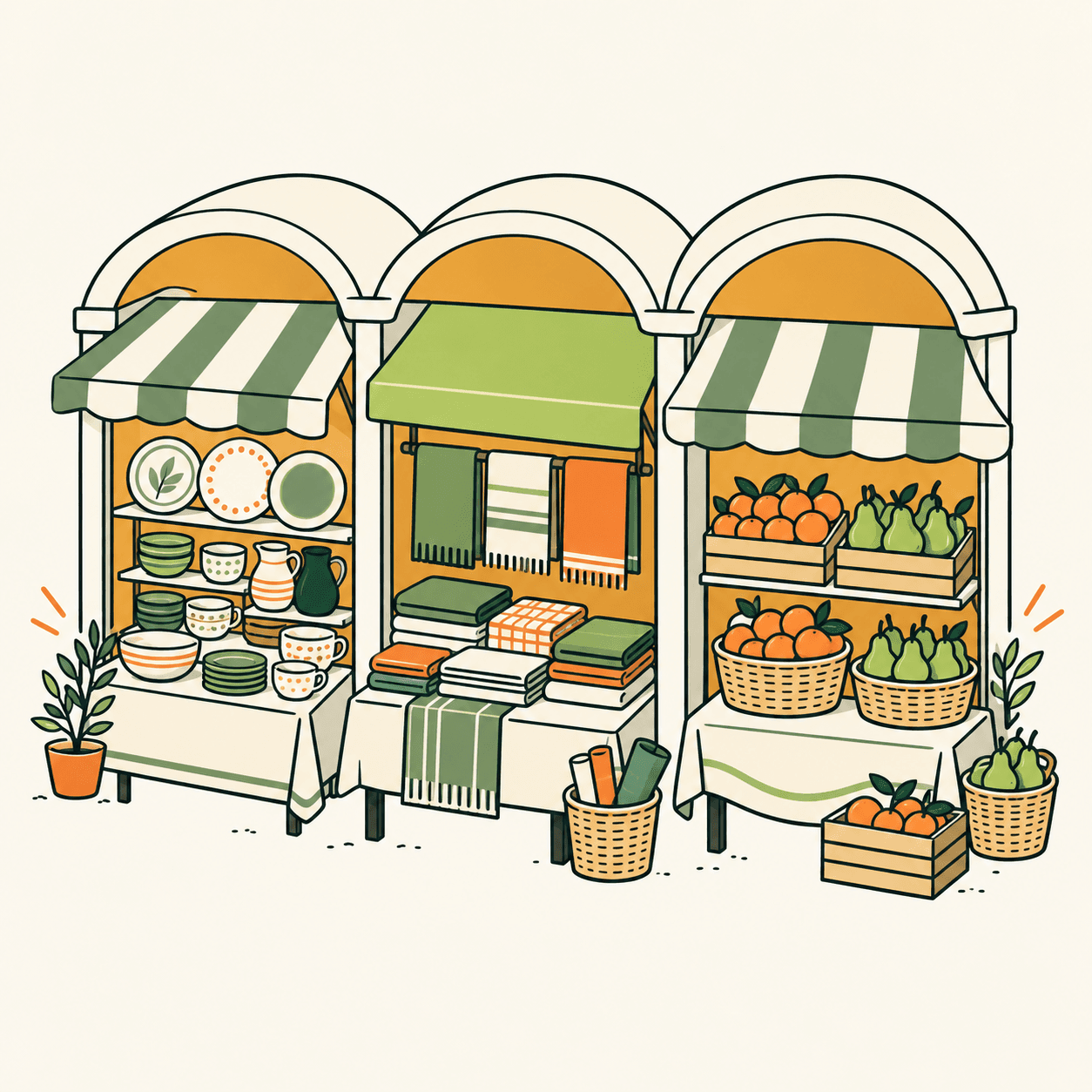
The Italian word “bazar” comes from Persian bāzār, meaning market, as documented by Treccani and Il Nuovo De Mauro. Its starting point is therefore not a messy room. The origin concerns a place of exchange. It helps to separate two levels immediately: etymology traces where a word comes from, while the meanings recorded in a dictionary describe the uses it can acquire in the language that receives it, rather than freezing it at its starting point. [1][2]
Il Nuovo De Mauro records it as an invariable masculine noun, stressed on its final syllable, with an attestation before 1340. Invariable means that Italian uses un bazar and più bazar without changing the word itself. The dictionary’s date is a documentary boundary: it does not let us imagine the exact day someone first pronounced it. This entry alone cannot establish a complete itinerary of people, cities and every passage between different languages. [2]
The dictionaries distinguish a marketplace, a shop selling varied goods, and a figurative use for a place full of mixed objects or disorder. Hoepli confirms this separation. Figurative means that we transfer an image to another situation: a desk can be called a bazar without becoming an actual marketplace. This usage does not show that all real markets are chaotic. A figurative meaning is a linguistic choice, not evidence supporting a judgment about a culture. [1][3]
Try an editorial example. Write three invented Italian sentences: nel bazar cerco una ciotola; quel negozio sembra un bazar; il mio cassetto è un bazar. They concern looking for a bowl in a market, comparing a shop to one, and describing a drawer figuratively. What changes is the scene being evoked. These are neither historical quotations nor evidence for the Persian origin. They simply show how much work context does when the same word appears in different surroundings. [2][3]
A second editorial exercise is to replace bazar with the Italian words for market, shop or disorder and notice what disappears. We are not seeking one perfect translation for every situation; we are comparing shades of meaning. The etymology gives us a secure starting point, bāzār, without forcing every Italian sentence to reproduce its original sense. This English feature, like its French counterpart, explains the same Italian word. Similar-looking words in other languages do not automatically establish identical histories. [1][2]
Take this with youTo understand a word, ask where it comes from and then what it is doing in its sentence. A documented origin and a figurative meaning can coexist without being identical.
One idea, in simple words
The Italian word bazar comes from Persian bāzār and originally means market. Treccani and De Mauro’s dictionaries explain this origin. In Italian it is masculine and does not change in the plural: un bazar, due bazar. It can mean a marketplace or a shop with varied goods. It can also be figurative, transferring an image into a different situation. [1][2]
Here is an example invented by our editors: il mio cassetto è un bazar, meaning my drawer is a bazar. There are no real sellers inside the drawer; the sentence describes different objects mixed together. It helps separate origin from use in a sentence. It does not prove that all markets are messy. Even in this English explanation, we are studying the Italian word bazar. [3][2]
A little discovery to keep
What did you discover?
Read the sources (3)
- bazar · Vocabolario Treccani · accessed 8 Oct 2026
- bazar · Il Nuovo De Mauro Internazionale · Il Nuovo De Mauro · accessed 8 Oct 2026
- bazar · Grande Dizionario Italiano di Aldo Gabrielli Hoepli · accessed 8 Oct 2026
Original writing and illustration made with AI assistance. Our editorial method
More in Words