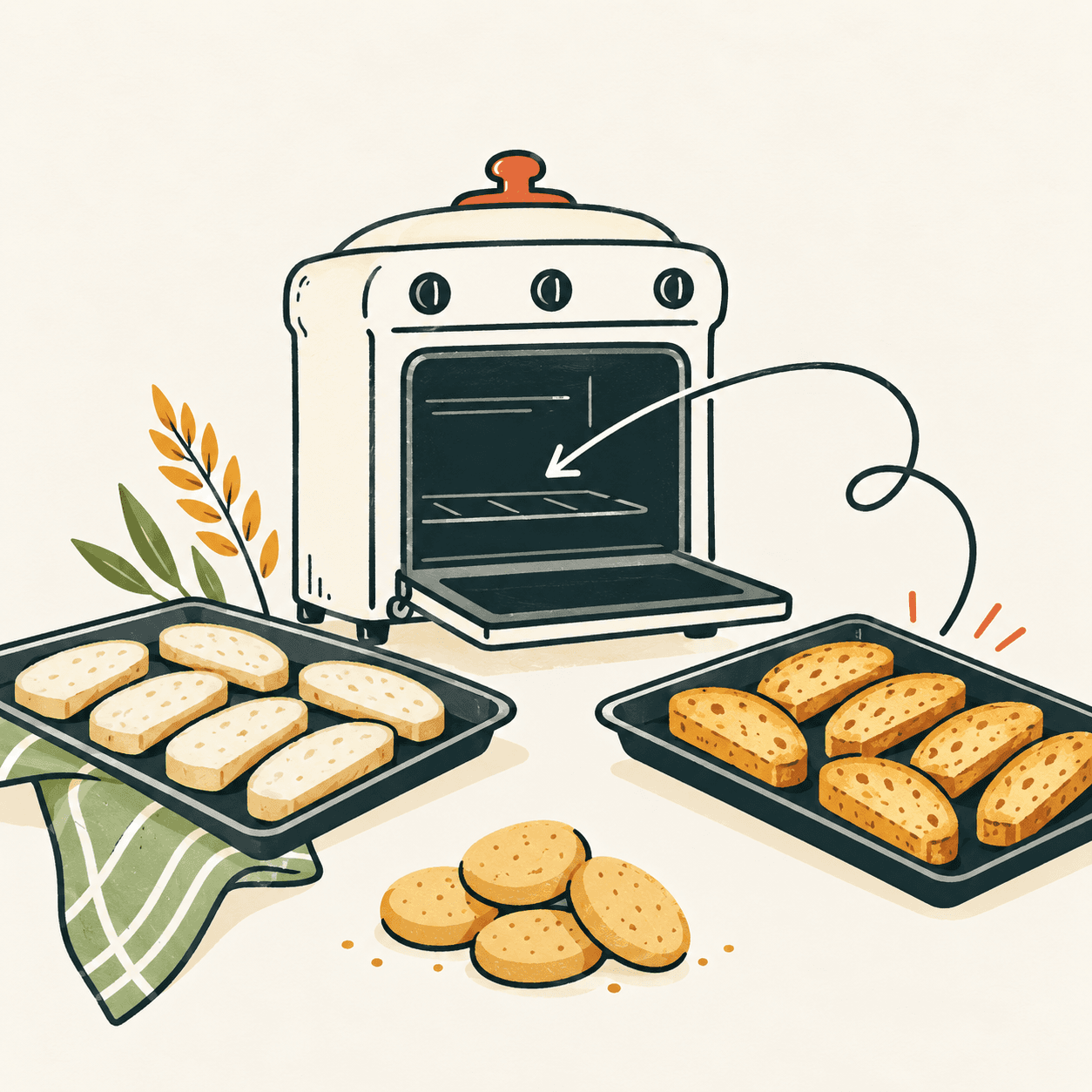
Opening a box of Italian biscotti means encountering different shapes, ingredients and textures. The Italian name nevertheless preserves a precise idea: repeated cooking. Treccani traces biscotto to medieval Latin biscoctus, formed from bis- and coctus, the past participle of coquere, to cook. This is an etymology documented by a dictionary, rather than a playful resemblance or a story about an imaginary baker who accidentally invented the word. [1]
Il Nuovo De Mauro records both an adjective meaning cooked twice and a noun referring to a small sweet baked item. The distinction helps us follow the word's path: something that described a way of treating food can become the name by which we recognise a family of products. We do not have to imagine that every modern use contains an explanation of the manufacturing process. [2]
For pan biscotto, Treccani explains that returning bread to the oven reduces moisture and helps preservation. The same entry notes that a similar aim can also be pursued with one prolonged, moderate baking. This detail prevents an overhasty conclusion: the origin of the name is not enough to establish how many times any particular biscotto in front of us has been baked during its preparation. [1]
Take an example invented by the editors, without turning it into a recipe. Write an object's name on one card; on another, describe how it was made. The two pieces of information are connected, but they are not identical. We can do the same exercise with biscotto: the word offers a historical clue, while learning about a particular product's preparation requires a description of that specific product. [2]
The Sabatini Coletti dictionary places the small oven-baked sweet alongside bread baked twice to help it keep. This lexical connection identifies neither a single place of invention nor one original recipe. Those are different questions, and the entries consulted here are not enough to answer them. Leaving them open is more accurate than filling the gaps with an appealing story that has no supporting document. [3]
In this English version of Words, the subject remains the Italian word biscotto. We do not automatically transfer its history to every English word used to translate it, or use its name to decide which sweet deserves to count as authentic. Our editorial reflection is simpler: an etymology helps us observe how past and present usage meet. It can prompt a useful question without becoming a rulebook for everybody's breakfast. [2]
Take this with youTry separating a word’s current meaning from its origin. The second can illuminate the first, without replacing it or imposing a recipe.
One idea, in simple words
The Italian word biscotto has a history connected with cooking. Treccani links it to medieval Latin biscoctus: its parts carry the idea of cooking twice. The name therefore preserves an action, not just the taste of a sweet food. Today biscotto can describe many small baked sweets that differ from one another. [1]
This does not mean every modern biscotto must be baked twice. Here is an editorial example: write a food's name on one card and how it was prepared on another. The cards give different information. A word's origin tells its history; a recipe explains a particular product. This reading is about the Italian word, even when we explain it in English. A name alone cannot tell us every step in a kitchen. [2]
A little discovery to keep
What did you discover?
Read the sources (3)
- Biscòtto · significato ed etimologia Treccani · Vocabolario on line · accessed 6 Oct 2026
- Biscotto Il Nuovo De Mauro · Internazionale · accessed 6 Oct 2026
- Biscotto · Il Sabatini Coletti Corriere della Sera · Dizionario italiano · accessed 6 Oct 2026
Original writing and illustration made with AI assistance. Our editorial method
More in Words