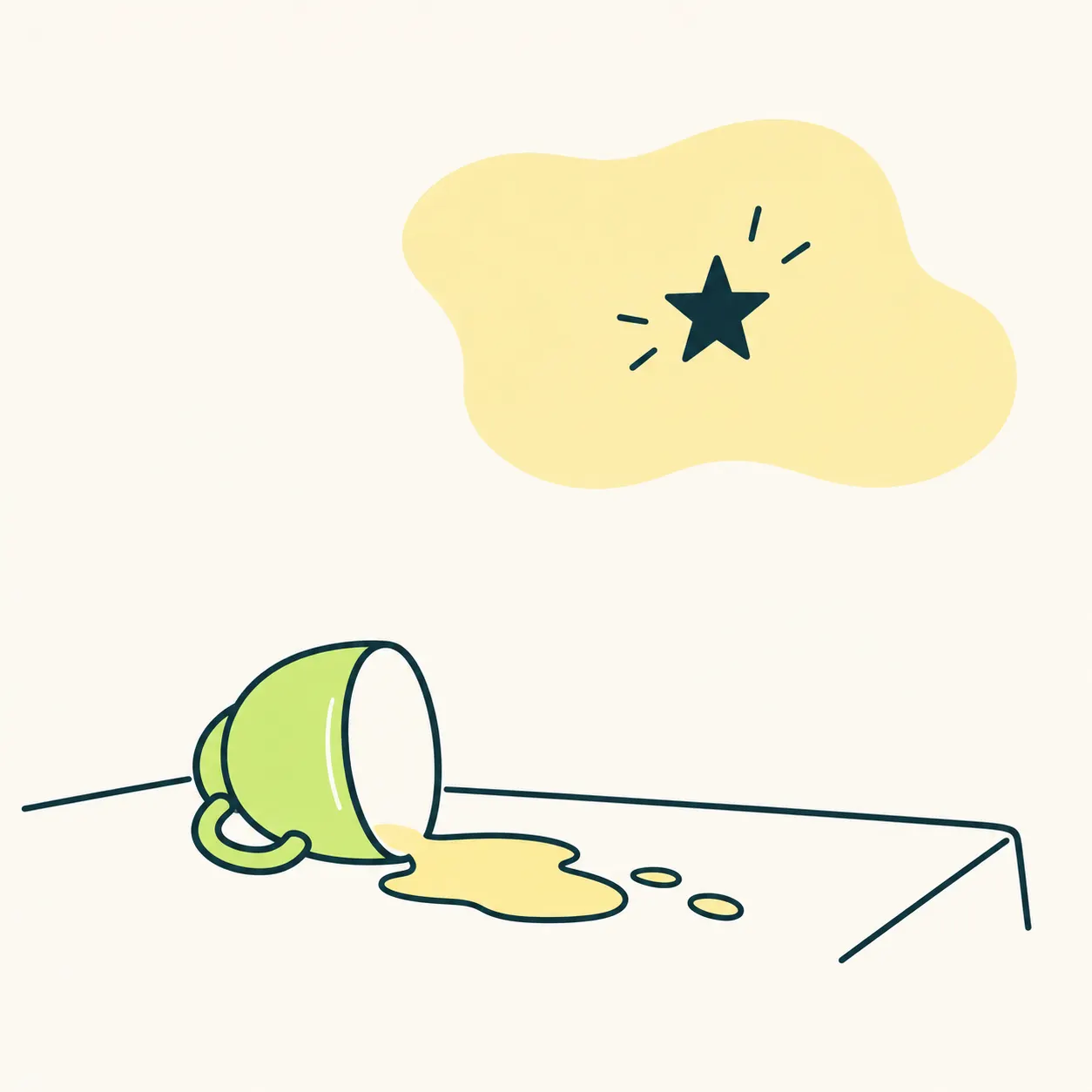
Spilled coffee, a missed delivery, a calamity: all can attract the Italian word disastro, although they carry very different weight. Before comparing events, let us pause over the word itself. Il Nuovo De Mauro derives it from astro with the prefix dis-. For astro, it gives the Latin astrum, from the Greek ástron. The small discovery is a linguistic relationship that remains visible in the letters: a star survives inside an Italian way of naming something that goes very badly. [1][2]
The same dictionary places disastro in the fourteenth century. That is a historical indication for the entry, rather than a certificate recording the exact day somebody first said it. A dictionary date cannot, by itself, reconstruct a medieval conversation or justify inventing a person who coined the word. We can recognise the documented elements and stop there. It would be convenient if every word arrived with a birth receipt. Dictionary work is generally much less theatrical, and rather more patient, than that imagined scene. [1]
Its current meaning goes beyond the word’s structure. De Mauro records a serious calamity or accident with major consequences, alongside confusion or failure in figurative uses. Treccani’s Thesaurus similarly distinguishes destructive harm from an extended use describing failure. Context guides us: a headline, a situation and the people involved change the force of the term. Knowing its etymology does not cancel those meanings or require an Italian speaker to think of a celestial body every time the word is used. [1][3]
Consider this explicitly editorial example. Someone tips a cup over a to-do list and exclaims, “Un disastro!” Here, exaggeration might even raise a smile. In a report involving victims or real destruction, the same lightness would be misplaced. The comparison illustrates a documented figurative use; it does not equate a stain with a calamity. We can choose more precise words when needed, describe what happened and let the facts establish its seriousness. Every small inconvenience need not become an alarming headline simply because a stronger word is available. [1][3]
One distinction remains essential: a word’s history is not a physical explanation of the world. Finding astro within disastro does not prove that stars cause accidents or decide how a day will unfold. This feature follows the Italian term, including in translation, without automatically assigning its history to every foreign equivalent. Next time you hear it, notice both its form and its context. A star can remain in the letters without having to take responsibility for someone’s spilled coffee. [1][2]
Take this with youChoose an Italian sentence containing disastro and ask whether it describes a calamity or exaggeration. Related words do not replace precise facts.
One idea, in simple words
The Italian word disastro contains astro. Il Nuovo De Mauro explains that it comes from astro with the prefix dis-. Astro came through Latin from Greek. The dictionary places disastro in the fourteenth century, but does not give the exact day someone first said it. Today it can describe a serious calamity or, figuratively, a failure. Imagine spilling coffee over your notes and saying “Che disastro!” You are exaggerating. A calamity that puts people in danger is different. The word’s origin does not show that stars cause accidents. It helps explain language. To explain an event, we still need facts and evidence. This feature follows the Italian word, not the history of its English equivalent. [1][2]
A little discovery to keep
What did you discover?
Read the sources (3)
- Disastro — Il Nuovo De Mauro Internazionale · Il Nuovo De Mauro · accessed 28 Oct 2026
- Astro — Il Nuovo De Mauro Internazionale · Il Nuovo De Mauro · accessed 28 Oct 2026
- Disastro — Thesaurus 2018 Treccani · accessed 28 Oct 2026
Original writing and illustration made with AI assistance. Our editorial method
More in Words