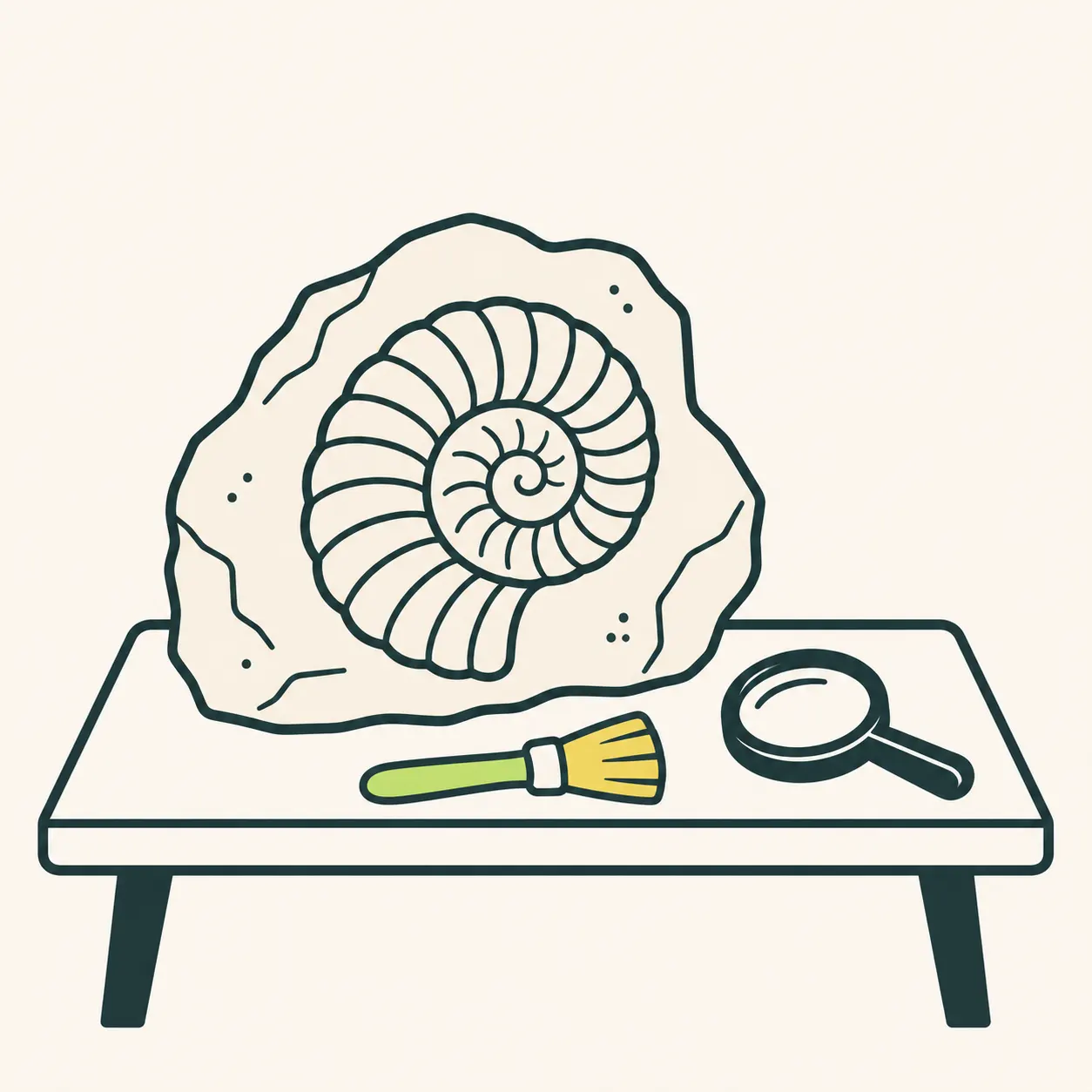
A spiral preserved in stone readily brings an ancient sea to mind. The Italian word fossile, however, enters the story through a different doorway: extracting something from the ground. Treccani traces it to Latin fossilis, derived from the verb fodere, to dig. Its etymology therefore begins neither with a dinosaur nor with a particular preservation technique. It begins with a very concrete relationship between hands, earth and something brought into the light. This is the history of the Italian word we are examining. [1]
Its older meaning was broader than today’s palaeontological one: it concerned things obtained by digging. De Agostini’s dictionary records this sense separately from the use referring to remains or traces of organisms from the geological past. The distinction matters. Knowing a root does not automatically supply the modern definition. An unearthed stone is not necessarily a fossil. The name preserves a route taken by language, while scientific use applies more specific criteria to what the word can describe. [2][1]
A fossil need not be a spectacular bone, either. Traces can matter alongside bodily remains: De Agostini includes footprints, trails and burrows among the evidence studied. A trace records activity without providing the entire body responsible. For an editorial example, imagine a display case containing a fossil shell and an impressed trackway. The first prompts a question about the organism; the second can prompt a question about the action that left a mark. These are different questions, but both begin with concrete evidence. [2]
The Natural History Museum explains fossil formation through processes of preservation, with more resistant body parts more likely to leave evidence than soft tissues. The accessible past is therefore not a complete photograph of everything that lived. For our reading of the word, this offers a useful limit: extracting something does not mean extracting the whole story. A specimen has to be studied alongside the conditions of its formation and the context in which it occurs. The object and its explanation are not identical. [3]
Italian has also extended fossile into figurative uses, including an idea considered outdated; dictionaries additionally record a linguistic use for elements preserved in particular forms. Here the comparison is metaphorical: a habit does not undergo geological fossilisation. Try reading three imagined sentences, one about a museum, one about an expression and one about an old opinion. Which sense works in each? The word remains recognisable, while context changes its job. Understanding a term sometimes requires digging, without forcing all its meanings to occupy exactly the same layer. [1][2]
Take this with youThe etymology of Italian fossile points to digging; its modern definition concerns evidence of past life. A root illuminates a history without replacing context.
One idea, in simple words
The Italian word fossile comes from Latin fossilis, linked to fodere, meaning to dig. Originally it concerned things extracted from the earth. In palaeontology today, it describes remains or traces of organisms from the geological past. Palaeontology is the science that studies this evidence. Not every stone found by digging is therefore a fossil. A preserved shell can be a fossil, but so can an impression left by an animal. Imagine a museum case containing both: one shows part of a body, while the other records an activity. This is an example to explain the distinction. A word’s history helps us understand it, but cannot explain every present-day meaning on its own. [1][2][3]
A little discovery to keep
What did you discover?
Read the sources (3)
- Fossile — Vocabolario Istituto della Enciclopedia Italiana, Treccani · accessed 8 Nov 2026
- Fòssile — Lessico e paleontologia De Agostini, Sapere.it · accessed 8 Nov 2026
- How are dinosaur fossils formed? Natural History Museum, London · accessed 8 Nov 2026
Original writing and illustration made with AI assistance. Our editorial method
More in Words