News dated
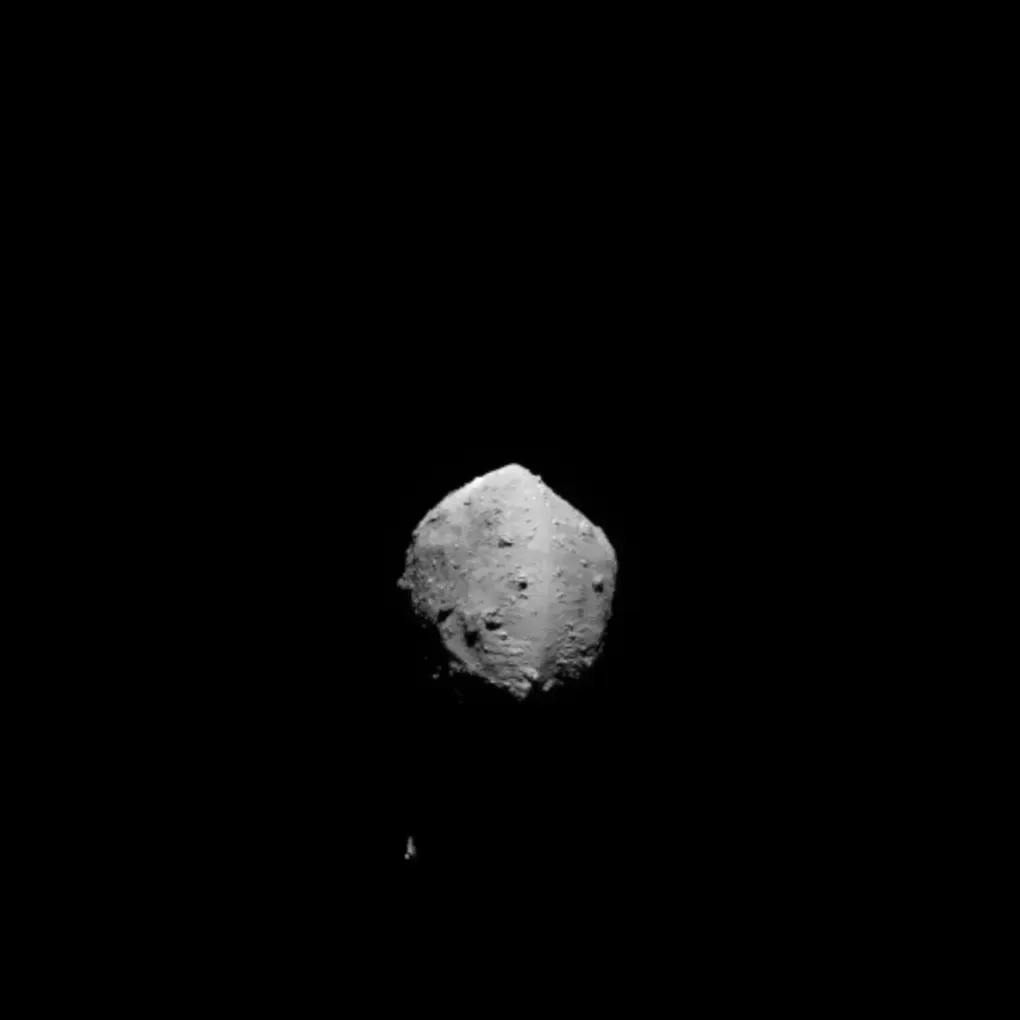
On 5 November, ESA published Hera’s first close-up view of the Didymos binary asteroid system. Its monochrome camera took the image from 60 kilometres away: the larger Didymos is clearly visible, while most of the smaller Dimorphos lies in shadow. [1]
NASA’s DART spacecraft struck Dimorphos on 26 September 2022, changing its orbit around Didymos. Hera will investigate the aftermath to improve understanding of asteroid deflection. Possible links between surface features and material thrown out by the impact remain hypotheses to investigate, not findings established by this image. [1]
The bright side
Close observation enables the effects of a real deflection experiment to be studied, separating images from interpretations that still need testing. [1]
One idea, in simple words
Hera is a European space probe: a vehicle with no people aboard that gathers information in space. On 5 November, ESA showed its photograph of two asteroids, Didymos and Dimorphos. The camera was 60 kilometres away. Didymos is the larger body; much of the smaller Dimorphos appears in shadow. [1]
In 2022, another probe, DART, hit Dimorphos and changed its path around Didymos. That path is called an orbit. Hera will investigate what happened after the collision. Think of a photograph taken after an experiment: it reveals details but does not explain every cause on its own. Scientists therefore still need to test ideas about marks on the surface. A new image is not an answer to every question. [1]
A little discovery to keep
What did you discover?
Straight from the source.
- Hera’s first close-up view of Didymos asteroids European Space Agency · 5 Nov 2026
- Hera: initial observations by the thermal infrared camera TIRI JAXA / ISAS · 6 Nov 2026
Original reporting summaries prepared with AI assistance and accessible sources. Our editorial method.