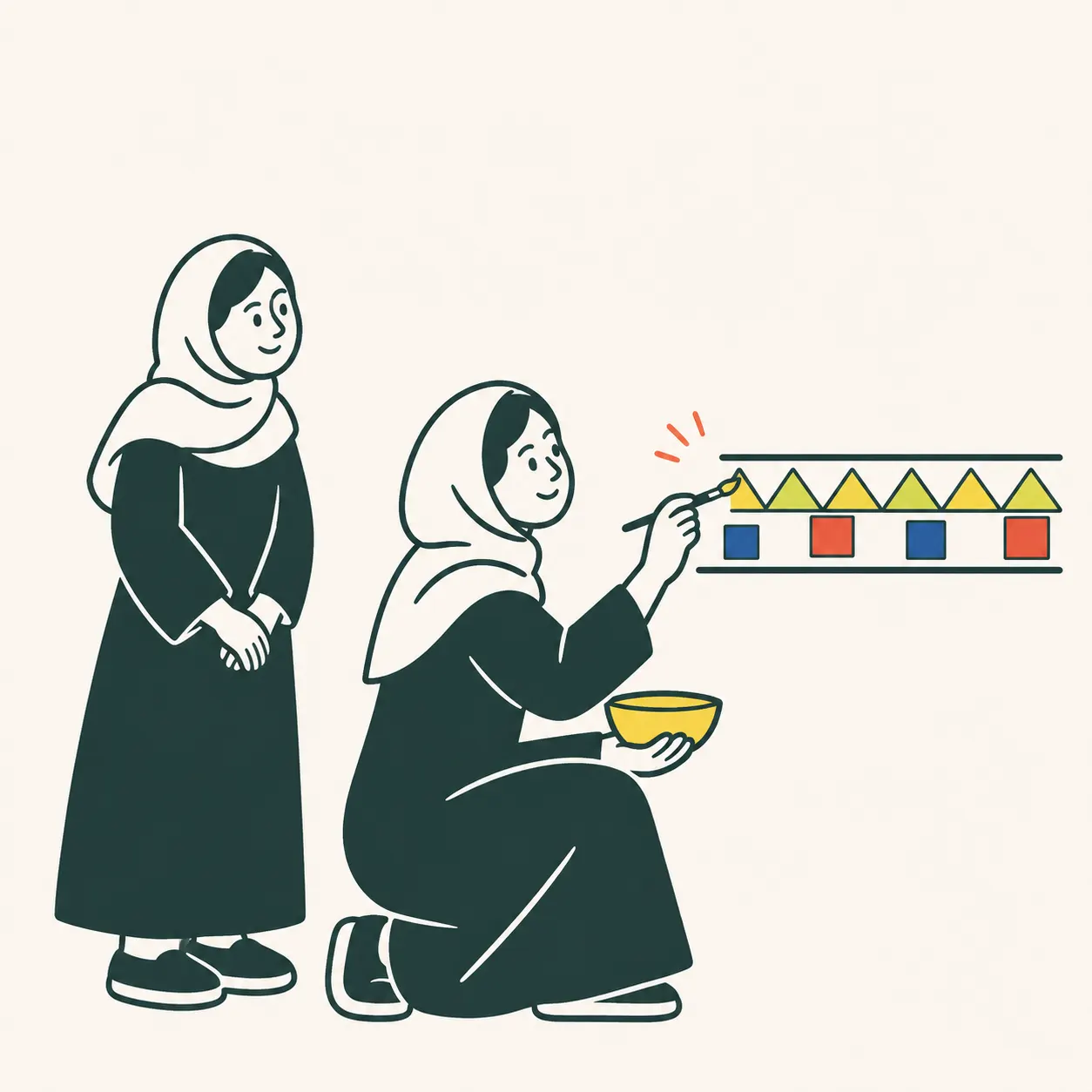
An interior wall can be more than a background. In Asir, in southwestern Saudi Arabia, the tradition called Al-Qatt Al-Asiri includes geometric interior paintings historically made by women. The central discovery is not only the beauty of repeated shapes: behind the surface lies a practice to learn, exercise and pass on. Art Jameel presents it through the relationship between murals, cultural meaning and technical knowledge, rather than treating it as an isolated decorative motif. [1]
Factum Foundation’s documentation, made with Art Jameel, shows why local details matter. The team recorded paintings in different Asir villages, distinguishing works, settings and their makers. Examples include Sharifa Bint Ahmed, who decorated homes between the 1950s and the 1980s. Her handling of corners and patterns is recognised as specific work. Belonging to a tradition does not make every contribution anonymous or interchangeable; an individual maker can still deserve attention and recognition. [2]
A wall can also be repainted. The dossier describes successive layers of decoration and different colour choices in the documented examples. This complicates the idea of an unchanging design preserved identically forever. Recording a surface also means distinguishing what remains visible from what has been digitally reconstructed. Images of a digital restoration must not silently become photographs of a wall that has supposedly survived intact through the decades. Their relationship to the original needs explanation. [2]
The book Al Qatt Al-Asiri Pattern, published in English and Arabic in 2020 by Art Jameel and Factum, is also intended as a teaching resource. Preservation here means more than collecting photographs. A reference collection can support the study of forms and techniques without automatically replacing painters’ experience. This distinction is our interpretation of the project: safeguarding a result and keeping knowledge available for practice are connected activities, but they are not identical tasks. [1][2]
The practice was inscribed in 2017 on UNESCO’s Representative List of the Intangible Cultural Heritage of Humanity, as later documentation about the Sarawat landscapes also records. This recognition concerns intangible heritage; it does not automatically make every house or village a World Heritage Site. The categories should not be confused. Nor does the tradition’s connection with Asir justify presenting it as the uniform style of all Saudi Arabia or the entire Arab world. [3]
Try this editorial observation when visiting any decoration: alongside triangles, bands or colours, ask who painted it, where, and how it was documented. Do not assign a universal meaning to every shape without a relevant source. Our illustration is an original composition inspired by the practice, not a copy of a particular mural. Acknowledging that distance leaves the works, their makers and their communities with their own concrete histories, instead of turning them into interchangeable visual examples. [1][2]
Take this with youWhen looking at a decorative pattern, look also for the maker, place and knowledge that make it a living practice.
One idea, in simple words
Al-Qatt Al-Asiri is a tradition of painting house interiors in Saudi Arabia’s Asir region. The geometric decorations have mainly been made by women. The shapes on the wall matter, but so do the people and the knowledge needed to paint them. Factum Foundation and Art Jameel have documented local examples and made a book for studying the practice. Some walls have been repainted over time. Photographs therefore need to be distinguished from digital reconstructions. In 2017 the practice entered a UNESCO list of intangible heritage, meaning knowledge and traditions. This does not automatically turn every house into a World Heritage Site. When looking at a design, we can ask who made it and where. Those answers help us respect its particular history. [1][2][3]
A little discovery to keep
What did you discover?
Read the sources (3)
- Al Qatt Al-Asiri Pattern, publication 2020 Art Jameel · accessed 11 Nov 2026
- Traditional Qut paintings; Al-Qatt al-Asiri Pattern Book Factum Foundation · accessed 11 Nov 2026
- The Rural Cultural Landscapes of Sarawat Mountains, Tentative List submission Saudi Permanent Delegation to UNESCO · UNESCO World Heritage Centre · accessed 11 Nov 2026
Original writing and illustration made with AI assistance. Our editorial method
More in Cultures & peoples