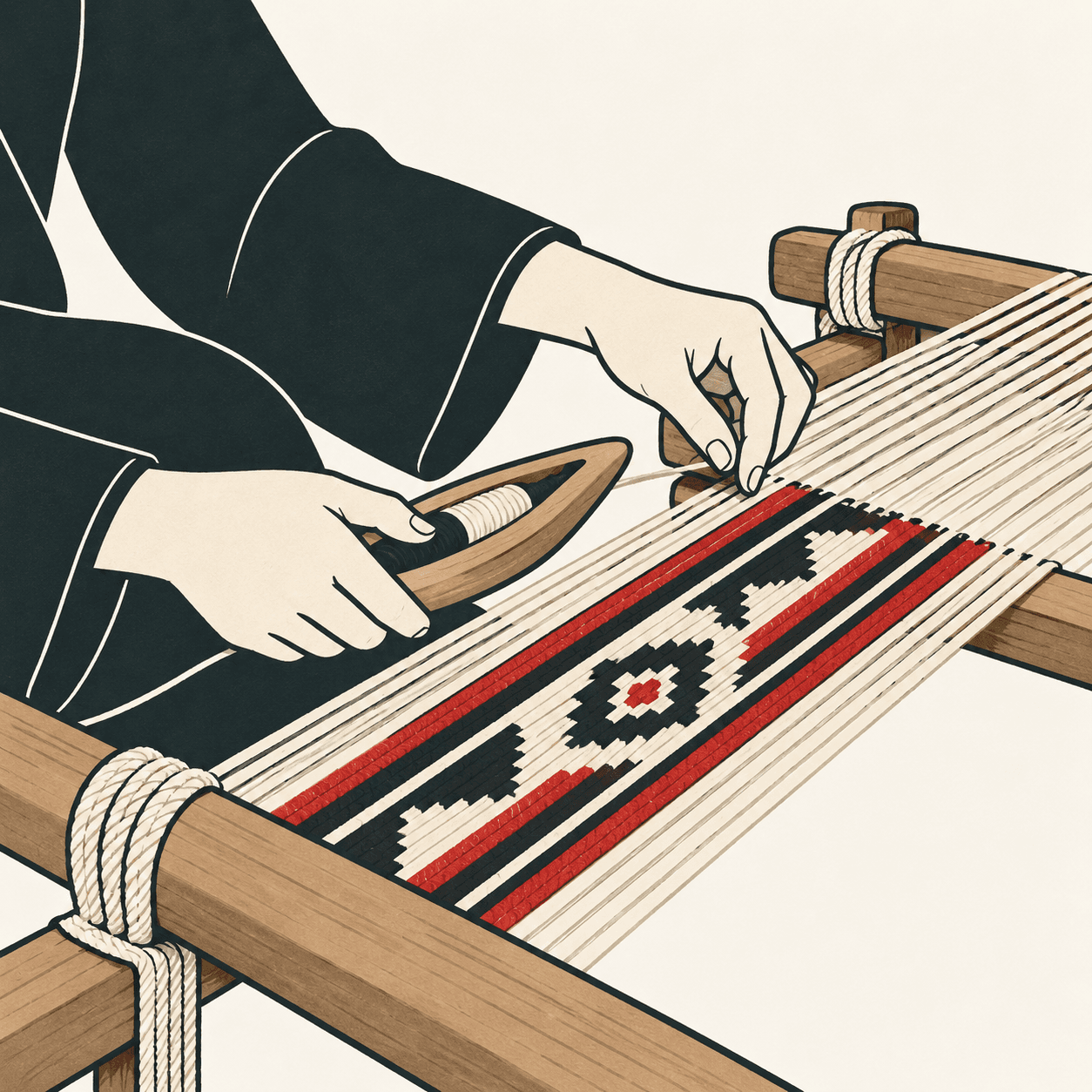
A geometric band may catch the eye immediately, but Al Sadu is more than the name of a decoration. Experience Abu Dhabi describes it as a weaving practice of Bedouin women in the United Arab Emirates, carried out on a floor loom. The design takes shape within the fabric as threads are interlaced: looking only at the finished surface can make the work needed to construct it disappear from view. [1]
Abu Dhabi Culture’s documentation describes materials including sheep’s wool, goat hair and camel hair. Before weaving come sorting, cleaning, spinning and dyeing: separate fibres become usable yarn. The loom holds threads arranged for the work. In the context described, the textiles have served practical purposes, from tents to carpets and cushions. They therefore did not originate solely as objects for people to admire behind the glass of a display case. [2]
The story extends beyond the Emirates. In Kuwait, the Al Sadu Weaving Cooperative Society documents and promotes a textile heritage that includes both Bedouin desert weaving and urban weaving. The Sadu House museum presents that journey through objects and processes, connecting past, present and future. Including the move towards the town helps avoid presenting the practice, and the people caring for it, as though they were frozen in time. [3][4]
Passing knowledge on requires opportunities to learn. The cooperative lists training, research and contemporary craft development among its aims; it also describes Insij, a programme teaching weaving techniques and skills. UNESCO’s Kuwait directory lists both traditional Al Sadu weaving and the educational programme for training trainers. These are distinct references: preserving a textile and enabling somebody to learn how to weave one are not the same action. Both deserve attention in their own right. [5][6][7]
An example invented by our editors: a class makes two pieces using paper strips. For the first, pupils draw red and black lines; for the second, they actually interlace the strips. Both produce a pattern, but only the second requires thinking about materials crossing one another. The exercise alone does not teach Al Sadu or reproduce an authentic motif: it helps us ask a weaver better questions, distinguishing imitation of an appearance from learning a technique. [1]
There are also limits to how we interpret what we see. The sources consulted describe particular contexts; they do not justify saying that every Bedouin person weaves or that each geometric shape has one universal meaning. In our editorial example, we ask who made an object, which materials were used and what purpose it served. Following the cooperative’s stated mission, curiosity can then include both inherited knowledge and new possibilities for the craft. [2][5]
Take this with youA pattern can be copied in a moment; understanding a weaving practice means noticing materials, movements and the people who pass knowledge on.
One idea, in simple words
Al Sadu is a weaving practice of Bedouin women, documented, for example, in the United Arab Emirates. Weaving means interlacing threads to make a textile. A low loom, close to the ground, is used. The pattern takes shape with the threads: it is more than a design printed onto fabric that is already finished. [1]
Fibres such as wool are prepared and turned into yarn before work at the loom. In Kuwait a cooperative preserves objects and organizes activities to pass knowledge on. An example invented by our editors: drawing lines on paper and interlacing paper strips produce different results. Trying the second action helps us ask questions about a weaver’s work, but it is not enough to learn the whole Al Sadu practice. [2][5]
A little discovery to keep
What did you discover?
Read the sources (7)
- Al Sadu — Culture and Traditions Experience Abu Dhabi · accessed 3 Oct 2026
- Al-Sadu — Cultural Resources Abu Dhabi Culture, Department of Culture and Tourism · accessed 3 Oct 2026
- Al Sadu Society Al Sadu Weaving Cooperative Society · accessed 3 Oct 2026
- Museum — Sadu House Al Sadu Weaving Cooperative Society · accessed 3 Oct 2026
- Mission Al Sadu Weaving Cooperative Society · accessed 3 Oct 2026
- Al Sadu Society — Insij and educational activities Al Sadu Weaving Cooperative Society · accessed 3 Oct 2026
- Kuwait — Lists and Nominations UNESCO · accessed 3 Oct 2026
Original writing and illustration made with AI assistance. Our editorial method
More in Cultures & peoples