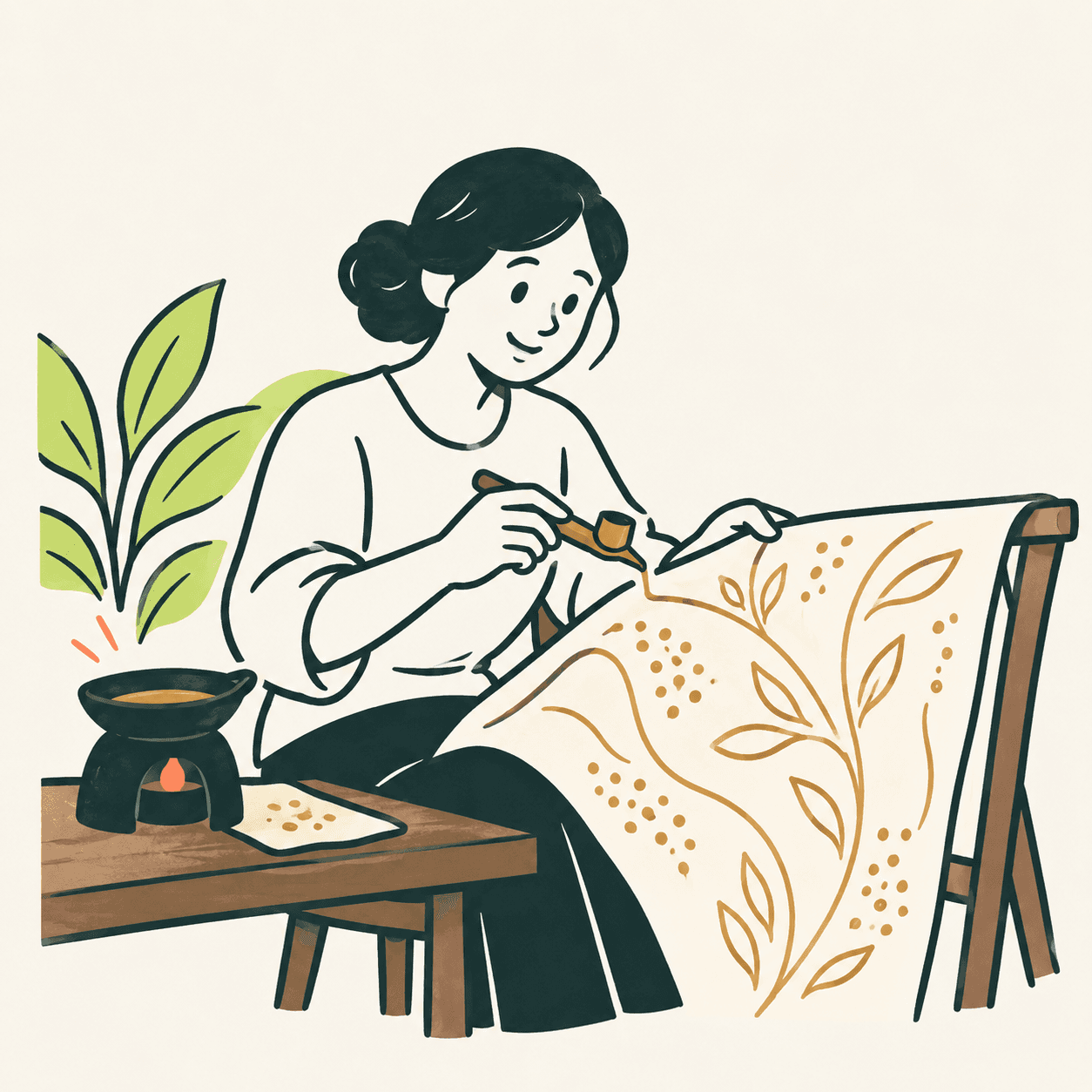
Looking at a batik cloth, we can follow the coloured lines, but also ask how other areas stayed pale. The technique described by the Australian Museum uses a protective layer of wax to resist dye. The design therefore also emerges from deciding where colour should not go. This is a concrete discovery: making a shape does not only mean adding marks. It can mean preserving a space while everything around it changes. [1]
Hand-drawn batik uses a canting, a tool with a handle, a small metal reservoir and a spout for applying wax. The museum distinguishes this work, called tulis, from copper stamping, called cap; the techniques can also be combined. Patterns that look similar are therefore not necessarily made in the same way. A photograph of the finished cloth does not automatically explain every stage of its making. [2]
Patterns also have different contexts. The Australian Museum explains that at the Yogyakarta court under Sultan Hamengku Buwono VIII, between 1921 and 1939, certain designs were reserved according to rank. This is a specific historical case, not a rule to apply indiscriminately across Indonesia today. It nevertheless invites us to avoid treating every decoration as a sign without history, available for any use without asking questions about it. [1]
UNESCO’s page about Pekalongan presents batik as part of the city’s culture and economy, and describes education activities and workshops linked to the museum. Craft knowledge does not live only in preserved objects. It must also be practised, explained and passed on. The point here is not to imagine an unchanging tradition. It is to recognise the people, places and opportunities through which someone learns a technique from another person. [3]
To explore the idea, our editors suggest a paper exercise without hot wax. First draw the areas you want to leave empty, then build a simple pattern around them. We are not making actual batik: we are exploring the relationship between filled and empty spaces. Invent a design without copying ceremonial motifs. If you show it to someone, explain both where the question came from and how limited this little model is. [2]
Finally, we can prepare three questions for an imagined workshop visit: who made the cloth, which process did they use, and what meaning do they give the pattern? These are editorial questions, not answers written in advance for every maker. They help us move from a generic label to respectful curiosity. A culture is not one design to memorise. Understanding it better requires verifiable details and room to hear explanations that may surprise us. [3]
Take this with youIn batik, wax protects parts of cloth from dye. To understand an object, also ask who makes it, with which technique and in what context.
One idea, in simple words
Batik is a way of decorating cloth. Wax is placed on some areas. It acts as a barrier, stopping dye, the colouring liquid, from reaching them. The design therefore also comes from protected areas. We should not only look at the colour: where it does not reach matters too. [1]
In Pekalongan, Indonesia, people also learn batik through education activities and workshops. To understand a cloth, we can ask who made it and how. Our editors suggest a paper game: leave some spaces white and draw around them. This is not real batik, but it helps explain protecting a shape. Invent your own pattern rather than copying one that might have a particular meaning for other people. [3]
A little discovery to keep
What did you discover?
Read the sources (3)
- Batik: the forbidden designs of Java Australian Museum · accessed 30 Sept 2026
- The batik process Australian Museum · accessed 30 Sept 2026
- Pekalongan UNESCO Creative Cities Network · accessed 30 Sept 2026
Original writing and illustration made with AI assistance. Our editorial method
More in Cultures & peoples