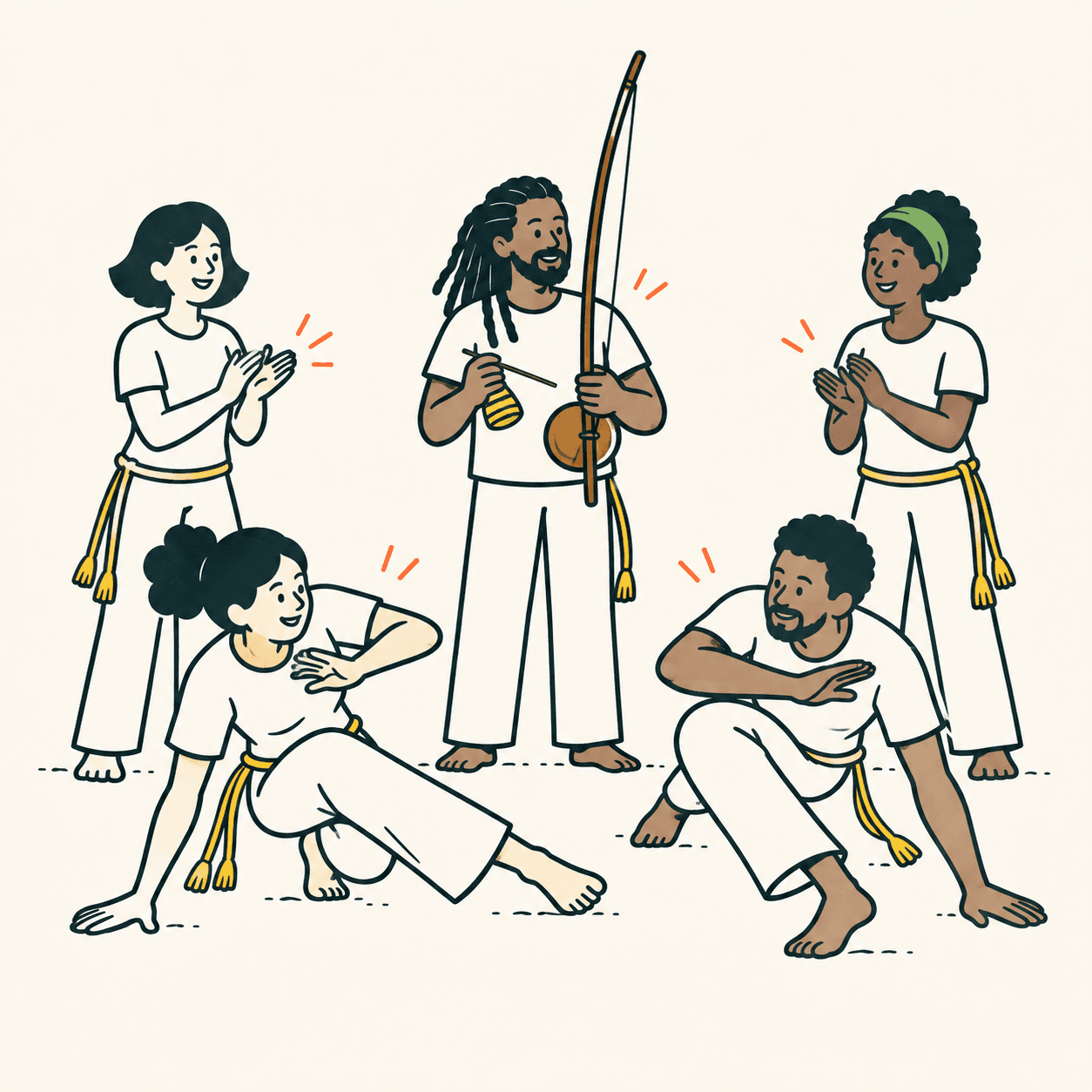
When watching capoeira, we might concentrate only on the people moving in the centre. The Portuguese word roda, however, invites us to consider the whole circle. Brazil’s heritage institute IPHAN describes an Afro-Brazilian practice bringing together combat, dance, music and play. Choosing just one label and ignoring the rest would miss something important. The collective setting belongs to what we are trying to understand, alongside the movements that first attract our attention. [1]
The same record distinguishes traditions including capoeira angola and capoeira regional, reminding us of differences within the practice. Instruments such as the berimbau, atabaque and pandeiro accompany the roda; songs also carry stories and memories. UNESCO recognition of the circle dates to 2014. That marks international heritage recognition, not the invention of the practice or proof that every community performs it in an identical way. A heritage label should start questions rather than end them. [1]
Another IPHAN record concerns mestres and mestras, people recognised by their communities for passing on knowledge. Their work includes teaching, music, guiding the circle and shared memory. The record also recalls capoeira’s past criminalisation. Behind an impressive movement lies a history involving people, prejudice and resistance that a brief performance cannot explain on its own. Looking beyond the spectacular moment does not diminish it; it opens a path towards the context around it. [2]
Here is an observation exercise invented by our editors. Watching a properly contextualised recording or an event open to visitors, divide a page into three sections: movements, sounds and roles. Note who plays, who responds to the singing and how the group’s attention changes. If you do not recognise a gesture, describe it without assigning a meaning. There is no need to pretend expertise. A well-framed question is a worthwhile result of watching carefully. [2]
In our workshop, we add questions for a willing teacher: which tradition is practised here? How do people learn to take part? What behaviour shows respect for this group? We do not prepare answers on the teacher’s behalf or infer every Brazilian person’s habits from one encounter. The exercise concerns a particular practice involving particular people and contexts. Someone who does not practise it is not an exception requiring an explanation: a country cannot be reduced to one cultural activity. [1]
Finally, compare two observers’ notes. One may have followed mostly the movements, the other the voices. Combining their accounts does not make us experts, but it reveals what each left out. That is the purpose of our editorial suggestion: to move from an image of one spectacular performer towards curiosity about the group. We are not suggesting acrobatics learned from a page. Learning a physical practice requires an appropriate setting and knowledgeable people who can teach it. [2]
Take this with youWhen encountering a tradition, notice who passes it on and who participates around it. Asking about the context is a practical way to show respect.
One idea, in simple words
Capoeira is an Afro-Brazilian practice: it comes from the history and culture of people of African descent in Brazil. It combines movement, combat, dance, music and play. The roda is the circle where it takes place. The people singing and playing music belong to the experience too, not just those moving in the centre. [1]
Mestres and mestras teach and pass on this knowledge in their communities. Try our editors’ activity: while watching a presentation, note movements, sounds and roles. What did you notice first? What did you miss? If you do not understand a gesture, ask a teacher. Capoeira has different traditions, and not every Brazilian person practises it. Learning its movements needs knowledgeable guidance; watching a video is not enough. [2]
A little discovery to keep
What did you discover?
Read the sources (2)
- Roda de capoeira IPHAN — Bens Culturais Registrados · accessed 28 Sept 2026
- Ofício dos mestres e mestras da capoeira IPHAN — Bens Culturais Registrados · accessed 28 Sept 2026
Original writing and illustration made with AI assistance. Our editorial method
More in Cultures & peoples