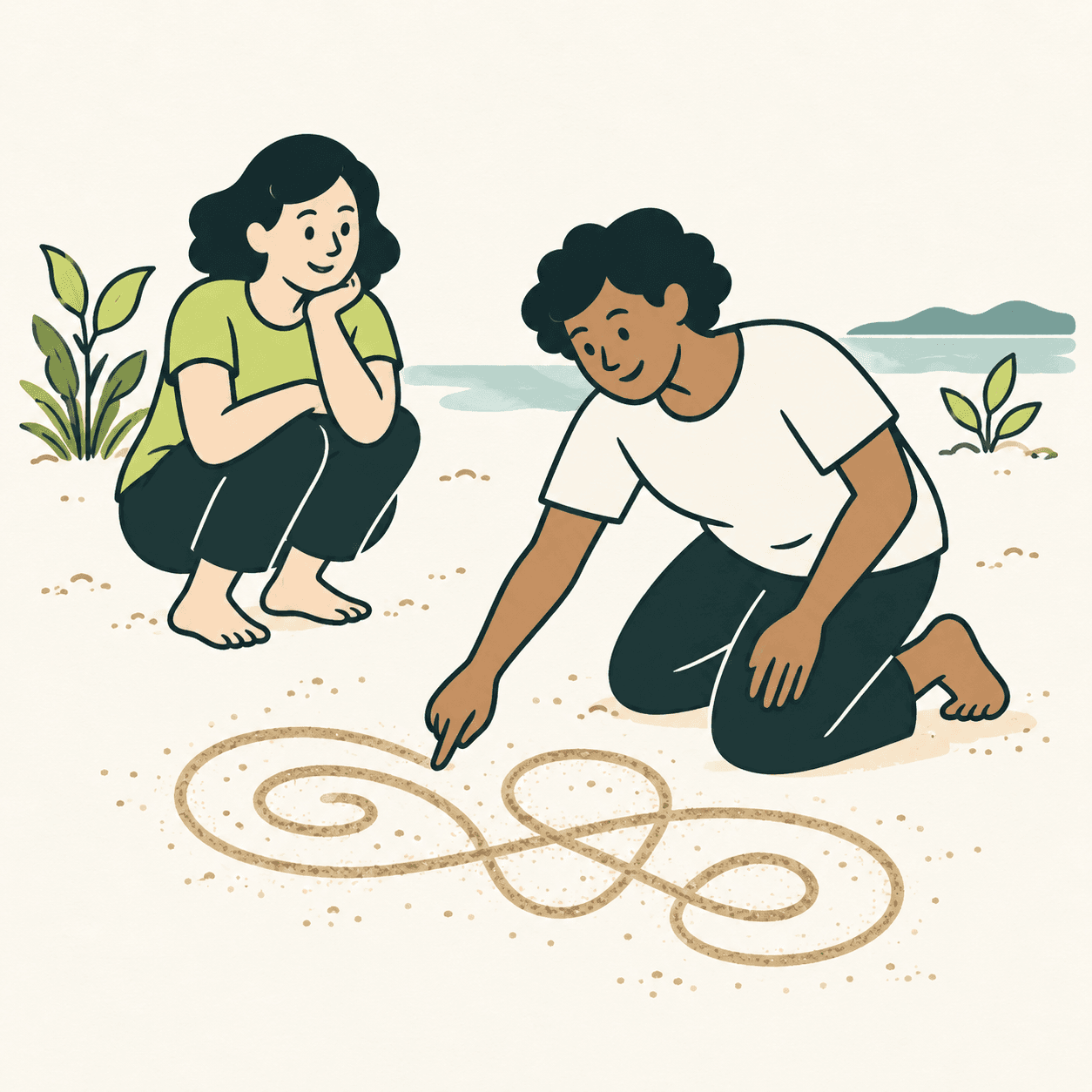
UNESCO’s multimedia archive entry for a Vanuatu Culture Centre documentary describes drawings made directly on the ground with a finger. A continuous line follows an imagined grid to create a composition. The practice is documented in Vanuatu’s central and northern islands in the Pacific Ocean: this is not an undifferentiated description of every person or tradition in the country. [1]
Research by Eric Vandendriessche and Alban Da Silva follows specific cases in northern Ambrym. The authors examine drawing procedures alongside words, contexts and the transmission of knowledge. This perspective matters: stopping at the finished figure would leave out part of what is being done and told. The drawing should not automatically be reduced to a simple geometric pastime for outsiders to copy. [2]
An academic comparison released as a preprint in 2024 considers properties including continuity, symmetry and paths that return to their starting point. A preprint is research made available before any eventual peer-reviewed publication; we do not present it as a definitive conclusion here. Comparing structures can help frame questions without making the practices, their names or their communities’ meanings interchangeable. [3]
An example invented by our editors: trace a completely original continuous curve on paper. Ask one person to look only at the result and another to watch the movement producing it too. What different questions might they ask? This small exercise explores the difference between object and process. We do not call it a traditional Vanuatu drawing or assign it an invented local story, ritual or meaning. [2][1]
A second editorial example: imagine an object record without a maker, place or explanation. We can describe what is visible, but essential questions remain: who made it? In what situation? Who was it shown to? Write these questions before looking for answers. If no reliable account is available, leave a question open. Our exercise proposes a way of reading information, not an interview that actually took place with a community. [2]
The image accompanying this page also keeps an explicit boundary. It is an illustrative scene with an abstract pattern devised to show a gesture, not a reproduction of a design claimed to be authentic or sacred. For a final editorial activity, try writing a caption that states what we know and what we are not showing. We can appreciate a carefully traced line without pretending that looking at it gives us all the knowledge a practice may transmit. [1][2]
Take this with youRemember: understanding a cultural practice also requires movement, context and the voices of those who transmit it, not just a finished figure.
One idea, in simple words
In some Vanuatu islands, people practise drawing on the ground with a finger. A continuous line forms figures along an imagined grid, a structure guiding its path. UNESCO’s description presents it as a means of communication. It is more than a picture to look at. [1]
Research in northern Ambrym also considers movement, stories and knowledge being passed on. Here is an example invented by our editors: first look at our own finished drawing, then watch it being traced. You might ask different questions. That exercise does not become a Vanuatu tradition. Learning about the practice requires listening to and reading those who study and transmit it. Our illustration uses an abstract pattern, not a design presented as an authentic symbol. [2]
A little discovery to keep
What did you discover?
Read the sources (3)
- Vanuatu Sand-drawings UNESCO Multimedia Archives / Vanuatu Culture Centre · accessed 1 Oct 2026
- Les dessins sur le sable du Nord de l’île d’Ambrym (Vanuatu) : une étude ethnomathématique ethnographiques.org — Eric Vandendriessche et Alban Da Silva · accessed 1 Oct 2026
- Comparative Study of Sand Drawings in Oceania and Africa arXiv — Linbin Wang, Rowena Ball and Hongzhang Xu · accessed 1 Oct 2026
Original writing and illustration made with AI assistance. Our editorial method
More in Cultures & peoples