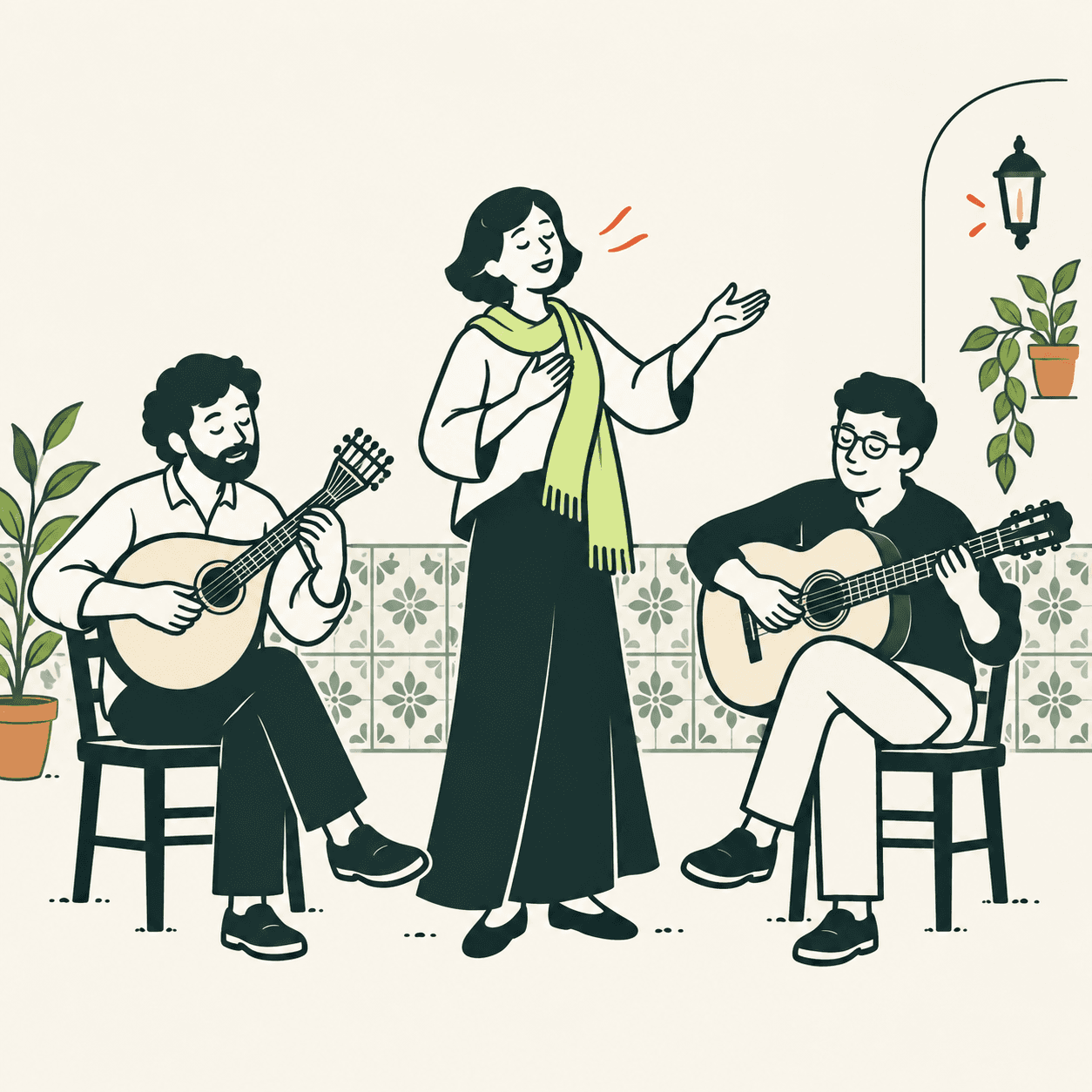
A voice begins, instruments make room for it, and someone listens nearby. Fado is a Portuguese musical practice particularly associated with Lisbon. UNESCO’s archive describes a meeting of different influences, often performed by a singer with an acoustic guitar and a Portuguese guitar. Our question is straightforward: how can we approach a tradition without treating it as a frozen postcard, or as the personality of everyone in a country? [1]
The history told by the Museu do Fado moves through nineteenth-century urban popular settings, theatre performances and, later, radio and other media. The music did not stay inside a single room. Song subjects also vary: everyday life, the city, feelings and social questions. To guide our listening, we can therefore ask who is singing, in what setting, and what story they are telling, without expecting every performance to deliver the same message. [2]
The Portuguese guitar deserves attention of its own. UNESCO describes its pear-shaped body and twelve strings; the museum’s account of musician Ricardo Rocha specifies six pairs of strings. Rocha is also a composer and soloist: the instrument does not exist only as a background to a voice. Noticing this helps us distinguish the different parts of a performance, instead of hearing everything as one undifferentiated block of sound. [1][3]
Try an editorial exercise with a recording published by a museum or an identifiable performer. On the first listen, note only when the voice enters and when an instrument stands out. On the second, choose a short passage and describe the relationship: reply, pause, support? These are our words for an experience, not technical labels to impose on a musician. We do not have to understand every word immediately to start paying attention to the structure. [3]
For the lyrics, then find a reliable translation or an explanation from the performer. Compare it with your first impression: had you imagined a different story? This second editorial exercise leaves room to revise our assumptions. A sound we find sad does not authorise us to invent the song’s content, and one song cannot describe every resident of Lisbon. Our notebook can keep both the first impression and what we learned later, without erasing the difference between them. [2]
UNESCO highlights how fado also lives through associations, families and transmission between generations. Continuity therefore involves people and situations, rather than just a list of musical features. Our route remains an introduction: one recording cannot represent an entire tradition. It can still be a useful beginning if it encourages us to find the performers’ names, the song’s background and another interpretation, instead of believing we have understood everything after a few seconds of listening. [1]
Take this with youChoose a performance with named musicians. First describe what you hear, then look for context: getting to know a tradition also means naming its people.
One idea, in simple words
Fado is a Portuguese musical tradition especially connected with Lisbon. Often, a person sings with guitars accompanying them. The Portuguese guitar has a pear-like shape and twelve strings. Songs can tell different stories; we should not assume they all say the same thing. [1][2]
Try an exercise from our editors. Listen to a recording with named performers, meaning the people singing and playing. Notice when the voice enters and when a guitar becomes easier to hear. Then look for an explanation of the words. The story might differ from what you first imagined. One song does not describe every person in a country. It introduces a particular expression that we can get to know more carefully by listening and asking questions. [2]
A little discovery to keep
What did you discover?
Read the sources (3)
- Fado, urban popular song of Portugal UNESCO Archives · accessed 29 Sept 2026
- Fado History Museu do Fado · accessed 29 Sept 2026
- Ricardo Rocha Museu do Fado · accessed 29 Sept 2026
Original writing and illustration made with AI assistance. Our editorial method
More in Cultures & peoples