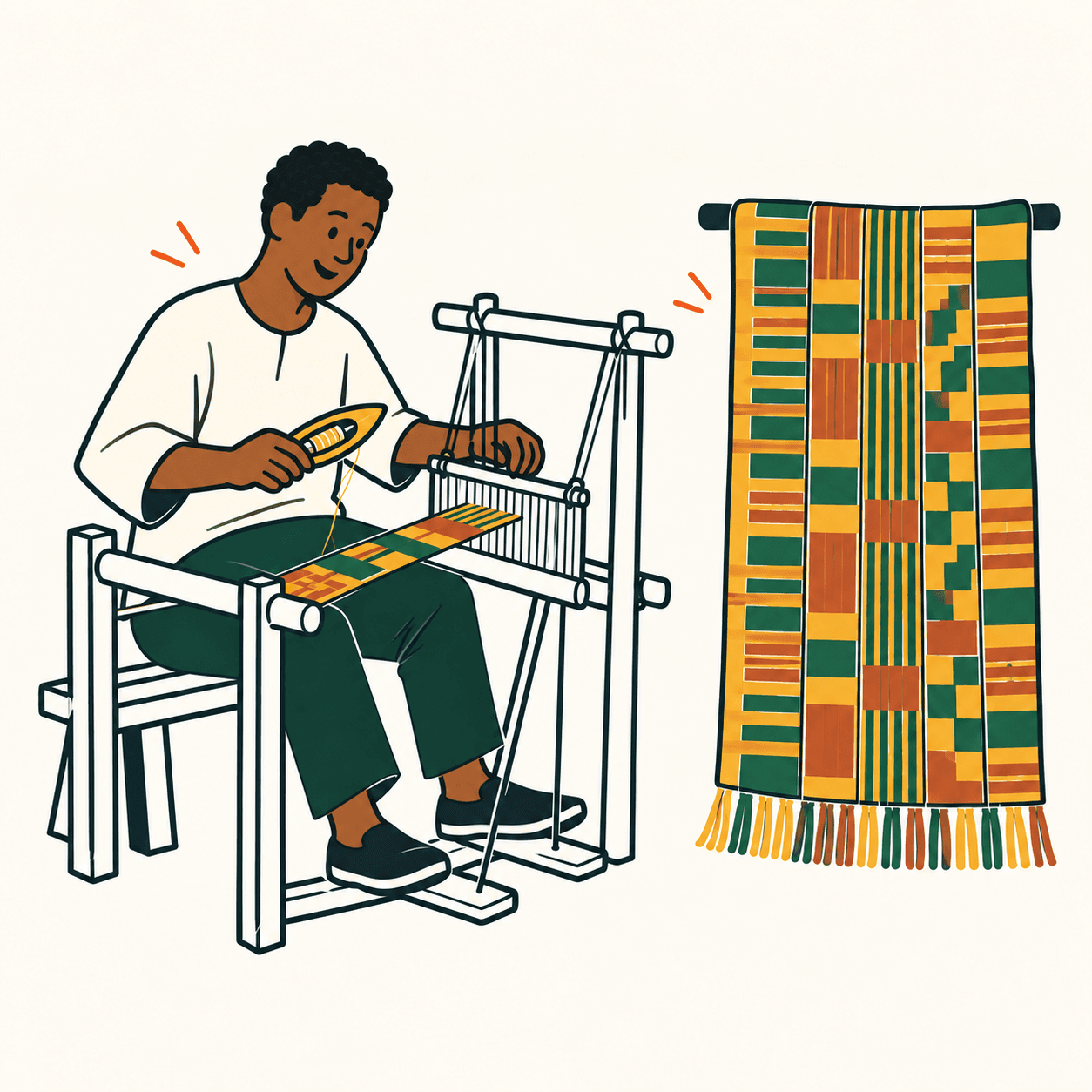
The Metropolitan Museum describes this construction of kente: narrow loom-woven strips are placed together and sewn into a broad panel. [1]
The Nelson-Atkins Museum holds another Asante kente from the early twentieth century, catalogued as silk and pigments. Its description identifies woven strips and geometric motifs. These are details of that object, not one universal recipe for every textile called kente. [2]
The Ghana Tourism Authority presents Bonwire as a centre of kente weaving and describes spinning, preparing threads and weaving in workshops. It also notes names and meanings associated with patterns. Looking only at colour leaves out both labour and context. [3]
Our editors suggest an original exercise, not a replica kente. Draw three invented paper strips using only dots and lines. Place them together facing the same way, then turn the middle one around. Note how the overall arrangement changes. You have explored a relationship between parts and a whole, but you have not thereby learnt weaving or created a traditional motif. Label the sheet invented paper composition: a clear caption prevents a school activity from presenting itself as a cultural object it is not. That distinction belongs on the page. [1]
In the second step of our workshop, imagine making a record for one of the museum textiles cited here. Separate three columns: what I see in the image, what I read in the catalogue and what I would ask someone who knows this work. An observed shape belongs in the first column; documented material and date belong in the second. If we want to understand a particular motif, leave room for a question. Do not invent a universal colour code simply to fill an empty box. [2]
One final invented scene: we meet a weaver and may ask only one question. Choose between how much it costs, how they learnt or which part of this work they would like to explain. There is no perfect sentence, but we can explain our choice and listen without replacing the answer with our assumptions. This is an editorial invitation to respect expertise, not a conversation that actually happened. A place name does not make every resident a spokesperson for a tradition; learning a practice calls for relevant people and testimony. [3]
Take this with youBegin with the particular object: how it is made, who describes it and what remains to ask. A tradition becomes more interesting when we look closely instead of reducing it to generic decoration.
One idea, in simple words
In the kente described by the Metropolitan Museum, narrow loom-woven strips are sewn together. A loom helps interlace threads. [1]
Another museum describes an individual Asante example in silk and pigments. That does not make every kente identical. Kente weavers work in Bonwire. Here is an activity invented by our editors: draw three paper strips and place them together. Turn the middle one around. How does the whole arrangement change? Label it an invented composition, not a traditional cloth. To understand a real object, find its record and ask about what you do not know. Do not assign invented meanings to colours simply because they look attractive. Finally, prepare a question to keep in your notebook for the next time you read. [2][3]
A little discovery to keep
What did you discover?
Read the sources (3)
- Man’s Prestige Cloth — Akan peoples, Asante group The Metropolitan Museum of Art · accessed 26 Sept 2026
- Kente cloth — Akan peoples, Asante group The Nelson-Atkins Museum of Art · accessed 26 Sept 2026
- Bonwire Kente Ghana Tourism Authority — Visit Ghana · accessed 26 Sept 2026
Original writing and illustration made with AI assistance. Our editorial method
More in Cultures & peoples