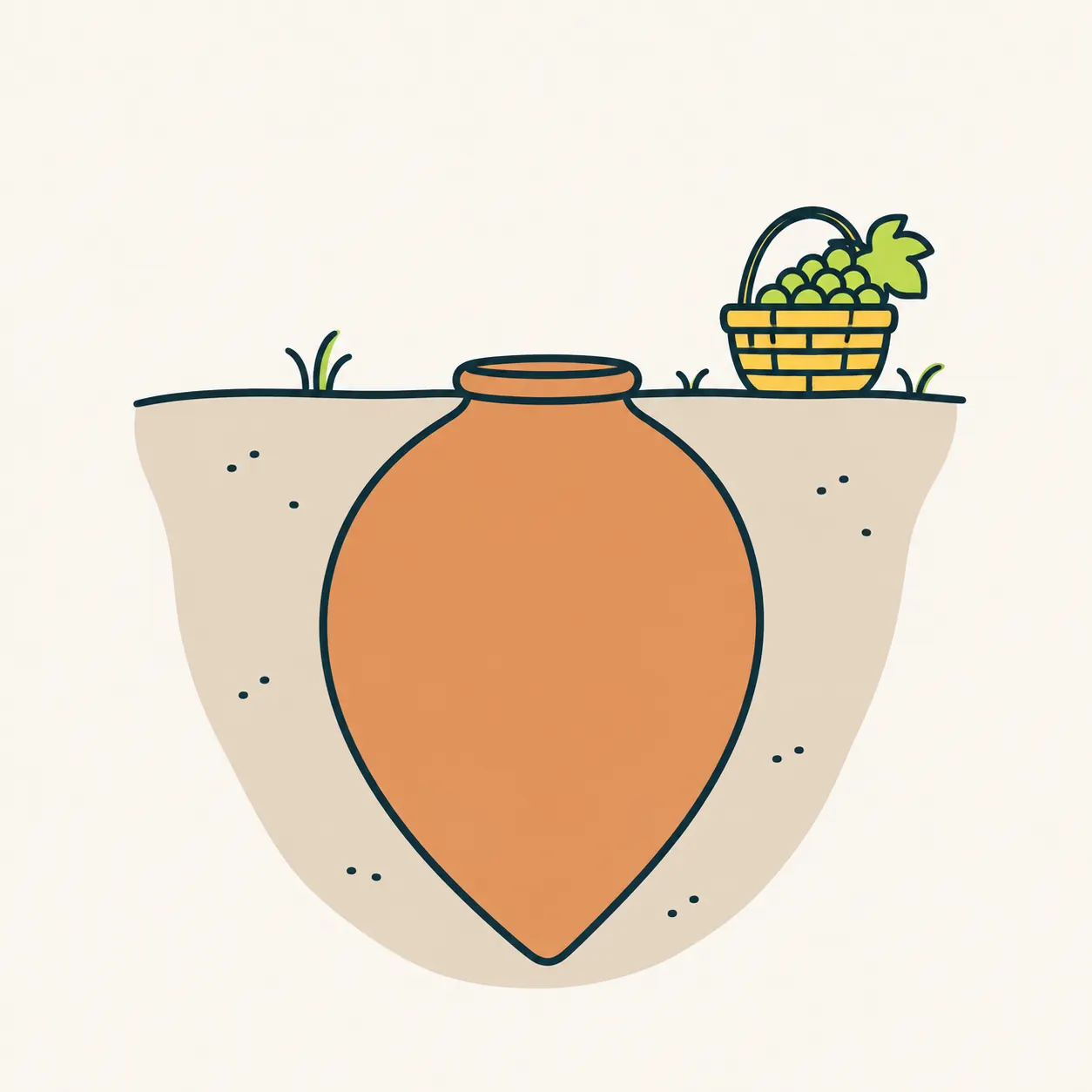
A wine cellar can conceal its most important feature beneath your feet. In Georgia, a qvevri is an egg-shaped earthenware vessel, buried almost entirely and used to ferment, mature and store wine. In winemaker and educator Shalva Khetsuriani’s account, published by WSET, it is not simply a pot to be moved around. Once installed, it becomes part of the cellar. The discovery therefore concerns a relationship between an object, its location and the work performed there. [1]
The Wine History Foundation describes the marani, the place for wine, with buried vessels and tools for pressing, drawing out liquid and cleaning. It also records differences between enclosed spaces in eastern Georgia and open or partly open arrangements in the west. We should not imagine one identical room in every village. The vessel’s shape belongs within local practices, domestic spaces and practical tools: a tradition is more than its most immediately recognisable photograph. [2]
The surrounding ground provides a more stable thermal environment, Khetsuriani explains; the vessel narrows towards the bottom, where solid material can settle. These features clarify why installation matters without giving clay miraculous powers. The same source distinguishes the container from the style of wine: a qvevri alone does not certify one colour, organic grape growing or a method without interventions. Human decisions still count within a traditional object, even when its familiar appearance encourages us to overlook them. [1]
Imagine an editorial visit: instead of asking only how old the vessel is, ask how it is cleaned, who knows how to maintain it and who passes on those skills. These are not interviews we have conducted, but questions for looking beyond the surface. The implements preserved and described by the museum reveal this dimension of work. A physical object may attract attention; understanding its use also requires gestures, relationships and knowledge that earthenware alone cannot display. [2][1]
In 2013, the traditional Georgian method entered UNESCO’s Representative List of the Intangible Cultural Heritage of Humanity, as the WSET account records. The interest concerns practised knowledge, rather than a health promise attached to the product. Nor should the antiquity of winemaking be confused with proof that every detail remained unchanged for millennia. We can appreciate cultural continuity while recognising variation, people and present work. That is more respectful to a living tradition than reducing it to a motionless postcard. [1]
Take this with youWhen encountering a traditional object, ask which actions must be learned for it to keep working. The buried qvevri is only partly visible; the knowledge surrounding it also requires attention beyond what first meets the eye.
One idea, in simple words
A qvevri is a large earthenware vessel used in Georgia to make and store wine. It is shaped rather like an egg and buried almost up to its neck. It is not designed to be moved frequently: it becomes part of the cellar. The ground helps keep the surrounding temperature more stable. The tradition also includes the people who make, clean and use these vessels, learning skills from others. Cellars are not all identical, and practices can differ between regions. A useful example is observing both the vessel and the tools used to clean it. Cultural recognition concerns this collection of knowledge. It does not mean that wine is good for health, or that every wine produced in the vessels is identical. [1][2]
A little discovery to keep
What did you discover?
Read the sources (2)
- Qvevri: The ancient vessel at the heart of Georgian winemaking Shalva Khetsuriani · WSET · accessed 5 Nov 2026
- Wine cellar — Marani Wine History Foundation · accessed 5 Nov 2026
Original writing and illustration made with AI assistance. Our editorial method
More in Cultures & peoples