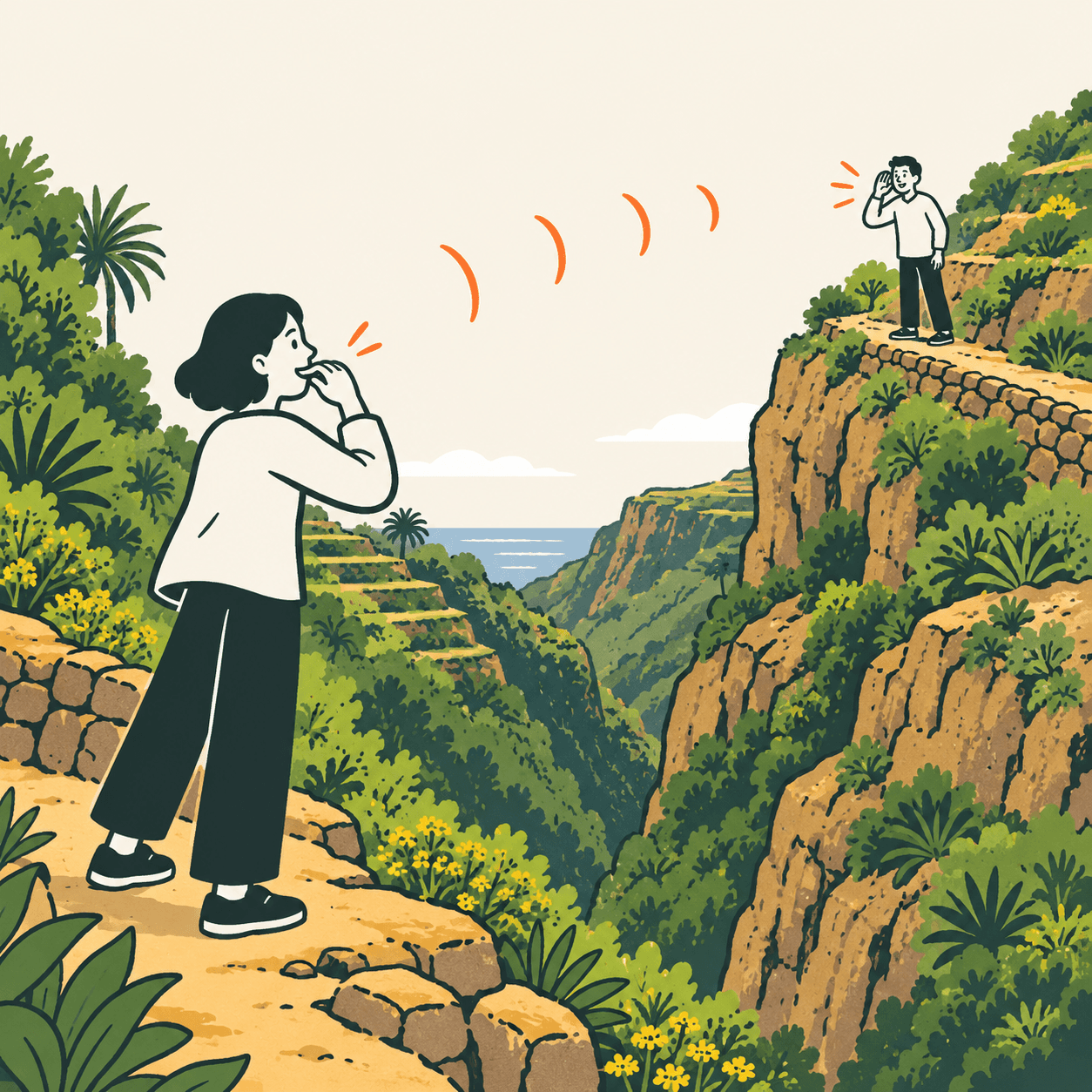
It is more than a call to attract attention. Silbo Gomero is a communication system from the island of La Gomera that represents Spanish speech sounds through whistles. Canary Islands government material presents it as a practice that coexists with the spoken language: we do not need to imagine an entirely different vocabulary for every object. [1]
The landscape helps explain the context. The local portal describes whistles being used to communicate across distances, valleys and ravines. We are not assigning an automatic ability to everyone in the Canary Islands: this is a particular practice that people learn and pass on. Our illustration therefore presents an editorial scene, not a photographic account or the reconstruction of a historical event. [2]
The local account of practitioners also describes young people learning and using silbo. UNESCO recognition dates to 2009. That date concerns heritage inscription rather than the beginning of the practice. Treating the two as equivalent would turn a history passed down over time into a recent administrative invention. [3]
School teaching is part of that transmission. The preamble to the Canary Islands decree of 9 March 2026 recalls its regulated introduction in 1999 and describes silbo as a whistled substitute for Spanish speech sounds. It discusses both individual technical practice and choosing words and sentences that aid understanding: producing a sound and making a message clear are not identical activities. [4]
An example invented by our editors: two people need to explain where to meet. One offers only an attention-getting noise; the other has a shared system for forming the message. Which information is missing in the first case? This activity separates attracting attention from communicating words. We are not inventing a whistling alphabet to call Silbo Gomero or assigning this dialogue to real practitioners. [1][4]
For a second editorial activity, imagine a small exhibition with three spaces: landscape, practice and transmission. Place an illustrated valley in the first, a question about constructing a message in the second, and a teacher’s name in the third when a documented account identifies them. Do not let a beautiful landscape take over the entire story. Understanding a tradition also means looking for the contexts where people learn it and the people who choose to keep practising it. [2][1]
Take this with youRemember: heritage can live in a way of communicating. Silbo requires learning and shared meanings, rather than simply enough breath.
One idea, in simple words
La Gomera is an island in the Canary Islands. It is home to Silbo Gomero: a way of communicating that uses whistles to represent Spanish speech sounds. It is more than whistling to attract attention. People who know the system can form and understand messages. The practice is learned and also passed on at school. [1]
The landscape includes valleys and ravines, which are deep openings in the land. Whistles have helped people communicate across these distances. Here is an example invented by our editors: getting a friend’s attention does not yet tell them where to meet you. Adding that information requires a shared message. The example does not teach Silbo Gomero: it helps us understand why communicating words differs from simply producing a sound. [2][1]
A little discovery to keep
What did you discover?
Read the sources (4)
- El Silbo Gomero. Materiales didácticos Gobierno de Canarias — Consejería de Educación · accessed 2 Oct 2026
- Monumento al Silbo Gomero La Gomera — portale turistico ufficiale · accessed 2 Oct 2026
- The Unique Whistled Language of La Gomera La Gomera — portale turistico ufficiale · accessed 2 Oct 2026
- Decreto 24/2026, de 9 de marzo — enseñanza del lenguaje silbado de La Gomera Gobierno de Canarias — Boletín Oficial de Canarias · accessed 2 Oct 2026
Original writing and illustration made with AI assistance. Our editorial method
More in Cultures & peoples