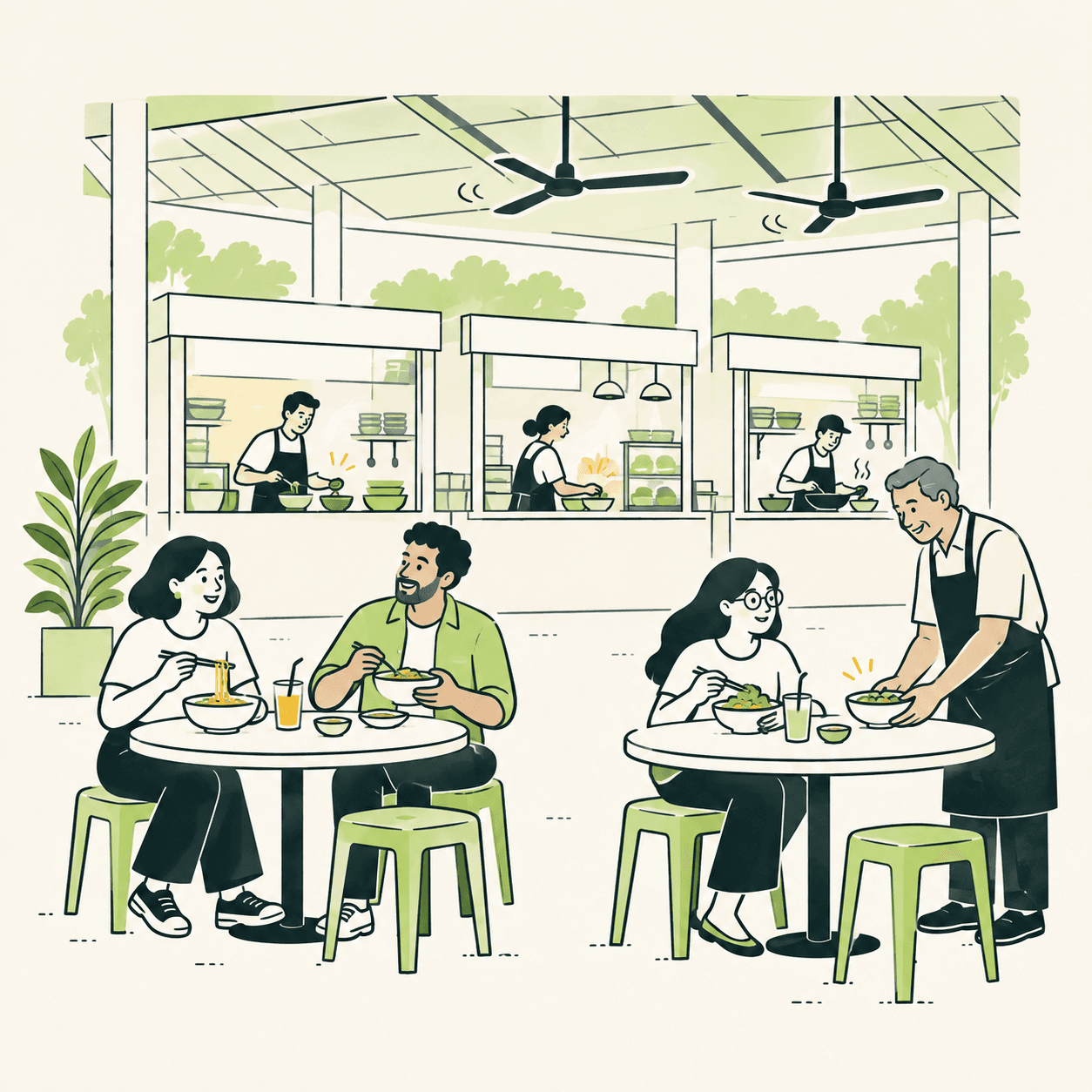
A Singapore hawker centre brings food stalls and tables together in a generally open-air space. The National Library Board describes businesses often run by families and specialising in a few dishes, alongside newer operators who reinterpret recipes. Its account includes Malay, Chinese, Indian, Peranakan and Eurasian traditions, among others. The interesting point is their coexistence: this form of dining lets us observe different practices in the same place, without having to compress them into a single national menu. [1]
These spaces have a concrete history; they are not a setting that has remained unchanged. The library’s account traces the transition from street vendors to purpose-built centres, particularly from the 1970s onwards. Relocation involved regulation, infrastructure and negotiations with the people working there. The same source documents later programmes to train new operators and help businesses find successors. Discussing tradition therefore also means considering the conditions that allow someone to continue it, rather than simply preserving a photograph. [2]
On 16 December 2020, Singapore’s hawker culture joined UNESCO’s Representative List of the Intangible Cultural Heritage of Humanity. The National Library Board describes a nomination prepared through research, documentation and participation by hawkers, institutions and organisations. The recognition concerns culinary practices and community life; it is not a ranking of individual dishes. Read this way, it shifts attention from an award to the passing on of skills, and from attractions to photograph towards the people who make that lunch possible. [3]
Here is an example devised by our editorial team for approaching a tradition without turning it into a test of other people. Imagine observing a shared dining space, in Singapore or your own city. Draw a simple map: who prepares food, where do people order, and where do they sit? Note one visible detail and one question the drawing cannot answer, such as who taught the person working there to cook. If you want to ask, choose a suitable moment and accept that they may be busy. Do not infer someone’s tastes or habits from their appearance. Our exercise does not claim to describe every hawker centre: it replaces a broad label with a specific curiosity. Cultural tourism can survive without an interrogation. [1]
Take this with youWhen you encounter a tradition, look for a gesture, a place and a person who keep it alive. One respectful question tells you more than a generalisation about an entire people.
Read the sources (3)
- Our Hawkers Through Time — aggiornato il 18 agosto 2026 National Library Board, Singapore · accessed 18 Sept 2026
- Hawkers After Independence — aggiornato il 25 agosto 2026 National Library Board, Singapore · accessed 18 Sept 2026
- Documenting Our Hawkers — aggiornato il 25 agosto 2026 National Library Board, Singapore · accessed 18 Sept 2026
Original writing and illustration made with AI assistance. Our editorial method
More in Cultures & peoples