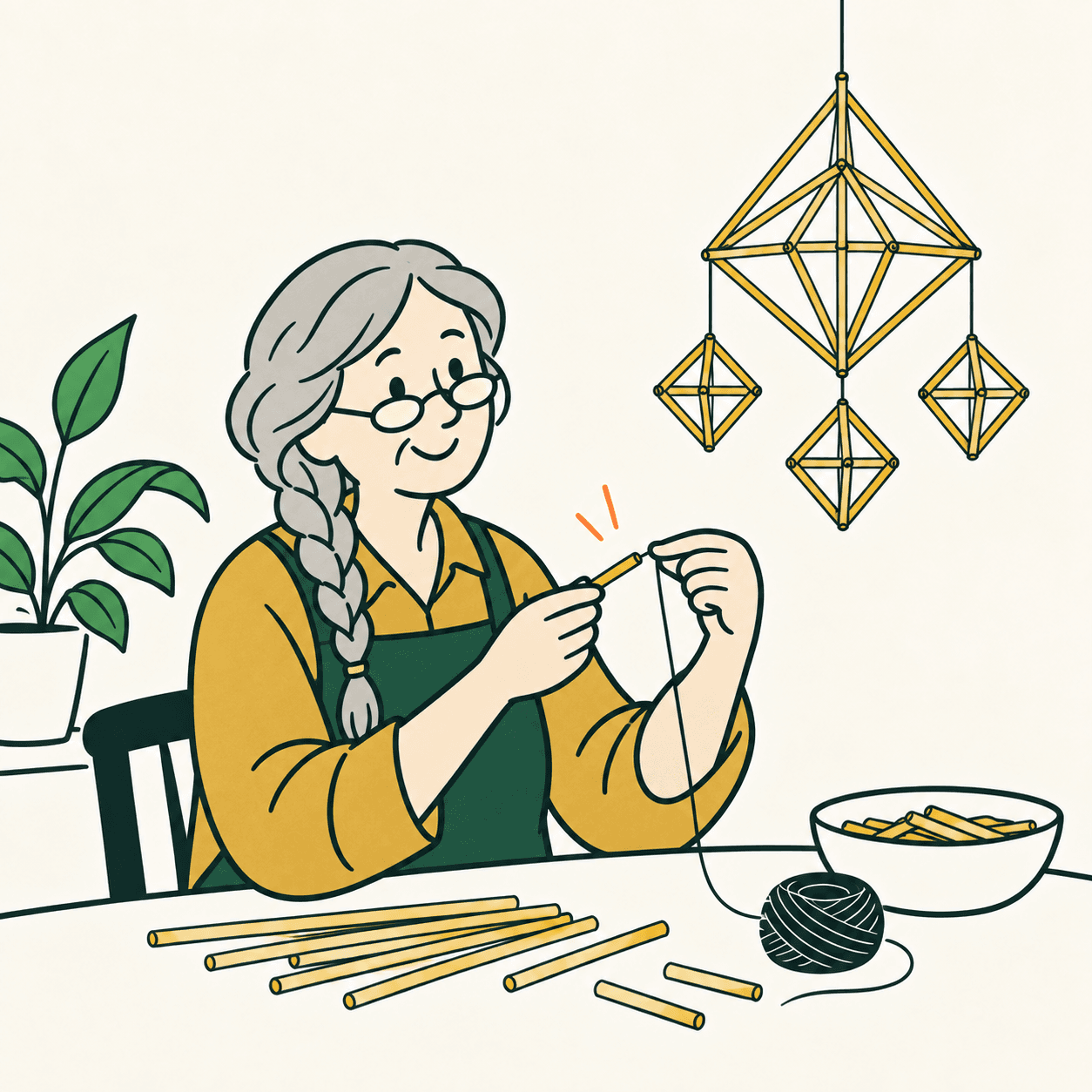
Sodai are Lithuanian hanging decorations of threaded, tied straw. Vilnius Ethnic Culture Centre describes geometric forms including the octahedron: two pyramids joined at their bases. Here, the “garden” is a light construction, not a flower bed. [1]
Look at the illustration in an editorial exercise. Follow a line with your finger without touching a real object: where does it meet the next one? Which spaces remain empty? Then draw only the outline of a double pyramid. We have not yet learned a traditional craft; we have prepared questions about its form. To understand the knots and the making, we need to listen to someone who practises and demonstrates them. [1]
On 5 December 2023, Lithuania’s Ministry of Culture announced the practice’s inscription on UNESCO’s Representative List of the Intangible Cultural Heritage of Humanity. “Intangible” here concerns knowledge and actions passed on, not only objects. The announcement describes makers of different generations and a practice that new participants can learn. [2]
Imagine visiting a workshop, as an editorial suggestion. Instead of asking only how long making takes, prepare three questions: who taught you, which step is difficult, and what have you changed in your way of working? Leave space for the exact answers. Do not anticipate them by assigning the same experience to every Lithuanian resident. Our maker would be telling a personal story within a broader tradition. [2]
The Centre’s page about a learning kit names maker Loreta Lichtarovičienė’s method and a 2024 book featuring four practitioners. It describes instructions in Lithuanian and English. This is a documented example of present-day transmission: people’s names and tools for learning make the work behind the decoration visible. [3]
Finish our notebook by separating three things: a shape we observed, an explanation we read, and a question we would like to ask. If we invent a paper decoration inspired by the geometry, call it a personal exercise rather than presenting it as a traditional sodas we have already mastered. This editorial invitation does not decide who may learn. It reminds us to name both our inspiration and what we still need to understand. [3]
Take this with youYou can meet a tradition through a good question: observe the object, find the maker’s name and listen to their account.
One idea, in simple words
In Lithuania, people make sodai, light decorations for hanging up. They use hollow pieces of straw joined with thread. These look like gardens of geometric shapes. Vilnius Ethnic Culture Centre also presents instructions for learning from people who know this tradition. [3]
Try our exercise. Look at the illustration and choose one shape. Follow its lines with your eyes and draw it in a notebook. Then prepare a question for a craftsperson, someone who makes objects through skilled work: who taught you? Do not invent their answer. What you have done is a first exercise in looking and listening. It does not tell us that everybody in a country has the same habits or knows how to make the same object. [3]
A little discovery to keep
What did you discover?
Read the sources (3)
- The Tradition of Straw Gardens (Sodai) Vilnius Ethnic Culture Centre · accessed 22 Sept 2026
- Straw garden making tradition received UNESCO recognition Ministry of Culture of the Republic of Lithuania · accessed 22 Sept 2026
- Introducing: Creative Kit “Two-Storey Garden” Vilnius Ethnic Culture Centre · accessed 22 Sept 2026
Original writing and illustration made with AI assistance. Our editorial method
More in Cultures & peoples