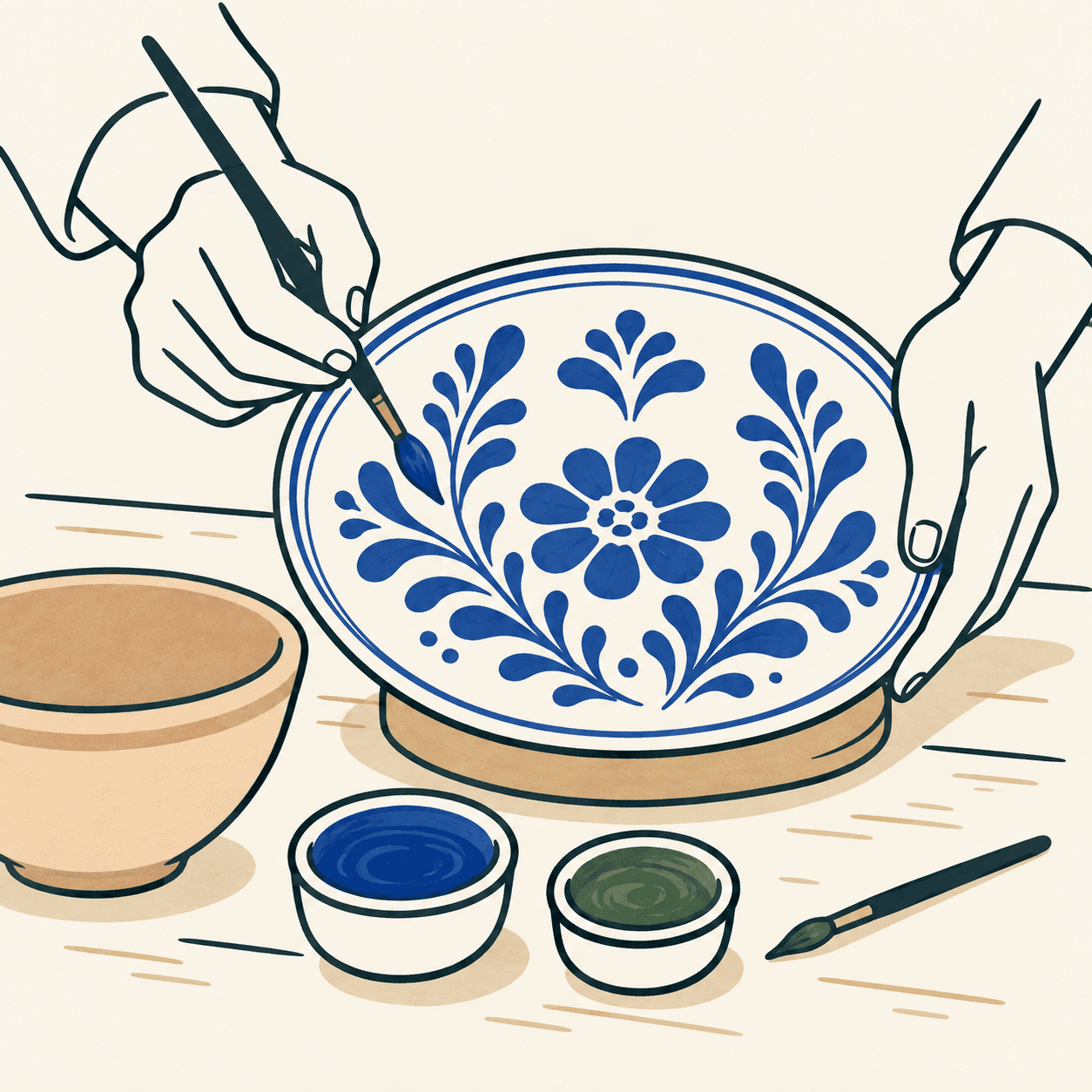
A decorated plate can be placed in a display case. But where do we put the skill of someone preparing clay, controlling a kiln or teaching a brushstroke? That question helps explain intangible cultural heritage. In 2019, UNESCO’s representative list included the artisanal processes of talavera in Puebla and Tlaxcala, Mexico, and ceramics in Talavera de la Reina and El Puente del Arzobispo, Spain. The recognition concerns more than attractive finished objects. [1]
It concerns living knowledge. INAH’s documentation lists preparing clay, shaping it on a wheel or with moulds, decorating, preparing pigments and glazes, and managing firing. Some artisans follow the whole process; others specialise in particular stages. The finished object is therefore the visible trace of many decisions and skills. Looking only at its painted design would leave much of the work, and many of the people involved, out of the story. These abilities are also learned and passed on through practice in workshops and families. [2]
Writing in the university journal Elementos, researcher Luz de Lourdes Velázquez Thierry describes work observed in Puebla workshops. Her account includes preparing clays, shaping objects and painting by hand before a further firing. These are observations from particular places, not a universal recipe for every workshop in both countries. They help explain why a shining surface begins long before the final brushstroke and depends on work that visitors may never see. [3]
Consider an example invented by our editors. An apprentice watches an experienced potter prepare a bowl. A photograph might show where the hands go, and a list might give the order of the steps. Questions would remain: when should you stop, how do you recognise a fault, and why change a movement? This imaginary scene illustrates the value of learning in workshops and families, where observation and explanation can accompany each other. [1]
Tradition does not mean a motionless world. INAH notes the introduction of tools such as electric wheels and stresses that each workshop has its own characteristics in shapes, colours and glazes. Heritage does not require everyone to produce identical objects. Nor does it describe the character of every Mexican or Spanish person. It concerns particular communities, skills and places, with differences that deserve to remain visible rather than disappearing into a national stereotype. [2]
An editorial suggestion: choose a handmade object and prepare three questions for its maker. Go beyond asking how long it takes. Ask which stage is hardest, who taught them and what they have changed over time. There is no need to try making glazes or firing ceramics yourself. We can begin by recognising the work and relationships within an object, and by listening to the person who knows how to make it. [3]
Take this with youWhen looking at a handmade object, add “who knows how to make it, and how is that learned?” to “what is it?”. Heritage lives in people who keep practising it.
One idea, in simple words
Talavera is a name connected with ceramic traditions in particular communities in Mexico and Spain. In 2019, UNESCO recognised their craft processes as intangible cultural heritage. Intangible means that knowledge and skills matter, not just the physical object we can hold or display. [1]
Making ceramics involves different kinds of work, from preparing clay to decorating and firing. Artisans pass on what they know in workshops and families. Here is an example invented by our editors: an apprentice watches a skilled potter, tries a movement and asks how to improve it. The finished plate cannot show all those lessons. Each workshop may have its own features. We should not imagine that everyone in a country makes the same objects or shares the same habits. [2]
A little discovery to keep
What did you discover?
Read the sources (3)
- Procesos artesanales para la elaboración de la Talavera — Declaratorias de la UNESCO Secretaría de Cultura de México · Sistema de Información Cultural · accessed 23 Sept 2026
- Procesos artesanales para la elaboración de la Talavera de Puebla y Tlaxcala y de la cerámica de Talavera de la Reina y El Puente del Arzobispo Instituto Nacional de Antropología e Historia · accessed 23 Sept 2026
- Los procesos artesanales para la elaboración de talavera de Puebla y Tlaxcala en México Luz de Lourdes Velázquez Thierry · Elementos, BUAP · accessed 23 Sept 2026
Original writing and illustration made with AI assistance. Our editorial method
More in Cultures & peoples