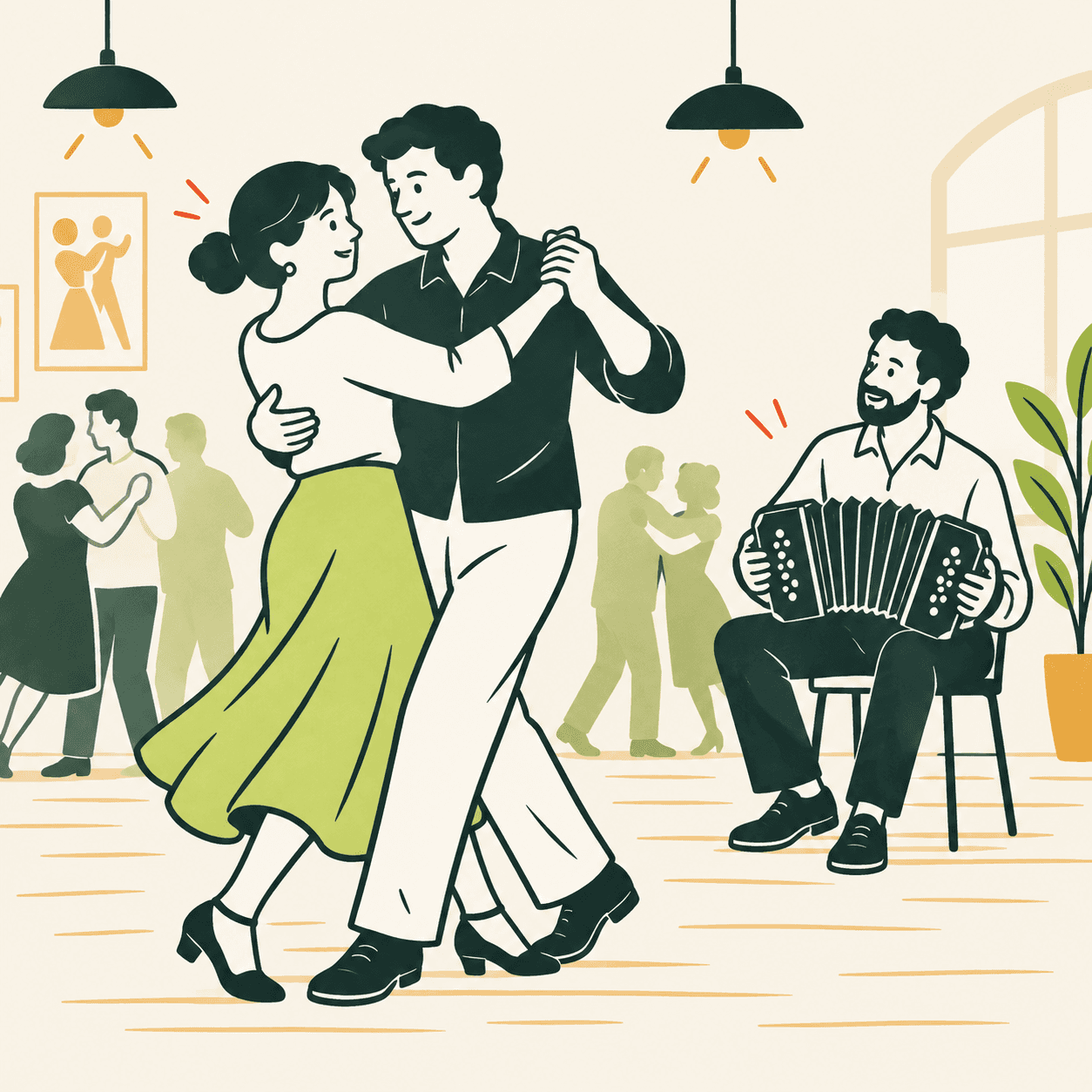
Tango is more than a couple in the spotlight. It brings together music, dance and poetry that developed around the Río de la Plata, between Argentina and Uruguay. Uruguay’s culture ministry describes its roots in the working-class communities of Buenos Aires and Montevideo: encounters between European migrants, descendants of enslaved Africans and local populations. Presenting it as the isolated invention of one group makes the story smaller than it is. [1]
An important setting is the milonga. Here, the word means a place where people go dancing, such as a hall or social club. It also names musical forms, so context matters. Montevideo’s Centre of Photography describes evenings with tangos, milongas and waltzes arranged in tandas, short groups of pieces separated by musical breaks called cortinas. These help organise a shared experience. [3]
One concrete example is the baile social milonguero described in Argentina’s cultural inventory. This style developed on crowded dance floors in the 1940s, adapting to limited space: an embrace and compact steps allow partners to move and turn together. The entry documents a particular practice, not a rulebook for every tango. Watching only spectacular performances can hide this social dimension, with its regular and occasional participants. [2]
Try an example from our editors, not a dance lesson. Imagine two people crossing a room full of chairs together. To succeed, they need to notice the space and coordinate their movements; the biggest step is not necessarily the best. This image helps explain why a dance practised on a shared floor cannot be judged only by the difficulty of its moves. Learning the actual practice requires teachers and context. [2]
The sound has a history of encounters too. The bandoneón has bellows, a folded section that opens and closes to move air. Designed in Germany and adopted by Río de la Plata musicians, it became one of tango’s characteristic sounds. It is not the only instrument: the ensembles described by the centre also include piano and strings. A musical tradition cannot be reduced to a single object. [3]
In 2009, tango entered UNESCO’s intangible cultural heritage list through a joint nomination by Argentina and Uruguay. Here, “intangible” concerns knowledge and practices passed between people. One example of safeguarding is Bandoneones del Uruguay, a book presented by the ministry in 2026. It grew from research with musicians, craftspeople who make or repair instruments, and other participants. Protecting tango includes understanding these people, rather than freezing a pose. [1][4]
This story does not mean that every Argentine or Uruguayan dances tango, or ought to enjoy it. The sources describe communities of practitioners, styles and changes. We can approach it by asking how a milonga works or listening to musicians, without assigning one preference to a whole population. It is a shared culture that people continue to interpret, teach and transform. [1]
Take this with youWhen you encounter a tradition, look for the people and places that keep it alive. A step can tell you more than its shape.
One idea, in simple words
Tango developed around the Río de la Plata, between Argentina and Uruguay. It is more than a dance: it includes music and sung words. It grew through encounters between people with different backgrounds, especially in the cities of Buenos Aires and Montevideo. [1]
A milonga can be a place where people meet to dance. Crowded floors helped shape a style with compact steps. For an example, imagine crossing a room with a friend: you need to coordinate your movements and notice the space. [2]
Tango is intangible heritage: a tradition passed between people. Musicians, dancers and teachers help keep it alive. Not every Argentine or Uruguayan dances tango. Learning about a culture does not mean assuming that everyone has the same tastes. [1]
A little discovery to keep
What did you discover?
Read the sources (4)
- Patrimonio Cultural Inmaterial — El Tango Ministerio de Educación y Cultura de Uruguay · accessed 24 Sept 2026
- Baile social milonguero Secretaría de Cultura de Argentina · accessed 24 Sept 2026
- El tango en el tiempo — Glosario Centro de Fotografía de Montevideo · accessed 24 Sept 2026
- Bandoneones del Uruguay Ministerio de Educación y Cultura de Uruguay · accessed 24 Sept 2026
Original writing and illustration made with AI assistance. Our editorial method
More in Cultures & peoples