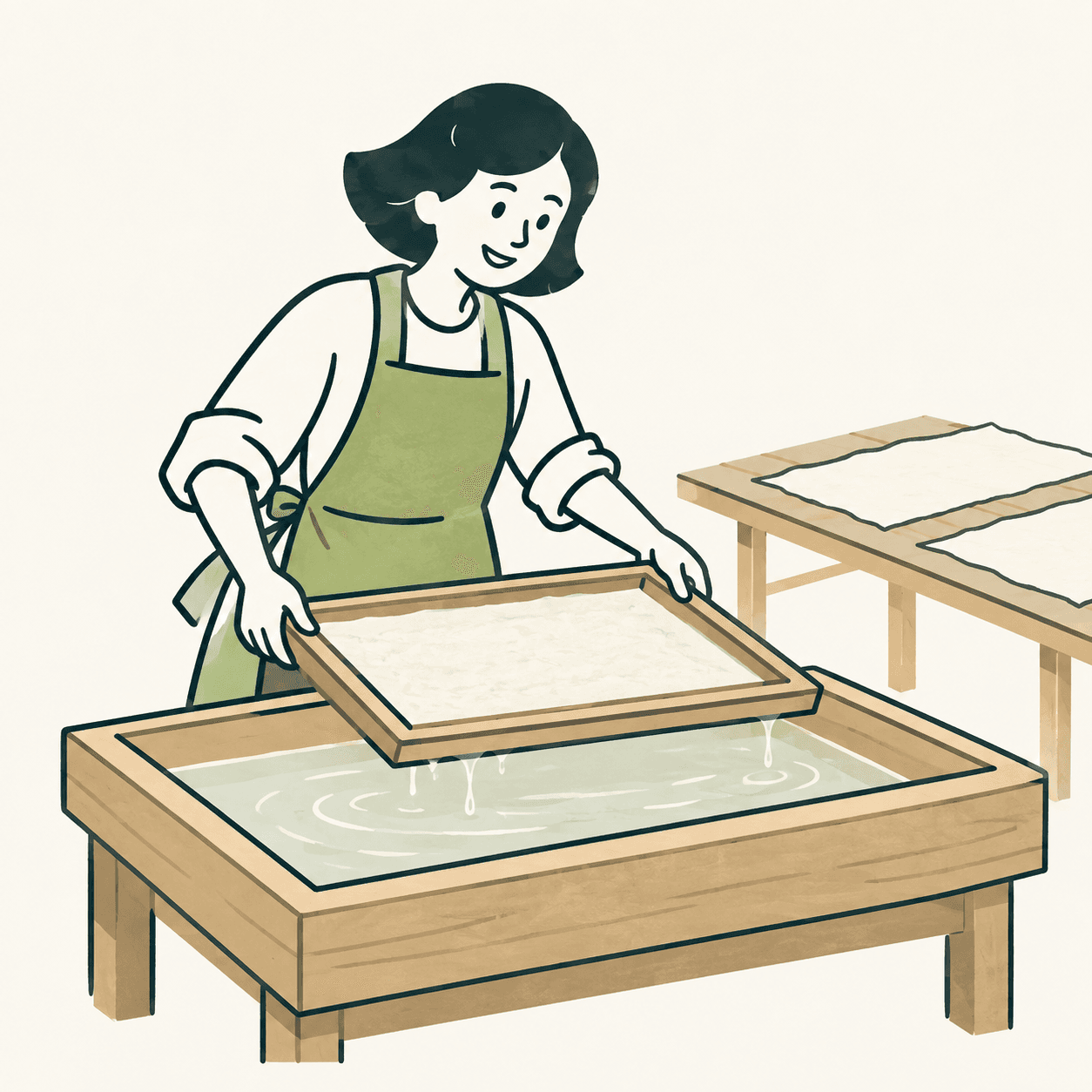
A sheet of paper can conceal the movement that formed it. In Mino, Japan, the process described by Traditional Crafts Aoyama Square involves gathering a suspension of fibres in a frame and moving it backwards, forwards and sideways. The nagashi-zuki method distributes and interlaces fibres while water drains away. The surface eventually lying on our table is the result of a controlled sequence, not simply material left to dry in a tank. [1]
The same account lets us look before and after that moment. Preparation includes separating and cleaning fibres; following formation, sheets are pressed and dried. Selection, attention and manual skill matter throughout. The description concerns a particular production tradition: it is neither a universal recipe for Japanese paper nor a home tutorial. A demonstration reveals a striking stage, but quality also depends on less photogenic work. Removing impurities, inconveniently for short videos, does not skip itself to the next chapter. [1]
The Japan Design Committee clarifies a point often lost in tourist descriptions: washi is a broad category, not an automatic guarantee that every sheet was made entirely by hand using identical materials. The term can include different processes and compositions. Its exhibition also connects paper with everyday objects and contemporary design. Describing this variety is more accurate than assigning an entire population one shared disposition towards patience or delicacy. The subject here is practices and people, not unchanging national characteristics. [2]
Washi-nary, a local business in Mino, presents a collection of papers from different Japanese regions and invites designers to compare them. This is a commercial voice, which should be read as an account of its own activities rather than an independent quality ranking. It nevertheless provides a concrete setting: papers selected for different uses, knowledge exchanged, and a material that remains part of working life today. A tradition does not become more authentic because we imagine it standing completely still. [3]
Here is an exercise from our editorial team: examine two available paper samples without assuming that either is washi. Look at transmitted light, edges and the evenness of the surface. Record what you notice separately from what would require information from the maker: fibres, place, method and date. If you visit a demonstration, ask which stage you are seeing and which happened earlier. The sheet then becomes more than an elegant background: it becomes a trace of work. [1][3]
Take this with youTry this: when looking at a handmade object, seek a particular movement and the people who pass it on. Respect begins with precision: knowing which practice we mean without turning it into a portrait of millions.
One idea, in simple words
In Mino, Japan, some craftspeople make paper by gathering water and plant fibres in a frame. Fibres are tiny strands taken from plants. Moving the frame backwards, forwards and sideways spreads and interlaces them. The sheets are then pressed and dried. [1]
This paper belongs to the world of washi, Japanese paper. However, washi is a broad name: it includes different materials and methods. Reading that name does not tell you whether a sheet was made entirely by hand. You need information about its maker. [2]
Here is an exercise from our editorial team: look at two sheets you already have, without assuming they are washi. Compare their edges and the light coming through their surfaces. Write down what you notice. Paper records particular work; to know its materials and method, you also need information from the maker. [1][2]
A little discovery to keep
What did you discover?
Read the sources (3)
- MINO Washi (Papers) Traditional Crafts Aoyama Square · accessed 19 Sept 2026
- Japanese Paper — The Future of Japanese Tradition Japan Design Committee · accessed 19 Sept 2026
- Washi-nary — Mino Washi Washi-nary / Marujyu Paper Company · accessed 19 Sept 2026
Original writing and illustration made with AI assistance. Our editorial method
More in Cultures & peoples