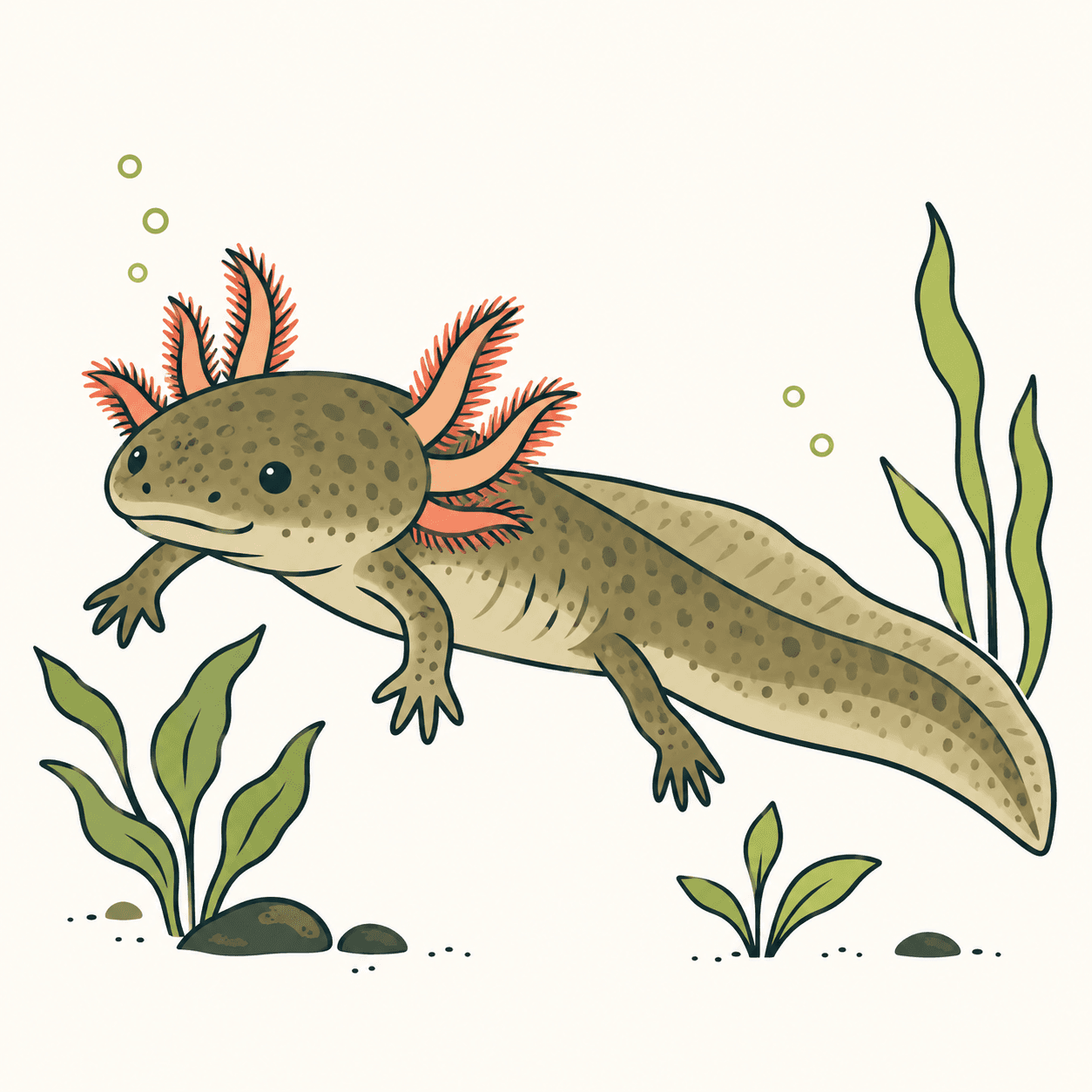
The little feathery, branch-like structures beside an axolotl’s head are gills. The American Museum of Natural History identifies them among its most recognisable features. The animal is a salamander, and therefore an amphibian; its scientific name is Ambystoma mexicanum. Looking at it raises a simple question: why does it retain an appearance associated with the young stages of other amphibians even after it has grown? [1][4]
San Diego Zoo describes this retention of juvenile characteristics using the term neoteny. The axolotl normally remains aquatic and keeps its external gills into adulthood; it also develops functioning lungs. Becoming an adult and transforming every structure of the body are therefore different things. Calling it a perpetual baby might be a joke, but it hides the fact that these animals reach reproductive maturity. [2]
The San Francisco Zoo profile adds a useful detail: the tail also retains a fin suited to swimming. It describes wild axolotls as dark greyish-green. The pink axolotl that might come to mind is therefore not a universal model for depicting the species. In our illustration, we choose a dark individual and keep its gills and tail clearly visible: the important details here concern form and function. [3]
Here is our editorial example: prepare two cards for a small imaginary museum. Write body appearance on the first and ability to reproduce on the second. After reading the explanation, write external gills beneath the first heading and can reach maturity beneath the second. The cards help prevent a visible characteristic from answering a different question. They are not a method for determining the age of an animal you see, and they require no handling: the exercise is about separating the information available to you. [2]
Living in water does not protect the animal from events around that water. The American museum’s educational card describes threats involving pollution, drained lakes and introduced predatory fish in its Mexican environment. A form suited to aquatic life does not make the habitat indestructible. This is an essential distinction: understanding a bodily feature and understanding the situation of the species are two connected tasks. [4]
Finally, return to our imaginary museum. Which label really helps a visitor: looks like a baby, or retains external gills into adulthood? We prefer the second because it explains a characteristic without turning it into a story about age. This is an editorial choice. Our reading concerns one aspect of normal axolotl development. It does not cover the species’ entire biology or allow husbandry instructions to be inferred from an illustration. The drawing simplifies what the text invites us to observe. [1][3]
Take this with youWhen a shape immediately suggests a story, ask which characteristic you observed and which conclusion you are adding yourself.
One idea, in simple words
An axolotl is an aquatic salamander. The feathery tufts beside its head are gills, which help it breathe underwater. Its body keeps juvenile features even when it becomes an adult. This characteristic is called neoteny. It does not mean the animal stays a baby forever: it can reach maturity and reproduce. It also has functioning lungs. [1][2]
Its tail has a fin that helps it swim. Wild axolotls are dark. Here is our editorial example: draw two boxes, one for appearance and one for maturity. Putting a description in each helps you keep them separate. The species’ natural environment is threatened by pollution and introduced fish, among other pressures. [3][4]
A little discovery to keep
What did you discover?
Read the sources (4)
- Fast Facts: Axolotl American Museum of Natural History · accessed 3 Oct 2026
- Axolotl — Ambystoma mexicanum San Diego Zoo Wildlife Alliance · accessed 3 Oct 2026
- Axolotl San Francisco Zoo & Gardens · accessed 3 Oct 2026
- OLogy Card 366: axolotl American Museum of Natural History · accessed 3 Oct 2026
Original writing and illustration made with AI assistance. Our editorial method
More in Curiosities