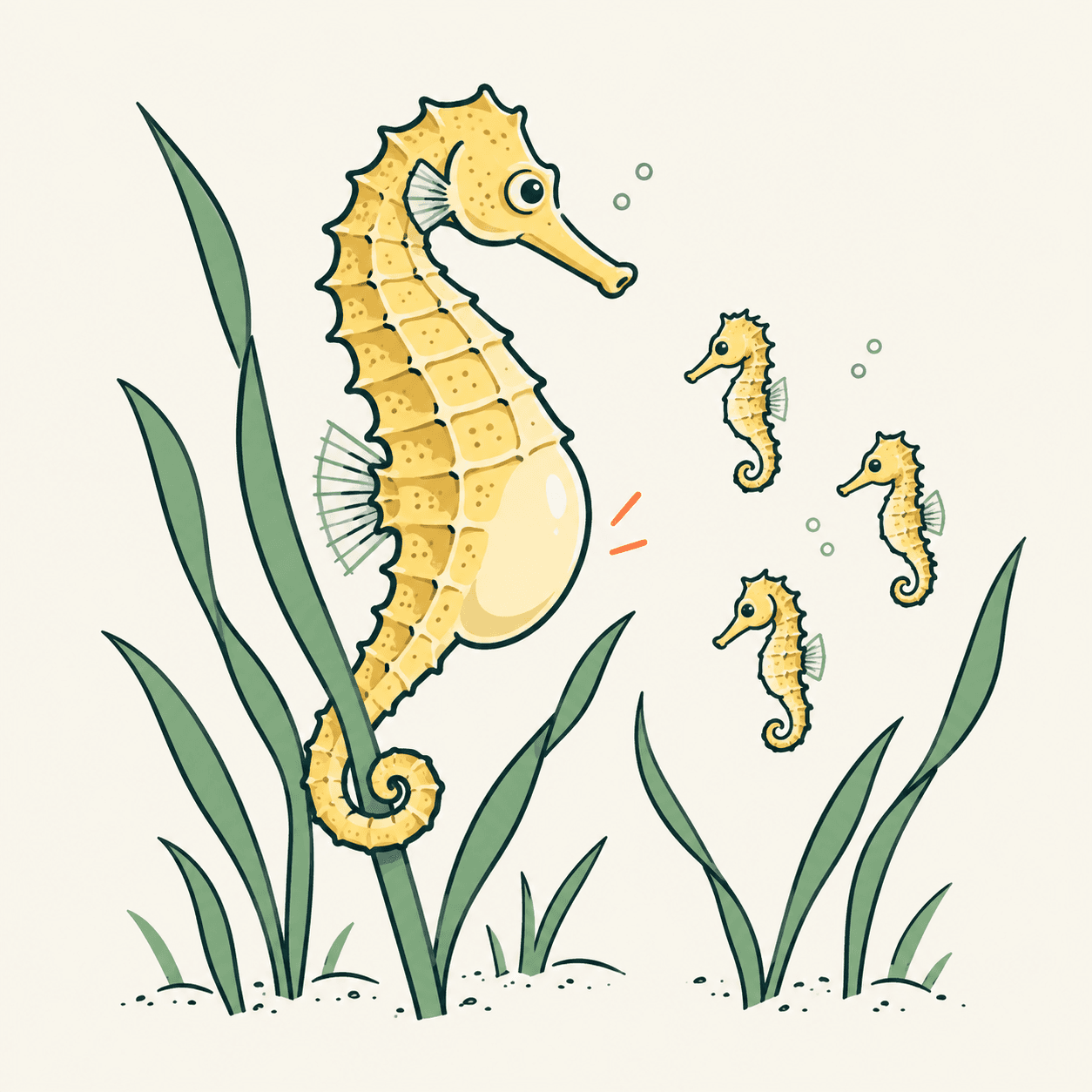
A male seahorse’s baby bump contains a useful distinction: producing eggs and carrying a pregnancy are different tasks. After courtship, the female transfers mature eggs into the male’s brood pouch, where they are fertilised. NOAA gives a usual gestation range of two to four weeks. [1]
The pouch is more than a container. Research described by the University of Sydney in 2015 followed gene activity during pregnancy, identifying functions associated with nutrition, gas exchange, waste removal and immune protection. Embryos also receive reserves from the maternal egg yolk: the father’s contribution adds to what the eggs provide. [2]
In 2020 the university presented experimental evidence of nutrients passing from fathers to embryos, including energy-rich fats. Moving from a genetic clue to an experimental result matters: suggesting that a tissue could perform a function is not yet the same as observing that transfer. The two studies approach the question with different tools and types of evidence. [3]
Birth also deserves its own explanation. In a 2022 study of pot-bellied seahorses, pouch tissue exposed to isotocin failed to show the expected contractions. Anatomical examination found few bundles of smooth muscle in the pouch and large skeletal muscles near its opening. The authors proposed that these helped expel the young, while specifying that further functional tests were needed. [4]
At birth, fully formed young are expelled into the water and must subsequently fend for themselves. The family analogy in the headline helps us remember the scene, but “dad” does not describe every later behaviour. The reproductive cycle needs to be followed through to what happens after birth, too. [1]
Our reading is that comparisons with mammals work best when they preserve differences. The general problem is supporting developing embryos; the actual solution needs to be studied in the species concerned. These findings are not breaking news: they come from different years and show how an explanation is assembled in stages. A curious headline opens the door, but should not furnish the entire room by itself. [3][4]
To organise the story, try this editorial exercise: draw three boxes, labelled “eggs”, “gestation” and “birth”, and connect each stage to what has been observed. Add one open question, such as how to measure a particular nutrient exchange. The diagram adds no data: it helps distinguish a fact, the method used to investigate it and a hypothesis. A surprise becomes more interesting when we can also explain where our knowledge stops. [1][3]
Take this with youDescribe the cycle by separating egg production from support during gestation. Then identify one piece of evidence and one open question: curiosity has room for both.
Read the sources (4)
- How do seahorses differ from all other animals? NOAA · National Ocean Service · accessed 15 Sept 2026
- Male seahorse and human pregnancies remarkably alike University of Sydney · accessed 15 Sept 2026
- Who’s your daddy? Male seahorses transport nutrients to embryos University of Sydney · accessed 15 Sept 2026
- New research uncovers the unique way seahorse fathers give birth University of Sydney · Camilla Whittington e Jessica Suzanne Dudley · accessed 15 Sept 2026
Original writing and illustration made with AI assistance. Our editorial method
More in Curiosities