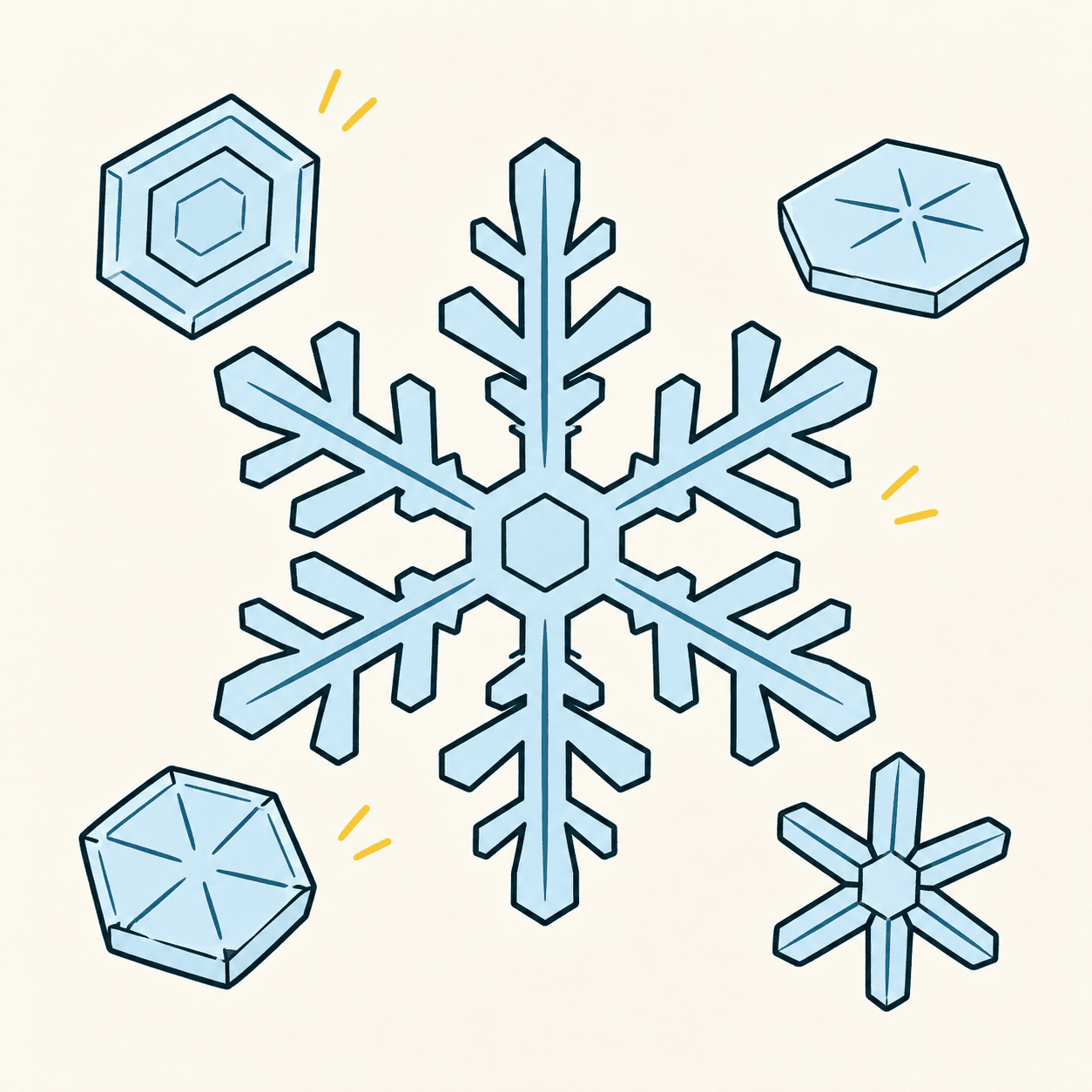
A branching snow crystal can look like a tiny geometric drawing. Its six main directions have an explanation in the arrangement of water molecules in ice: the Met Office describes this hexagonal structure. Hexagonal refers to six sides or directions. However, that does not mean every visible piece of snow is a perfect, undamaged little star with identical branches. [1][3]
NOAA NESDIS’s educational page distinguishes crystals with flat faces from branching crystals. As a crystal grows, water vapour can join the ice, and its journey encounters different conditions. The basic structure is therefore not a mould producing just one figure. It helps to separate two questions: where does the geometric organisation come from, and how does an individual crystal take shape? [2]
Another NOAA explanation highlights the temperature and humidity encountered during the journey through a cloud. Its examples include plates and needles as well as more familiar branching designs. Our illustration therefore has an explicit limit: it shows one enlarged example of a branching crystal. It does not represent every possible shape or allow the crystal’s actual size to be measured. [3]
An editorial example: draw six rays around one point, spacing them evenly. On one sheet, add little sideways strokes; on another, make the ends wider. The drawings keep a geometric relationship while changing their appearance. This paper model was invented to distinguish structure from growth, not to provide a weather recipe. Pencil marks, ice and water vapour do not behave in the same way. [1][2]
A second editorial exercise: put the figures side by side and list everything you chose yourself. The length of the strokes? The number of small branches? The colour? Separate these choices from the single idea you wanted to illustrate: six directions. This prevents an attractive picture from becoming evidence for details you never observed. A drawing can explain one question without answering every other question. [1]
Finally, write a careful editorial caption: “Enlarged example of a branching crystal; snow shapes vary.” Compare it with an absolute statement such as, “Every snowflake looks exactly like this.” Which leaves room for the other forms described by the sources? We do not need to settle whether two crystals could ever be identical: the Met Office notes how difficult a universal claim is to test. The useful discovery concerns the mechanism, not a contest to find a perfect snowflake. [1][3]
Take this with youRemember: the organisation of ice explains the six directions; growing conditions help produce the variety of shapes.
One idea, in simple words
Molecules are tiny groups of atoms. In ice, water molecules form a structure that helps explain the six directions of many snow crystals. The wind does not cut them out with six snips like scissors. [3]
As a crystal grows, temperature and humidity help shape it. There are plates and needles too: not all snow looks like a perfect star. Here is an example invented by our editors. Draw six rays and add different little branches on two sheets. You have kept the basic idea while changing the pattern. Paper does not reproduce what happens inside a cloud: it simply helps separate a shared structure from different possible appearances. Our illustrated crystal is greatly enlarged. [3][2]
A little discovery to keep
What did you discover?
Read the sources (3)
- Snowflakes Met Office · accessed 1 Oct 2026
- How Do Snowflakes Form? NOAA NESDIS · accessed 1 Oct 2026
- How do snowflakes form? Get the science behind snow NOAA · accessed 1 Oct 2026
Original writing and illustration made with AI assistance. Our editorial method
More in Curiosities