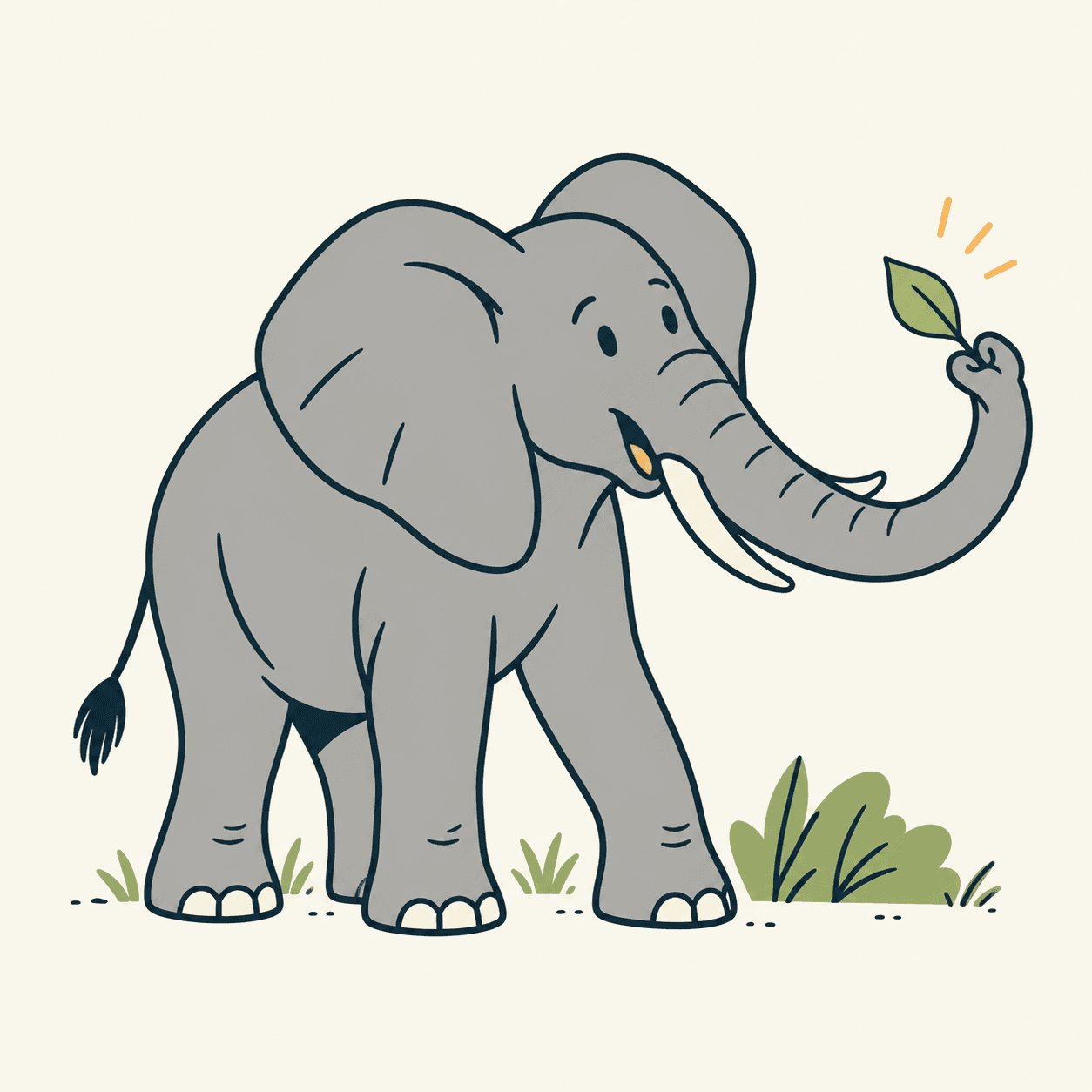
An elephant can grasp a twig without a hand. It uses its trunk, which combines the nose and upper lip and contains no bones. The Smithsonian describes muscles running in different directions alongside nerves and other tissues: coordinated action allows both strength and precision. It is therefore not an empty tube that bends passively. It is a body part that can change shape while touching, searching and picking things up. [1]
San Diego Zoo’s animal guide clears up another common misunderstanding: an elephant draws water into its trunk and then pours it into its mouth. It does not send water straight to its stomach as though using a drinking straw. African elephants have two small finger-like projections at the tip; Asian elephants have one. The comparison reminds us that the single word elephant can hide real differences, even in such a recognisable body part. [2]
A study published in the Journal of the Royal Society Interface in 2021 also investigated suction when gathering food. In tests, a female African elephant at Zoo Atlanta could pick up a thin tortilla chip using airflow. The behavioural experiments involved one animal. They demonstrate a capability observed under those conditions, rather than measuring what every elephant does each day. A surprising result becomes more interesting when we know how researchers obtained it. [3]
To think this through, our editors suggest a paper exercise. Draw three tasks: reaching a leaf, picking up something small, and bringing water to the mouth. Beside each, note the action required: extending, grasping or transferring. We are not building an artificial trunk or encouraging anyone to approach an animal. We are separating operations that, in a quick video, might look like one easy and almost automatic movement. Consider which task would require the most precise contact. [2]
Then ask what information your drawing cannot supply. You cannot see every muscle working beneath the skin, and a photograph does not reveal air pressure on its own. This is our editorial distinction between observing an action and explaining its mechanism. Watching may be enough for the first; appropriate measurements and research are needed for the second. An exciting image does not replace the evidence that lets us understand what is happening, even when it helps us ask a question. [3]
Try one final exercise: describe the elephant’s action without calling it clever, clumsy or mischievous. You might write that the tip touches an object, curves around it and lifts it. This choice of words helps us avoid attributing intentions we have not checked. We can feel wonder and remain precise at the same time. The trunk needs no invented superpowers to be fascinating. We only need to pause over the relationship between its shape, its movement and its task. [1]
Take this with youWhen an animal surprises you, separate the action from the mechanism: what did you actually observe, and which explanation still needs checking?
One idea, in simple words
An elephant’s trunk joins its nose and upper lip. It contains no bones. Muscles, the parts that move a body, can work together in different ways. This lets the trunk bend and grasp objects. It can make strong movements or delicate ones, depending on the task. [1]
To drink, the elephant collects water in its trunk and pours it into its mouth. It does not drink straight through its nose like a straw. Here is an activity invented by our editors: draw a twig and imagine the steps needed to pick it up. Reach, touch, grasp and lift. While watching an animal from a safe distance, try describing these steps. Saying what you see is different from guessing what it thinks. Do not approach an elephant to try the activity. [2]
A little discovery to keep
What did you discover?
Read the sources (3)
- Asian elephant Smithsonian’s National Zoo and Conservation Biology Institute · accessed 28 Sept 2026
- Elephant San Diego Zoo Wildlife Alliance · accessed 28 Sept 2026
- Suction feeding by elephants Journal of the Royal Society Interface — Georgia Tech author copy · accessed 28 Sept 2026
Original writing and illustration made with AI assistance. Our editorial method
More in Curiosities