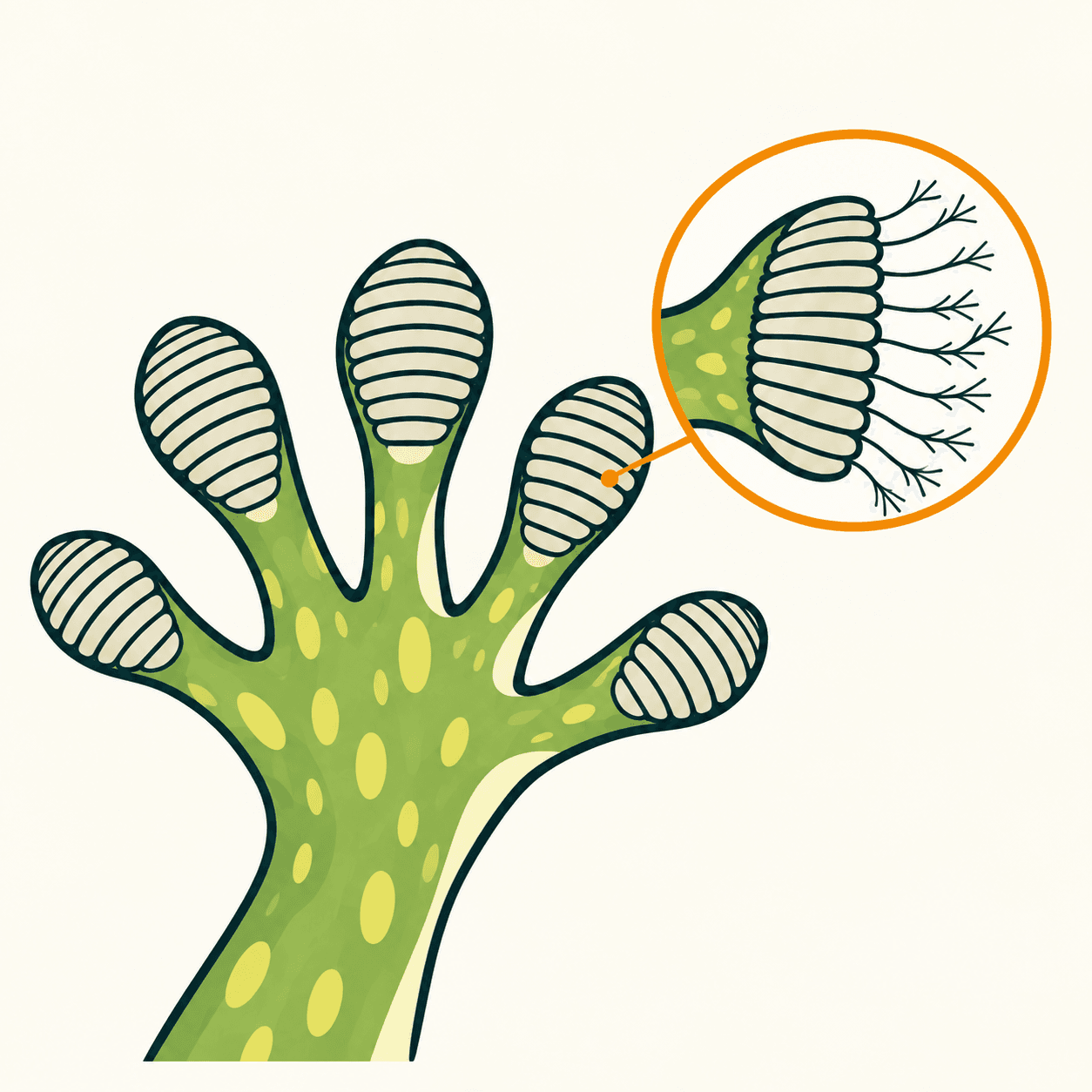
Beneath a tokay gecko’s toes are hair-like structures called setae, with tiny tips. Researcher Robert Full describes how numerous contacts allow adhesion. They are not suction cups or liquid glue: surface structure does a crucial part of the work. [1]
Imagine a drawing workshop devised by our editors. Make three frames: the whole gecko, one toe, and a small area beneath that toe. Each frame answers a different question. In the first, look for where the animal rests; in the second, which parts touch the wall; in the third, try to represent what an unaided eye cannot distinguish. Mark the final drawing as an enlarged diagram, not a photograph. [1]
A 2002 study measured tokay adhesion on different surfaces and also measured individual setae. Its results supported the role of van der Waals forces: weak attractions between particles very close together. The research therefore went beyond watching a climbing animal, comparing explanations through measurements. [2]
For a second editorial exercise, write two ideas on paper: “it needs a suction cup” and “it needs many tiny contacts”. We do not need to test them on a real gecko. Instead, ask what information we would want from an experiment: a picture of the toes, a force measurement, or behaviour on a different material? We may want more than one piece of evidence. This question game does not reproduce laboratory measurements or settle the matter by itself. [2]
In 2022, another team found an extremely thin film of lipids, substances in the fat family, on tokay setal tips. The authors stated that the coating’s function remained an open question. Describing a structure and proving exactly what it does are different steps; surface chemistry remains important to investigate. [3]
Finish our diagram by adding two labels: “observed” and “still to explain”. Put the first beside a detail described in the research, and the second beside an open question. Do not turn the drawing into a recipe for climbing: it depicts an animal and scientific observations, not equipment for people. Our small exercise is simply to choose carefully the scale at which to examine a problem, without pretending that magnification answers every question. [3]
Take this with youWhen something seems impossible, try changing scale: describe the detail first, then ask which evidence explains how it works.
One idea, in simple words
The tokay gecko has tiny hair-like structures beneath its toes. Their tips make many close contacts with a surface. A study measured attractive forces between these contacts and different materials. We do not need to imagine a foot smeared with glue. [2]
Here is an activity invented by our editors. Draw three windows: put the animal in the first, a toe in the second and an enlarged detail in the third. Write “diagram” beneath the last one. It helps us think; it is not a microscope photograph. A microscope is a tool for seeing very small things. Now ask which window shows where the animal walks and which helps explain contact. You do not need to catch a gecko or test its feet. Paper, a pencil and questions are enough. [2]
A little discovery to keep
What did you discover?
Read the sources (3)
- Berkeley Talks transcript: Learning from nature to design better robots University of California, Berkeley · accessed 22 Sept 2026
- Evidence for van der Waals adhesion in gecko setae Autumn et al. / PNAS · accessed 22 Sept 2026
- Evidence that gecko setae are coated with an ordered nanometre-thin lipid film Rasmussen et al. / Biology Letters · accessed 22 Sept 2026
Original writing and illustration made with AI assistance. Our editorial method
More in Curiosities