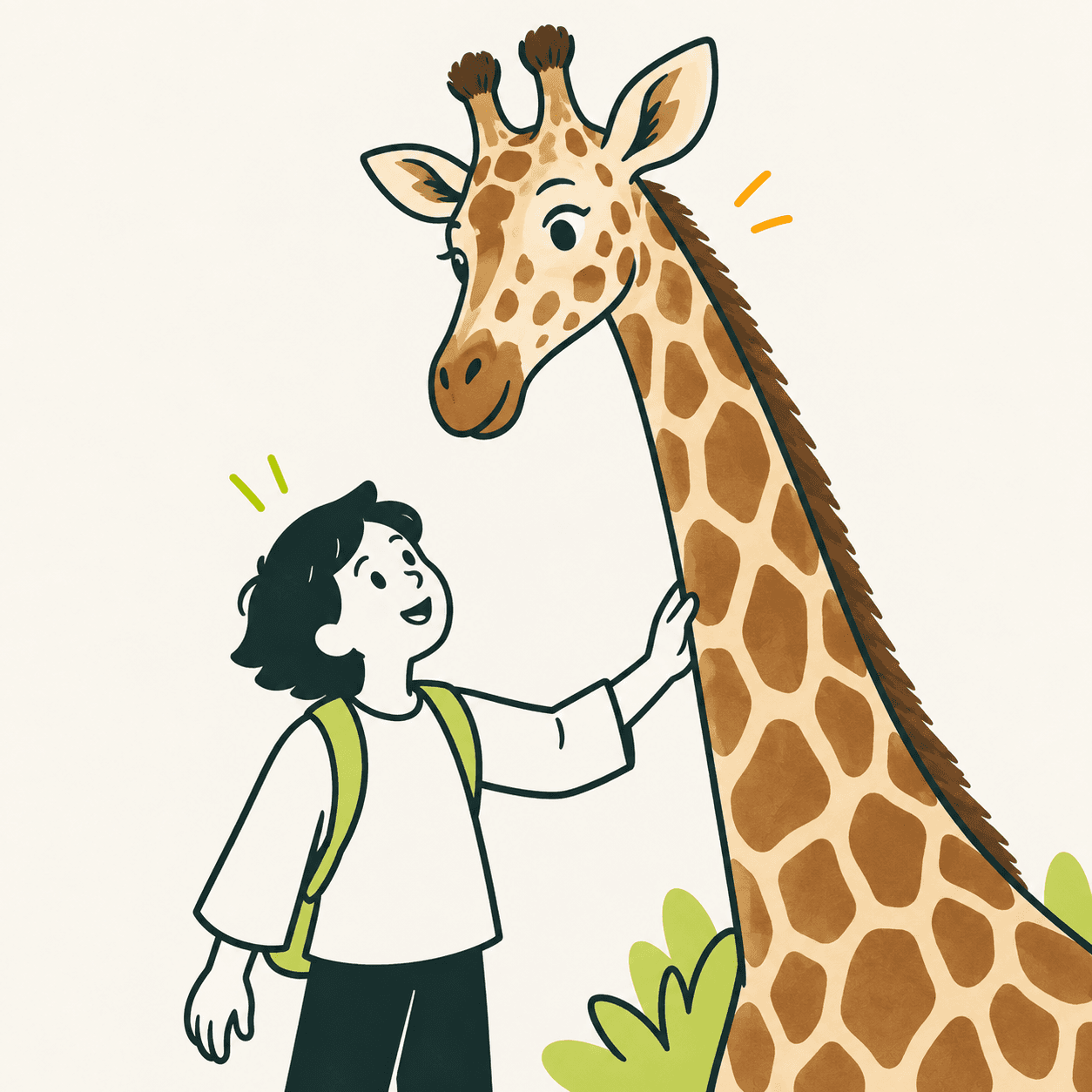
How many bones does such a long neck need? A giraffe has seven cervical vertebrae, just like a human. “Cervical” refers to the section of the backbone running through the neck. The obvious difference therefore does not come from an exceptionally long queue of extra vertebrae: the giraffe's vertebrae are elongated. San Diego Zoo notes that an individual neck vertebra can be more than twenty-five centimetres long, a striking difference in scale. [1]
The University of Minnesota's veterinary anatomy museum displays a real set of giraffe neck vertebrae obtained from a zoo. Its description offers a concrete comparison: as in most other mammals, there are seven, but they are proportionally longer. “Most” matters here. A correct comparison does not need to become an exceptionless rule about every animal, and the number of bones cannot, on its own, tell us their shape or dimensions. [2]
Let us make a model invented by our editors. Prepare two rows of seven paper rectangles: one row has short rectangles and the other longer ones. Both contain seven pieces, but the second occupies more space. This model illustrates only the difference between number and size. It is not an accurate skeleton: real vertebrae, joints and tissues are not independent rectangles to stick together. A model becomes useful when we also understand what it leaves out of the picture. [2]
A giraffe is much more than its neck, of course. San Diego Zoo describes a prehensile tongue and lips, meaning they can grasp, which help it reach leaves among branches. Watching the animal feed can therefore lead to several different questions: how high can it reach, how does it pick up a leaf, and how does it move its head? Attributing everything to one spectacular feature risks overlooking the contribution made by other parts of its body. [1]
Drawing requires care too. Our editorial illustration shows the animal from the outside, without inventing an X-ray. To count vertebrae, we instead choose a documented anatomical image such as the museum's specimen. If a stylised picture lengthens a neck for expressive effect, it must not become evidence for a precise measurement. The difference between a scientific plate and an illustrated character should be acknowledged, rather than concealed under the same caption. [2]
One final question from our editors: if two necklaces both have seven beads, must they be the same length? Before answering, ask how large the beads are and how much space lies between them. The example does not explain giraffe evolution, but it clarifies the original mistake: assuming that “longer” must always mean “made from more pieces”. A giraffe's neck is a wonderfully visible invitation to count and measure without confusing those two operations. [2]
Take this with youWhen comparing two things, separate the questions: how many parts are there, and how large are they? The surprise often lies between those two answers.
One idea, in simple words
A giraffe has seven vertebrae in its neck. Vertebrae are the bones forming that part of the backbone. We have seven too. A giraffe's neck bones, however, are much longer. A longer neck therefore does not necessarily need a greater number of bones. [1]
Try this example from our editors: draw seven short rectangles in a row. Then draw another row with seven longer rectangles. Count the pieces: the number is the same, but the length changes. Your drawing is not a real skeleton; it only explains this difference. Real bones have more complicated shapes and connections. We study them using photographs of anatomical specimens, not just cartoon characters. Counting and measuring give us different information, and both can be useful. [2]
A little discovery to keep
What did you discover?
Read the sources (2)
- Giraffe San Diego Zoo Wildlife Alliance · accessed 27 Sept 2026
- Cervical Vertebrae — Giraffe University of Minnesota · Veterinary Anatomy Museum · accessed 27 Sept 2026
Original writing and illustration made with AI assistance. Our editorial method
More in Curiosities