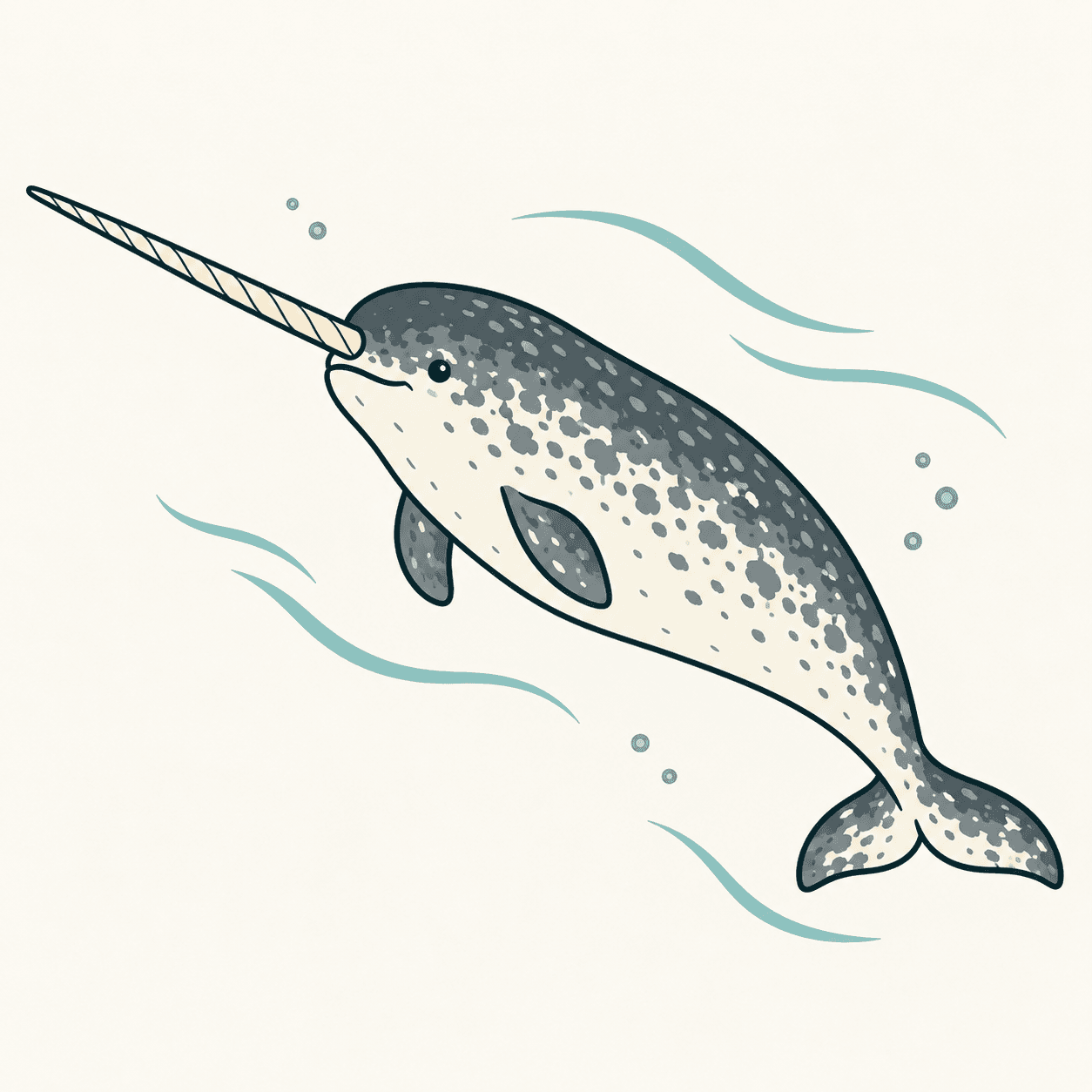
A narwhal seems to carry a horn, but that long spiral is a tooth growing from its upper jaw. NOAA Ocean Exploration describes how the left tooth in males can extend forwards for two or three metres. This distinction matters in a drawing too: the tusk does not grow from the forehead. Resemblance to an imaginary animal may catch our attention, but anatomy tells a different story. [1]
We should not turn the familiar shape into a rule without exceptions. NOAA Fisheries records females with tusks, males without tusks and individuals with two tusks. It also describes a sturdy body, short flippers and no dorsal fin. Adults have mottled skin. This Arctic whale therefore has a recognisable outline even when we look beyond its most famous feature, instead of letting one striking detail stand for the whole animal. [2]
What does that tooth do? NOAA’s profile identifies a role in social relationships between males and considers other functions too. Smithsonian’s overview separates evidence from proposed explanations and mentions observations of narwhals striking fish with their tusks. We do not have to choose one label for every behaviour. Knowing where a structure comes from and understanding all its uses are different scientific questions. [2][3][5]
There is also documented sensory ability. A 2014 paper in The Anatomical Record describes channels linking the tusk’s surface to internal tissues and changes in heart rate when the tusk was exposed to solutions with different salt concentrations. This is evidence of sensitivity to external stimuli. On its own, it does not prove that every narwhal uses its tusk to predict weather or avoid ice. [4]
Here is a small editorial exercise: imagine making two labels for a museum. On the first, write what you could identify with an arrow, such as the point where the tooth emerges. On the second, collect questions about how it is used. Do not mistake a precise arrow for a complete explanation. Separating description from function helps us recognise both what we know and what still needs investigation. [1][3]
There is a reason to stay cautious. As NOAA explains, narwhals live in remote places that are difficult to reach and observe. Filming an action documents that action, rather than automatically describing everything the species does. In our museum exercise, we could add a third label: what observation would help us distinguish two explanations? This is an open editorial question, not an experimental finding. The animal remains interesting even when the answer cannot fit on a single line. [1]
Take this with youWhen you meet a surprising shape, separate three questions: what is it, where does it grow, and what can it do? The answers may be unequally complete.
One idea, in simple words
A narwhal is a whale that lives in the Arctic. Its long tusk is not a horn: it is a tooth growing from the upper jaw. In males, it usually sticks out on the left side. However, narwhals do not all look the same. Some females have a tusk, and rare animals have two. [2]
Here is an editorial example. If you draw a narwhal, start its tusk near the mouth, not on the forehead. The drawing helps you remember where it grows. Scientists also study what it does. The tusk may have several functions, including a role in relationships between males. Knowing it is a tooth does not mean that every use has already been explained. [3]
A little discovery to keep
What did you discover?
Read the sources (5)
- What is a narwhal? NOAA Ocean Exploration · accessed 4 Oct 2026
- Narwhal NOAA Fisheries · accessed 4 Oct 2026
- Why a Tusk? The real-life unicorns of the sea and the tusks that make them famous Smithsonian Ocean · accessed 4 Oct 2026
- Sensory ability in the narwhal tooth organ system The Anatomical Record · accessed 4 Oct 2026
- Use of tusks by narwhals, Monodon monoceros, in foraging, exploratory, and play behavior Frontiers in Marine Science · accessed 4 Oct 2026
Original writing and illustration made with AI assistance. Our editorial method
More in Curiosities