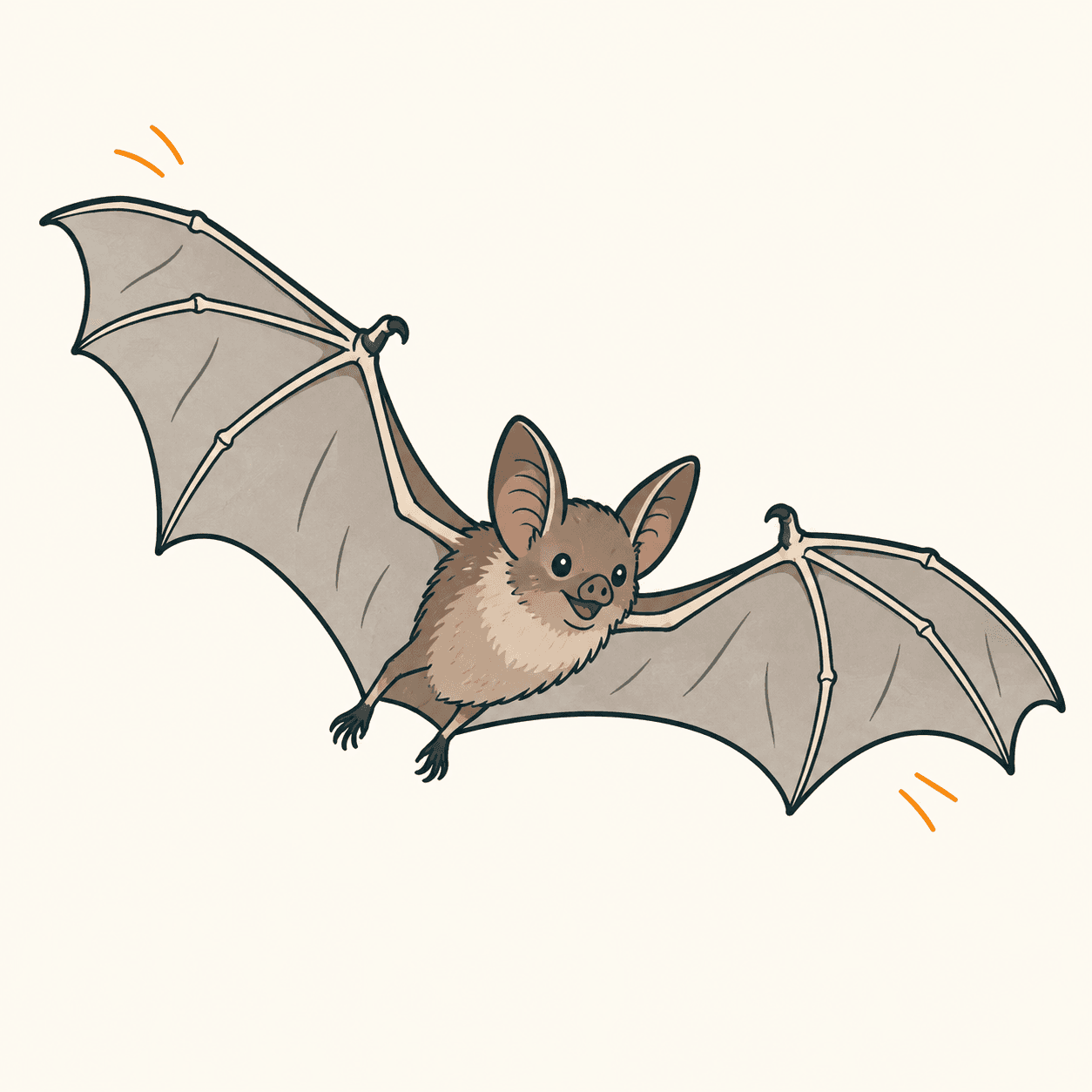
A bat is not a mouse with two accessories attached to its back. Its wings are transformed forelimbs. The Smithsonian’s teaching collection describes a membrane connecting elongated fingers while leaving the thumb free: a hand that has become a flying surface. Bats are mammals capable of powered flight, whereas other mammals called flying, such as flying squirrels, glide. The difference concerns how they move through the air, rather than how persuasive their names sound. [1]
The Natural History Museum’s guide reminds us that identifying a species in flight can be difficult. Silhouette and behaviour provide clues, but are not always enough; some identifications also use echolocation calls detected with appropriate equipment. A wing glimpsed against the sky for a second is not a taxonomic record. We can make a precise observation without yet knowing the animal’s full name. Acknowledging that limit is part of observing successfully. [2]
A longer feature from the same museum clears up a separate misconception: bats are not blind. Their vision can function in low light, while echolocation supplies other information. The article, focused on British species, also describes differing needs for roosts, feeding areas and routes between habitats. We should not turn a local account into a rule about every bat in the world. Their differences are more interesting than the single character assembled from cartoons, superstitions and Halloween decorations. [3]
Here is a comparison devised by our editorial team, using images from scientific collections. Rest your hand on a table and look at your thumb, palm and fingers. Then find the corresponding parts in a drawing of a bat’s wing: not identical proportions, but recognisable elements in a transformed arrangement. There is no need to imitate flight or stretch fabric between your fingers; that would mainly be an excellent way to knock over your mug. Ask instead what the comparison reveals and what it leaves out. A still photograph shows a structure, but cannot on its own measure movement, force or energy use. This distinction stops an analogy becoming an all-purpose explanation. The wonder does not diminish when we stop imagining a tiny superhero. It grows when we notice how dramatically a familiar form can change. [1]
Take this with youTry this: when an animal seems to have an extraordinary accessory, look for the body parts that form it. The useful question may be not what was added, but what was transformed.
One idea, in simple words
Look at your hand: it has a thumb and four other fingers. A bat’s wing also contains fingers, but they are much longer. A membrane, meaning a thin layer of skin, connects them; the thumb stays free. Its wings are therefore front legs that have changed shape. [1]
Bats are mammals and flap their wings to fly. Flying squirrels glide instead: they move through the air without that flapping. And bats are not blind. The Natural History Museum explains that they can see in low light too. [1][3]
An activity from our editorial team: compare a scientific drawing of a bat’s wing with your open hand. Find the fingers and thumb, then notice their different proportions. You can recognise similar parts with different shapes. However, a still drawing cannot show every movement needed for flight. [1]
A little discovery to keep
What did you discover?
Read the sources (3)
- Tent-making Bat — About Bats: Locomotion Smithsonian National Museum of Natural History, Q?rius · accessed 19 Sept 2026
- Bats in flight identification guide Natural History Museum, London · accessed 19 Sept 2026
- How to see UK bats and give them a helping hand Natural History Museum, London · accessed 19 Sept 2026
Original writing and illustration made with AI assistance. Our editorial method
More in Curiosities