Why do little bright circles appear beneath a tree when the gaps between its leaves have irregular shapes? The question begins on the ground, rather than in the sky. In Bob Miller’s light explorations at the Exploratorium, these patches become a clue: under suitable conditions, they are images of the Sun. The leaves have not acquired a talent for cutting perfect circles. Openings between them select some of the light and allow a recognisable image to appear farther away. [1]
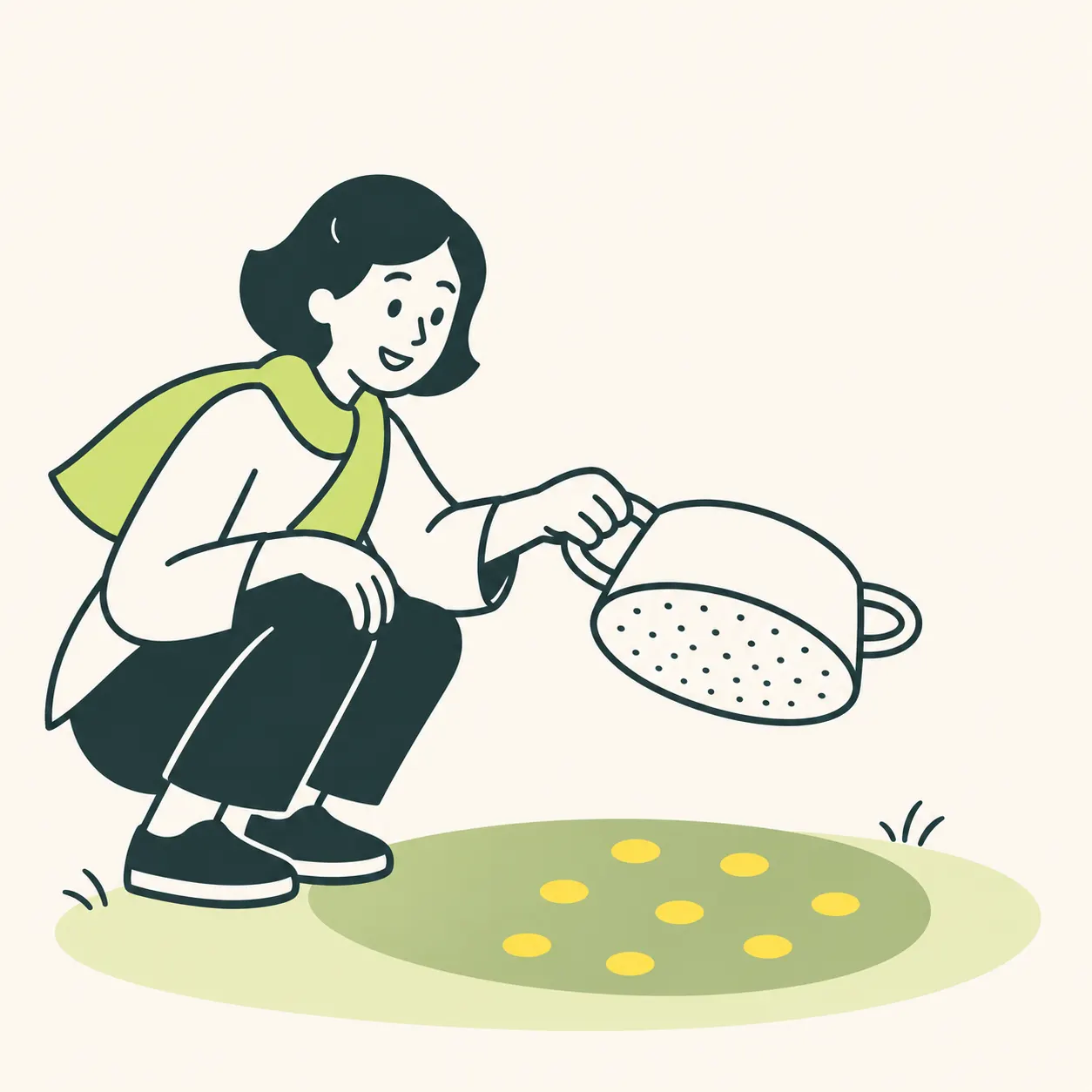
A small opening can act as a projector without a lens. It admits light from different points on the Sun; on a sufficiently distant surface, the shape of the solar disc appears. The holes in a kitchen colander can likewise produce several separate images. Each opening need not be round: its size and distance from the receiving surface matter too. Here is the unexpected connection: an everyday kitchen object can help explain something we notice in the shade of a tree. [1][2]
The shape does not emerge equally clearly in every situation. Close to a large opening, the outline of the hole can dominate; farther away, the Sun’s image becomes more recognisable, though still blurred and less bright. Overlapping projections can be difficult to distinguish. We therefore cannot describe every light patch on the pavement as a crisp little portrait of our star. The explanation concerns a relationship between the aperture, light and distance, rather than a decorative pattern that every shadow must contain. [1]
The American Astronomical Society also describes projection for viewing an eclipse indirectly, when some images become crescents. That illustrates the principle; it does not announce an eclipse today. The precaution is specific: keep the Sun behind you and look only at the images on the ground or a card, never directly at the Sun or through the holes. This activity requires no lenses, binoculars or telescopes. A colander remains a perforated screen, rather than something to hold in front of your eyes. [2]
Try this small editorial exercise in attention: on a walk, pause beside a shaded patch and describe its shapes before explaining them. Are there separate circles, irregular outlines or overlapping patches? You can change your viewing position without looking up at the Sun. This is not a scientific measurement, but a way to separate what you observe from the explanation you suggest. The pleasure of discovery lies in the next question: which detail of the world have we mistaken for a merely decorative effect? [1][2]
Take this with youLook at the projections with the Sun behind you. A hole need not resemble the image it reveals: sometimes the light describes its source.
One idea, in simple words
You may see circles of light beneath a tree. This does not mean all the gaps between its leaves are round. A small opening can project an image of the Sun onto a surface farther away. This is called projection. A kitchen colander can also produce several bright discs on the ground. Their appearance depends on hole size and distance: sometimes the images blur or overlap. Imagine looking for separate circles among the shadows during a walk. Look only at the ground or a card, with the Sun behind you. Never look directly at the Sun or through the holes. A colander does not protect your eyes. This example explains a phenomenon; it does not announce an eclipse today. [2][1]
A little discovery to keep
What did you discover?
Read the sources (2)
- Light Walk by Bob Miller Exploratorium · accessed 9 Nov 2026
- Pinhole & Optical Projection American Astronomical Society · accessed 9 Nov 2026
Original writing and illustration made with AI assistance. Our editorial method
More in Curiosities