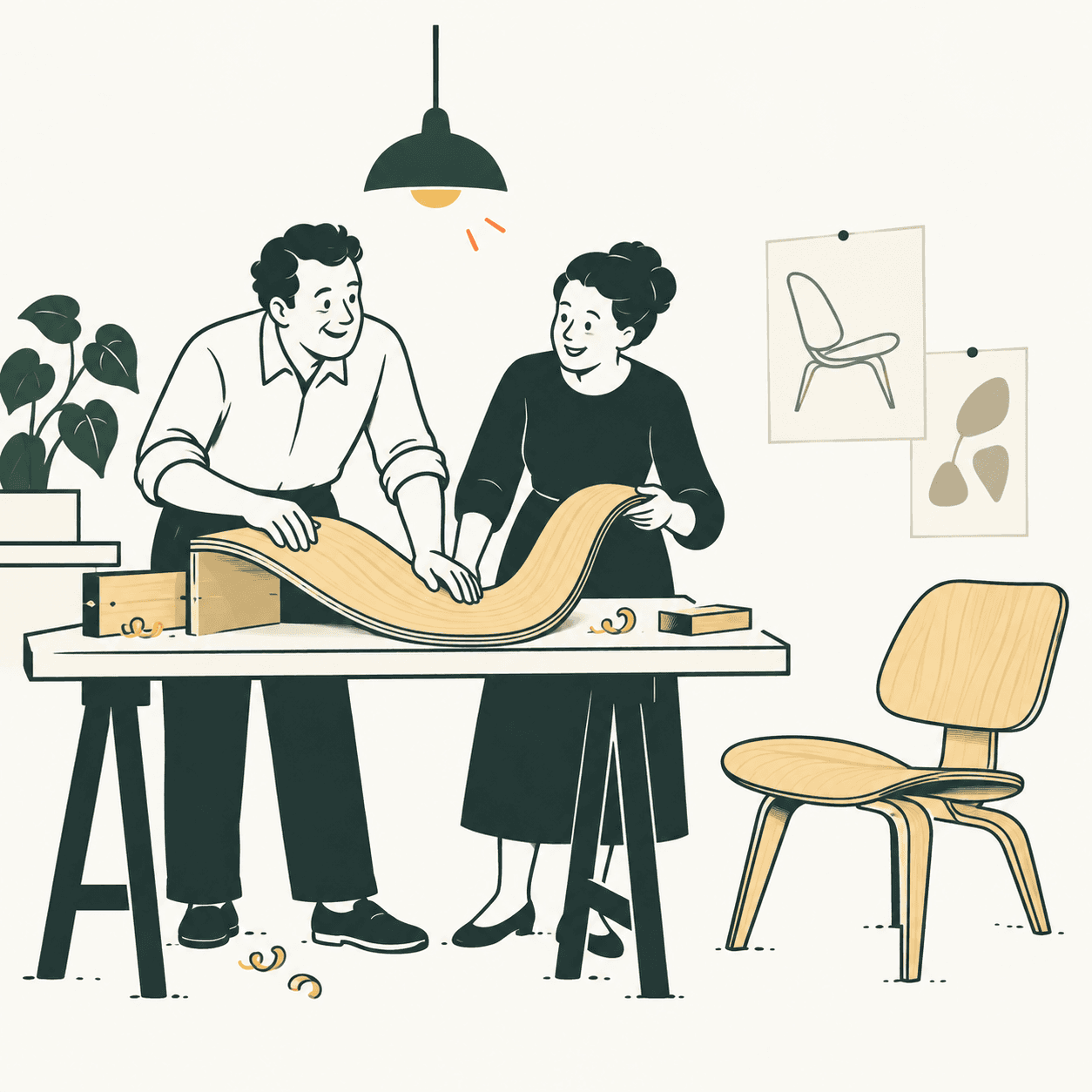
A chair can begin with a problem quite different from sitting down. MoMA holds a moulded plywood leg splint credited to Charles and Ray Eames and dated 1942. Both names matter: this is a story of collaboration, rather than the solitary genius familiar from an advertising campaign. [1]
According to the Eames Office archive, during the war the pair investigated a support for injured legs that addressed problems with metal splints during transport. Plywood could bring the support closer to the body’s shape. They were exploring what a material could do in response to a practical need. [2]
Openings in the wood relieved bending stresses and let bandages pass through. Evans Products enabled production to expand. A design had to be manufacturable, as well as convincing on a workbench: our reading of that transition is that the practical possibility of making an object belonged within the design itself. [2]
In their chair experiments, the Eameses wanted a single plywood shell with complex curves. Tests kept revealing the material’s limits: achieving the shape required splits. Insisting on the ideal silhouette did not solve that difficulty. Progress came through changing the question they were asking of the wood. [3]
The DCW separated seat and back instead of forcing them into one piece. Eames Office dates the resulting design to 1945 and its public availability to 1946. That distinction reminds us that designing an object and bringing it to people are connected stages, but they are different ones. [3]
The splint’s dates also deserve care: the museum gives 1942, while the Eames Office entry is headed 1943 and describes research begun the previous year. We retain the museum object’s date without treating it as a complete invention timeline. Catalogue labels are evidence to compare, rather than a race to be first. [1][2]
An editorial example: imagine a pen holder intended for both long pencils and small paper clips. If one compartment makes them awkward to retrieve, dividing it is not surrender. It means paying attention to use. The colleague proposing two compartments may understand the problem better than the one presenting a spectacular rendering. [3]
Our reading is that tests, constraints and people come before the memorable shape. The pen holder is not an Eames design, and the illustration does not reproduce a historical prototype. Both invite us to examine an everyday object and ask which difficulty it solved, and which it merely concealed beneath an elegant surface. [2]
Take this with youChoose an awkward object and identify one action to improve. Before adding anything, try changing the relationship between its existing parts.
Read the sources (3)
- Charles Eames, Ray Eames. Leg Splint. 1942 The Museum of Modern Art · accessed 16 Sept 2026
- Molded Plywood Leg Splint Eames Office · accessed 16 Sept 2026
- DCW Eames Office · accessed 16 Sept 2026
Original writing and illustration made with AI assistance. Our editorial method
More in Design