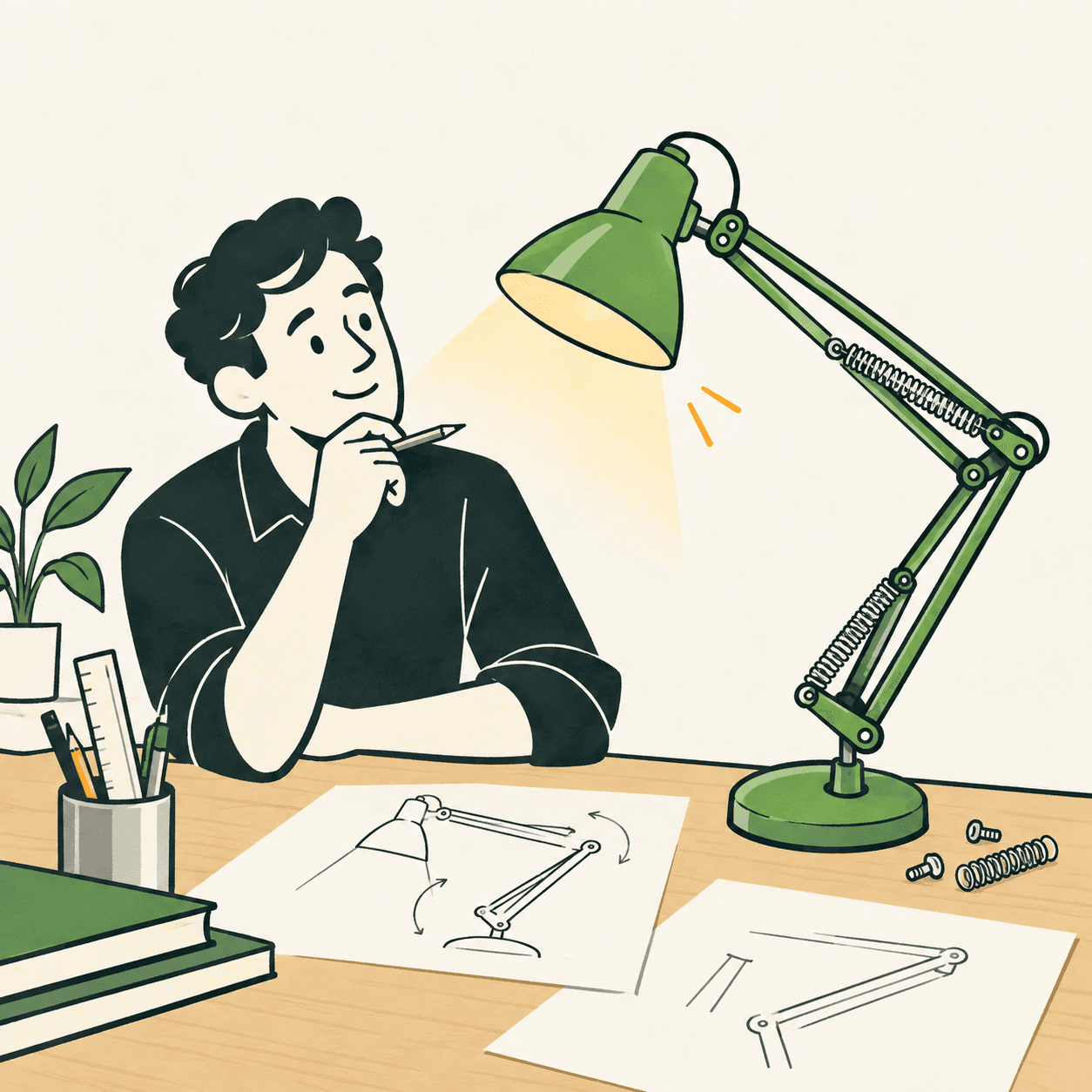
George Carwardine came to lamp design through a seemingly distant occupation: automotive engineering. The Design Museum connects his experience with vehicle suspension to his work on springs and levers. In 1932 he patented the mechanism that would lead to Anglepoise. The interesting problem was not simply moving a light, but making it stay in the position someone had chosen. [1]
The principle brings together parts with different jobs. Springs help balance the moving arms; a heavy base provides stability; the shade directs the light. The Design Museum describes an adjustment mechanism that avoids repeatedly clamping the joints into place. Movement and a steady position are therefore parts of the same design, rather than separate questions to answer later. [2][3]
An editorial example: imagine a desk with a notebook near the edge and a model farther back. Draw the lamp above the notebook, then above the model, without moving its base. Use different colours to mark what moves and what stays still. This exercise does not calculate forces. It makes the question that the mechanism answers easier to see. [1][2]
Anglepoise’s company history records the three-spring Original 1227 model in 1935. That is a specific historical reference, not a promise that every spring lamp works in exactly the same way. Our illustration evokes the principle of an articulated lamp. It is neither a technical drawing of the patent nor a plan for constructing an electrical appliance at home. [3]
A second editorial example: write a tiny design brief saying, “I need to read here and draw over there.” Add three requirements: reach both places, hold a position and leave room for the objects. Suggest different solutions on paper and ask which requirement each one meets. There is no need to choose a winner immediately: a convenient solution in one place might become awkward in another. Compare the decisions, rather than the brand. [2]
Our suggested observation exercise is to describe an adjustable object using verbs instead of adjectives. Does it bend, support or point? What should happen after someone moves it? Return to Carwardine’s lamp and connect a verb to each documented part of its mechanism. This is our way of reading the design, not a quotation attributed to its designer or a measurement of the lamp’s performance. [1][3]
Take this with youThe discovery to remember: designing a movable lamp also means deciding how it will stay where it is needed.
One idea, in simple words
A lamp needs to light the right place. George Carwardine designed a mechanism with springs and moving arms. Springs are elastic parts: a force changes their shape, and they tend to return to their earlier shape. In this lamp they help balance the arms, allowing the light to move and remain in a chosen position. [1][3]
A heavy base helps keep things steady. The shade directs the light. Here is our editorial example: imagine reading a notebook, then looking at a model farther away. You want to move the light without rearranging the whole desk. Carwardine tackled a problem involving movement and balance. Our drawing shows the general idea; it does not explain how to build a real lamp. [2]
A little discovery to keep
What did you discover?
Read the sources (3)
- Anglepoise Design Museum · accessed 1 Oct 2026
- Anglepoise, under the spotlight Design Museum · accessed 1 Oct 2026
- Our History Anglepoise · accessed 1 Oct 2026
Original writing and illustration made with AI assistance. Our editorial method
More in Design