A pleat can look like a finishing touch before leaving the house. In Issey Miyake’s work, it becomes a decision that organises the whole garment. The Metropolitan Museum holds a dress from around 1993 associated with this research. The interesting question is not only how it looks, but when the fabric receives its folds. Looking closely means asking how something was made before asking whose body it might suit. [1]
The process described by the museum begins with a garment already cut and sewn, larger than the intended result. Pleating comes afterwards, set with heat between layers of paper. This reverses the sequence of making clothing from fabric that has already been pleated. The central discovery is that changed order: sew first, then transform the garment’s surface and dimensions. Starting proportions depend on the design, rather than following a single universal recipe. [1][2]
Pleats Please, the line launched in 1993, does not represent all of Miyake’s investigations into folds. The FIDM Museum documents silk trousers from 1987–1989 whose pleats arise through construction. Comparing them with later industrially treated synthetic materials avoids a shortcut: calling everything “pleated” and overlooking differences between stitching, fibre and treatment. One everyday word can conceal very different processes, as well as very different visual results when a garment is worn. [3]
A two-piece outfit held by the Uffizi, dated around 1993, brings the discussion back to a concrete object: a high-necked top and a long pleated skirt. There is no need to imagine a spectacular runway. Repeated folds run through two recognisable garments and change how their surfaces can be read. It is an opportunity to distinguish designing an outline from designing the material that gives that outline movement and physical presence. [4]
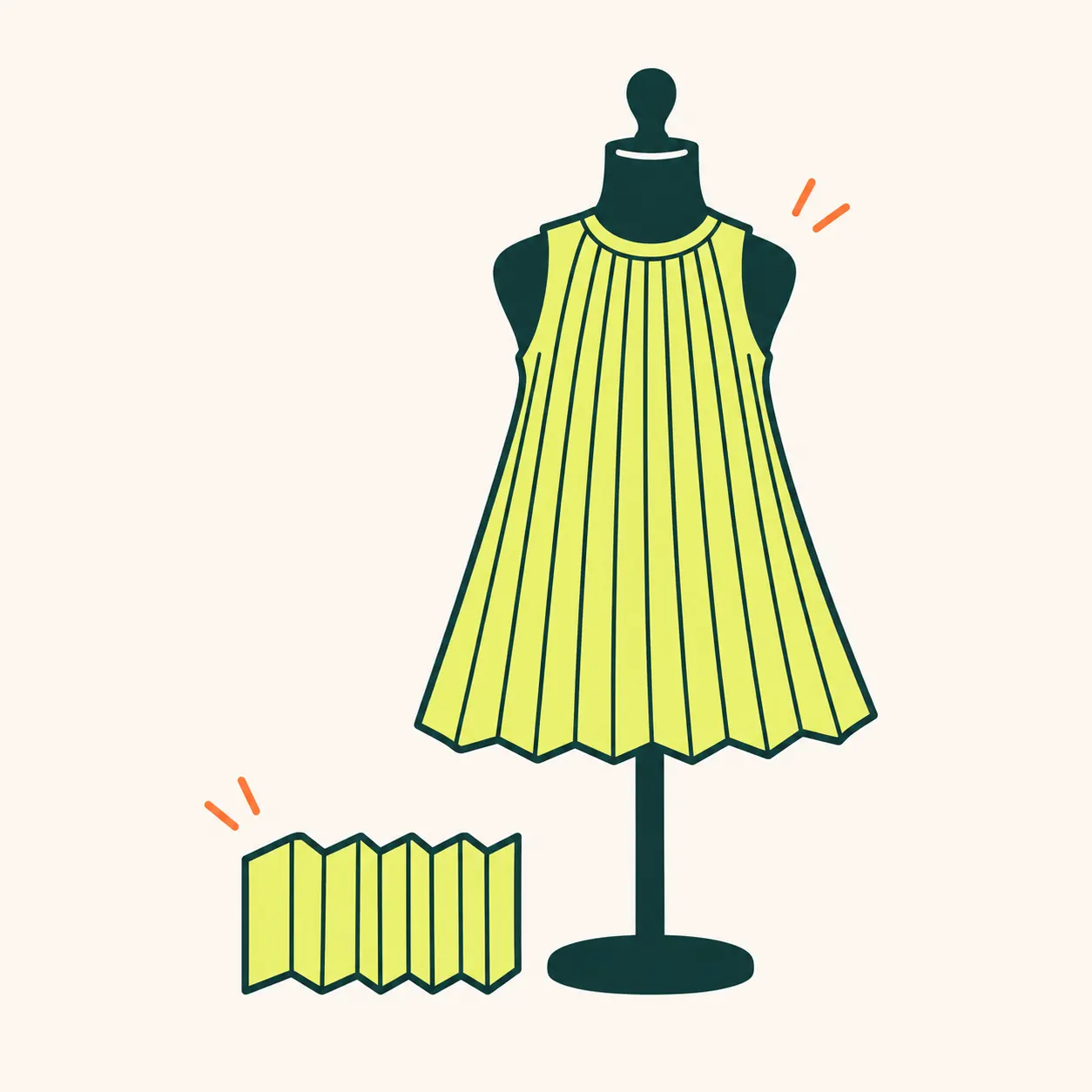
Here is an editorial comparison, rather than an account of industrial manufacture: fold a sheet of paper into an accordion, put it down, then gently open it. The same amount of paper occupies different widths. That small gesture helps us notice an opening structure; it reproduces neither polyester’s behaviour nor Miyake’s process. The Philadelphia Museum’s “Origami Pleats” dress, from 1989, supplies a documented example of the relationship between folding and a wearable form. [2]
The work suggests a useful question beyond the wardrobe: are we adding an effect at the end, or changing the process that creates the object? This is our interpretation, not a saying attributed to the designer. Next time you see a pleat, notice where it begins, how it continues and what happens when the garment moves. A detail can be the organising principle of the whole, rather than an isolated decorative decision. [1][3]
Take this with youNotice the sequence of actions: changing when a fold is made can change the whole design of a garment.
One idea, in simple words
Issey Miyake was a clothing designer. In some of his designs, a garment is first cut and sewn larger than needed. Many folds are then made and set with heat. This process is called garment pleating. The special feature is its order: sewing comes first and pleating afterwards. The Metropolitan Museum describes the technique in a dress from around 1993. However, Miyake’s pleats were not all made in the same way. Some earlier silk trousers have folds made through sewing. For a simple comparison, think of paper folded into an accordion: it takes up more space when opened. This is just a way to understand a changing shape. Paper does not behave exactly like fabric that has been specially treated. [1][2][3][4]
A little discovery to keep
What did you discover?
Read the sources (4)
- Dress, Issey Miyake, ca. 1993, 2015.227 The Metropolitan Museum of Art · accessed 11 Nov 2026
- Woman’s Origami Pleats Dress, Spring/Summer 1989 Philadelphia Museum of Art · accessed 11 Nov 2026
- Issey Miyake’s early pleats ASU FIDM Museum · accessed 11 Nov 2026
- Two-piece suit, Issey Miyake, c. 1993 Gallerie degli Uffizi · accessed 11 Nov 2026
Original writing and illustration made with AI assistance. Our editorial method
More in Design