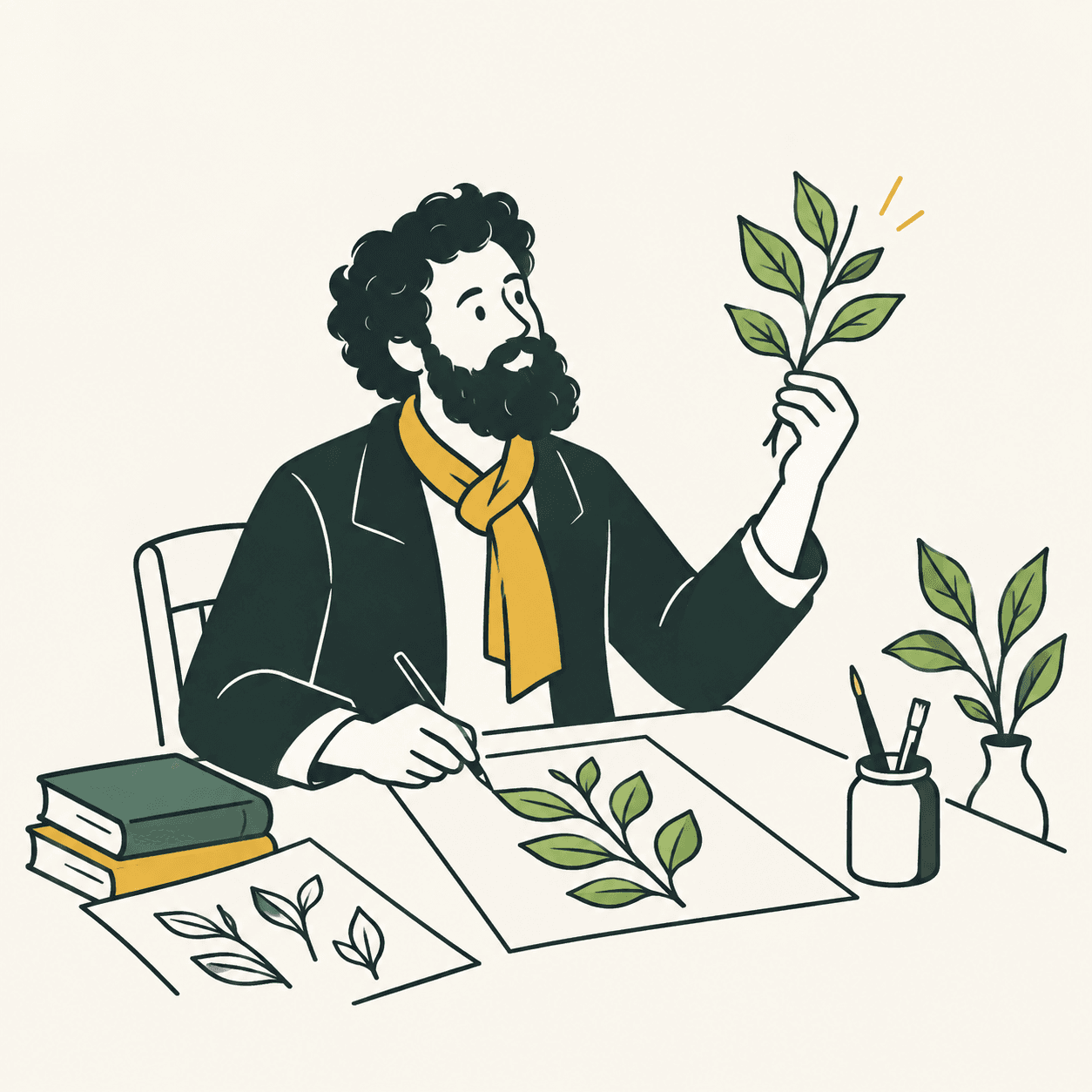
William Morris observed plants without simply copying them. In his wallpapers, natural forms became stylised motifs: shapes simplified and arranged into designs. The Victoria and Albert Museum stresses this difference between close observation and literal reproduction. [1]
Technique mattered too. Morris’s textile work involved embroidery, dyeing and printing, with contributions from collaborators and family members including Jane and May Morris. A designer’s name on an object does not, by itself, identify everyone needed to make it. [2]
In the William Morris Gallery’s teaching material, a preparatory drawing for Trellis retains pencil revisions. Repeating designs need planning so that motifs continue between neighbouring sections. An apparently effortless result can therefore involve carefully considered corrections. [3]
Here is an experiment invented by our editors, without copying one of his patterns. Imagine a page for a walking journal. Choose just one feature of a leaf you have observed: its curve, its point, or the relationship between broad and narrow parts. Now invent a mark that recalls that feature without claiming to identify the plant. Write down what you kept and what you left out. Making that choice, rather than achieving a perfect likeness, is the centre of our exercise. [1]
Continue our editorial workshop by placing three marks on the page, then changing only the distance between them. In a second version, rotate the middle mark. Which arrangement would you choose for a quiet cover? Which for an energetic page? We are not seeking Morris’s answer or a rule that works for everyone: we are asking you to explain a decision. If a classmate reads the design differently, record the difference instead of correcting their taste. It might suggest a third solution. [3]
One final invented situation: the group chooses a design, but the person printing it notices a detail that is too small. Stopping to listen does not spoil the idea; it opens a discussion about making it. Our final label therefore has three lines: who suggested the shape, who tested it and who made it. This is an educational choice by our editors, not a historical label from Morris’s workshops. It invites us to consider both design and labour, without turning a famous name into somebody who did everything. [2]
Take this with youObserve, choose a detail and transform it deliberately. Then explain your choices and acknowledge those who help you make them real. Even a small pattern can start a substantial conversation.
One idea, in simple words
William Morris designed patterns for wallpapers and fabrics. He looked at plants, then changed their shapes. Stylising means simplifying and arranging a shape, instead of copying every detail exactly. [3]
His preparatory drawings also show corrections. A continuing pattern needs thought about how neighbouring parts meet. The work involved several people, too. Here is an exercise invented by our editors: look at a leaf and choose just one curve. Use it to invent a new mark in your notebook. Put three marks together, then move them further apart. Which page do you prefer? Explain why to a friend and listen to their answer. You are not copying Morris: you are practising a design decision. [3][2]
A little discovery to keep
What did you discover?
Read the sources (3)
- William Morris and wallpaper design Victoria and Albert Museum · accessed 26 Sept 2026
- William Morris textiles Victoria and Albert Museum · accessed 26 Sept 2026
- Inspiration from Nature — Activity Sheet Teachers’ Notes William Morris Gallery · accessed 26 Sept 2026
Original writing and illustration made with AI assistance. Our editorial method
More in Design