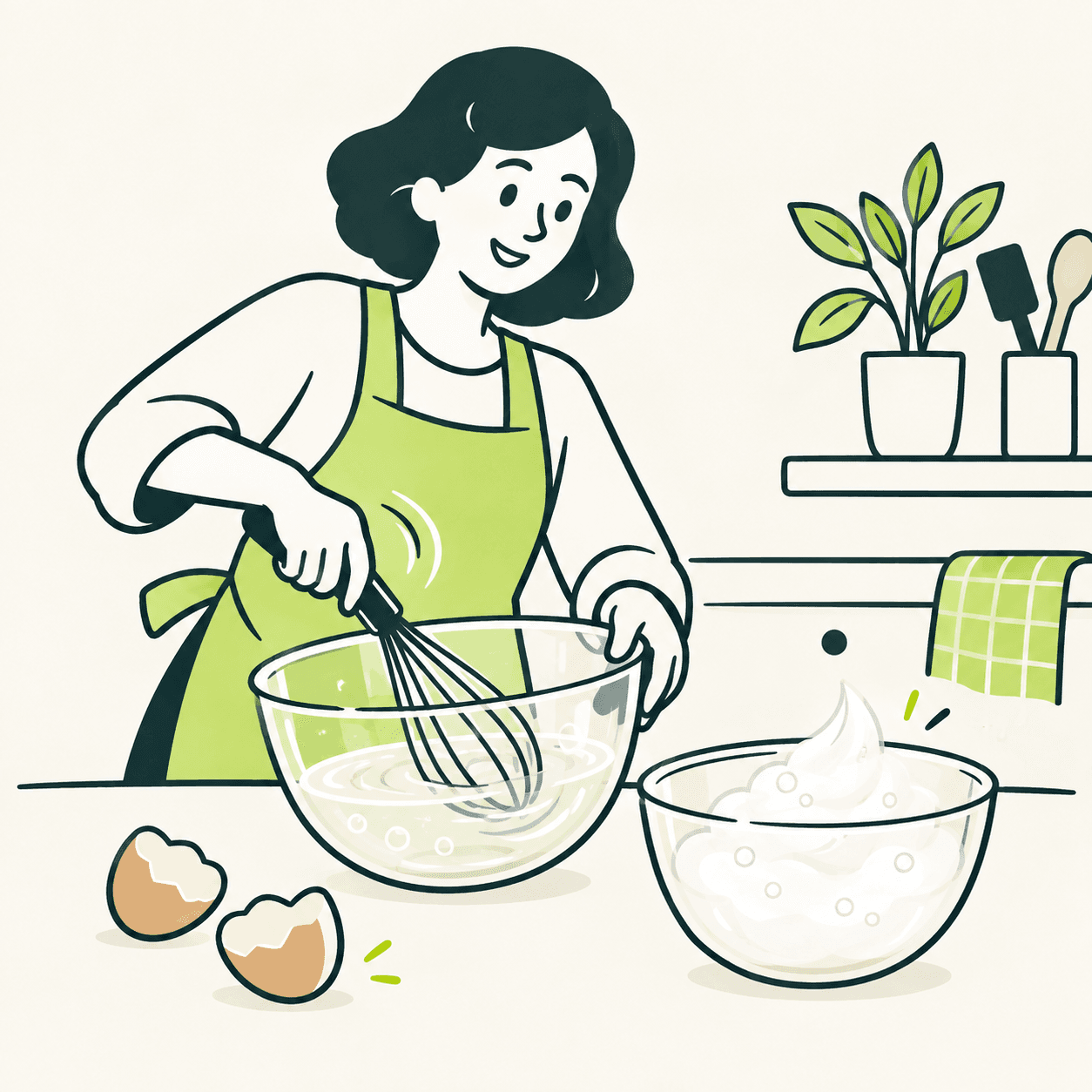
How can a little egg white turn into a mountain of foam? A whisk introduces air into the liquid, but bubbles alone do not explain everything. Egg-white proteins change their arrangement and form a network that helps retain those bubbles. The Exploratorium describes this cooperation between air, water and proteins. Volume increases without the whisk manufacturing extra egg white: an ingredient we cannot see, air, has entered the mixture and become part of its structure. [1]
A protein is a long chain of smaller components called amino acids, folded into a particular shape. In egg white, some parts of that protein interact well with water and others less readily. When whipping brings a protein close to a bubble, its shape can open and rearrange itself between air and water. “Denaturation” names this structural change: it does not automatically mean the food has spoiled or that all its components have disappeared. [2]
The rearranged proteins can link together around the bubbles. Imagine a very thin network, rather than rubber balloons hidden inside the egg. That is a metaphor to help explain the result; the scientific description concerns molecules and bonds. Foam is therefore a structure: gas distributed within material surrounding it. Asking “where is the air?” becomes more useful than imagining that the egg white has somehow multiplied while the whisk moved through the bowl. [2]
Heat introduces another stage. The Exploratorium explains that bubbles expand as their gas warms, while the protein network can become firmer during cooking. Whipping and cooking are not interchangeable words, however: the first introduces air and changes the arrangement of proteins; the second further alters the structure. The final texture depends on how the process is carried out, rather than merely on having egg somewhere in the list of ingredients. [1]
Here is a model invented by our editors to make on paper. Draw a bowl with a few lines representing liquid; beside it, draw the same bowl containing many small circles enclosed in a network. Add a key to distinguish air from the liquid part. Now ask a classmate where the extra volume has appeared. If they answer “in the bubbles”, the drawing has explained something. If they think each circle represents an egg, the key needs improving. [1]
Our model is not a recipe and does not show molecules to scale. A real preparation needs suitable ingredients, proportions and cooking, while we are isolating one mechanism. Whipped egg white provides a useful reminder: describing food also means considering how its components are organised. Two preparations containing similar ingredients can look and feel different because the transformations matter as much as the list printed on a packet or written in a kitchen notebook. [1]
Take this with youNext time you describe a texture, ask what it contains and how those parts are arranged. In foam, air is part of the answer.
One idea, in simple words
Whipping egg white with a whisk introduces air. Egg white is the clear part of a raw egg. It contains water and proteins: tiny structures made from long, folded chains. During whipping, proteins change shape and link together around air bubbles. This helps keep the bubbles inside the foam. [2]
The whisk does not produce extra egg white. The volume increases because many bubbles have entered it. Here is something to draw: a bowl of liquid, then the same bowl full of small circles representing air. It is a simple model, not a photograph of molecules. Cooking can make the protein network firmer. Whipping and cooking are therefore different steps, even though both change the structure of the egg white. [1]
A little discovery to keep
What did you discover?
Read the sources (2)
- Science of Eggs: Egg Science Exploratorium · accessed 27 Sept 2026
- When you beat egg whites, does denaturation occur? Exploratorium · The Inquisitive Cooks · accessed 27 Sept 2026
Original writing and illustration made with AI assistance. Our editorial method
More in Food