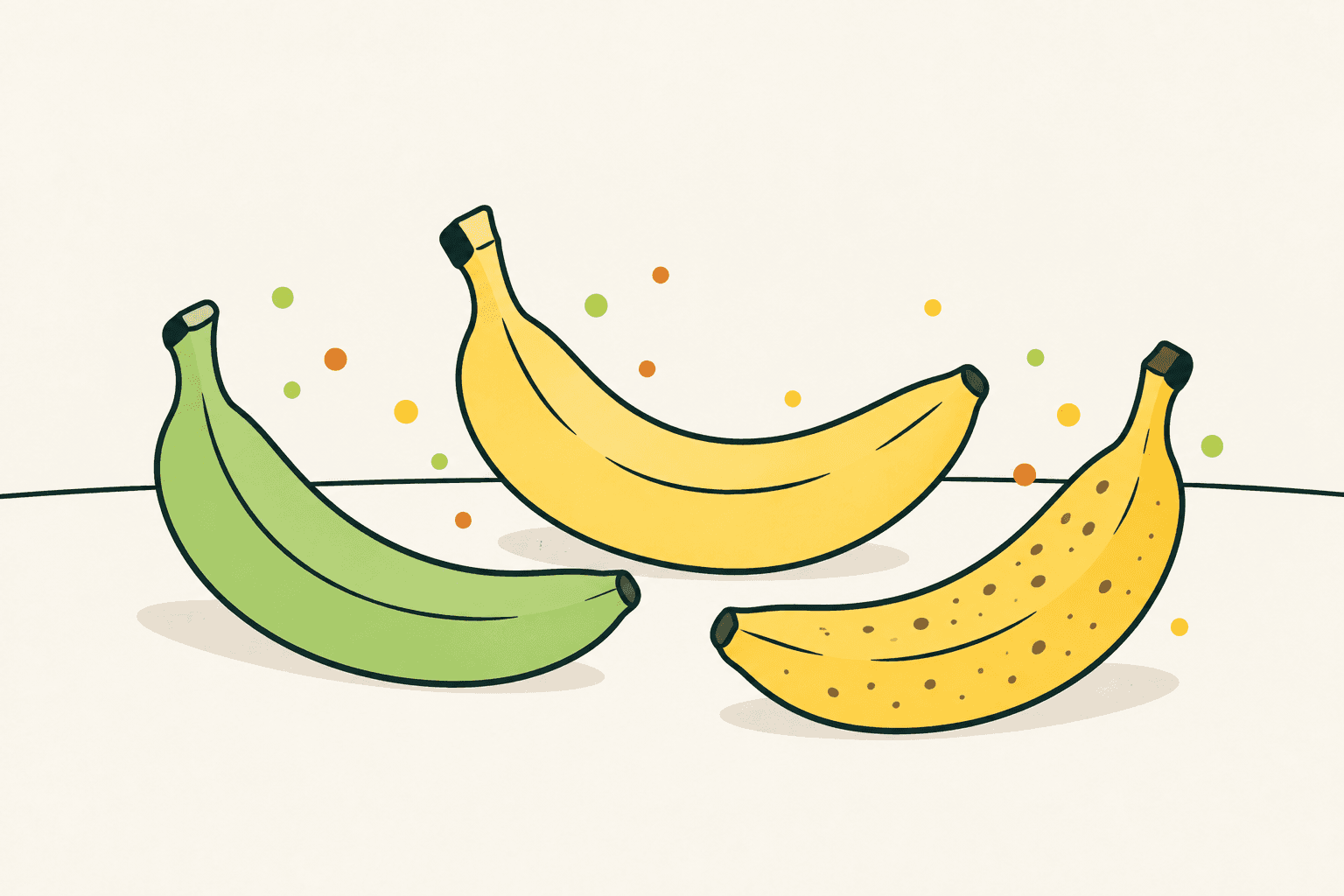
A banana on the table has not necessarily finished changing. The University of California, Davis fact sheet describes commercial Cavendish bananas harvested mature but still green, then ripened for eating. During the process, some starch is converted into sugars. That opens the question behind this discovery: how can a fruit continue transforming when it is no longer attached to the plant that produced it? [1]
Diane Beckles’s plant physiology laboratory at the same university explains that freshly harvested produce remains biologically active. It is not a collection of motionless objects. One signal involved in ripening is ethylene, a gaseous plant hormone: a messenger that helps regulate the process. Calling it a messenger is a useful simplification, provided we do not imagine fruit reading a note or consciously deciding when it wants to become sweet. [2]
Postharvest expert Adel Kader explains that bananas responding to ethylene change in colour, texture and aroma, alongside the conversion of starch. The fruit’s temperature affects the process. Yellow, soft and fragrant are therefore not three names for the same property: they are different clues. To learn how to observe, it helps to distinguish them instead of gathering every change into one word and leaving the explanation there. [3]
Here is a small diary suggested by our editors, with no treatments or laboratory procedures. Photograph a banana intended for ordinary eating over a few days, under similar lighting each time. Add the date and describe only what you see: overall colour, darker areas, differences from the previous picture. If you cannot explain a mark, write open question. The diary does not require tasting questionable fruit, and cannot establish on its own whether food is safe to eat. [1]
Add two columns: observation and possible explanation. In the first, you might write that the peel looks yellower; in the second, that its stage of ripeness might have changed. In our example, we have measured neither sugars nor the amount of ethylene. Keeping the columns separate stops us presenting an impression as chemical analysis. We can also compare photographs taken under different lighting and ask how much of the apparent change belongs to the light. [3]
One banana observed in a kitchen cannot represent every variety, journey or storage condition. The university sources distinguish many factors in handling produce after harvest; our diary records very few of them. Its value is in practising a question: which transformation am I actually observing, and which am I only imagining? The discovery to bring to the table is that ripening is a process, rather than a switch that suddenly flips from completely off to completely on. [2]
Take this with youTry describing a fruit with separate words for colour, texture and smell. Better observation starts by keeping different clues distinct.
One idea, in simple words
A banana can continue ripening after harvest. As it changes, some starch, a substance inside the fruit, turns into sugars. This contributes to its sweet taste. Ripening is not only a change in the colour of the peel. [1]
Ethylene is a gas that acts as a messenger in plants and helps regulate ripening. Texture and smell can change too. Here is an example from our editors: photograph a banana on different days and note its colour. We may see a difference, but the picture does not measure how much sugar is inside. Write down what you observe separately from what you think explains it. Our diary helps us ask questions; it does not determine whether fruit is safe to eat. [2][3]
A little discovery to keep
What did you discover?
Read the sources (3)
- Banana: Produce Facts University of California, Davis · Postharvest Research and Extension Center · accessed 29 Sept 2026
- Postharvest FAQs University of California, Davis · Diane Beckles Lab · accessed 29 Sept 2026
- Do bananas respond to ethylene when they are below 16 deg C? University of California, Davis · Postharvest Research and Extension Center · accessed 29 Sept 2026
Original writing and illustration made with AI assistance. Our editorial method
More in Food