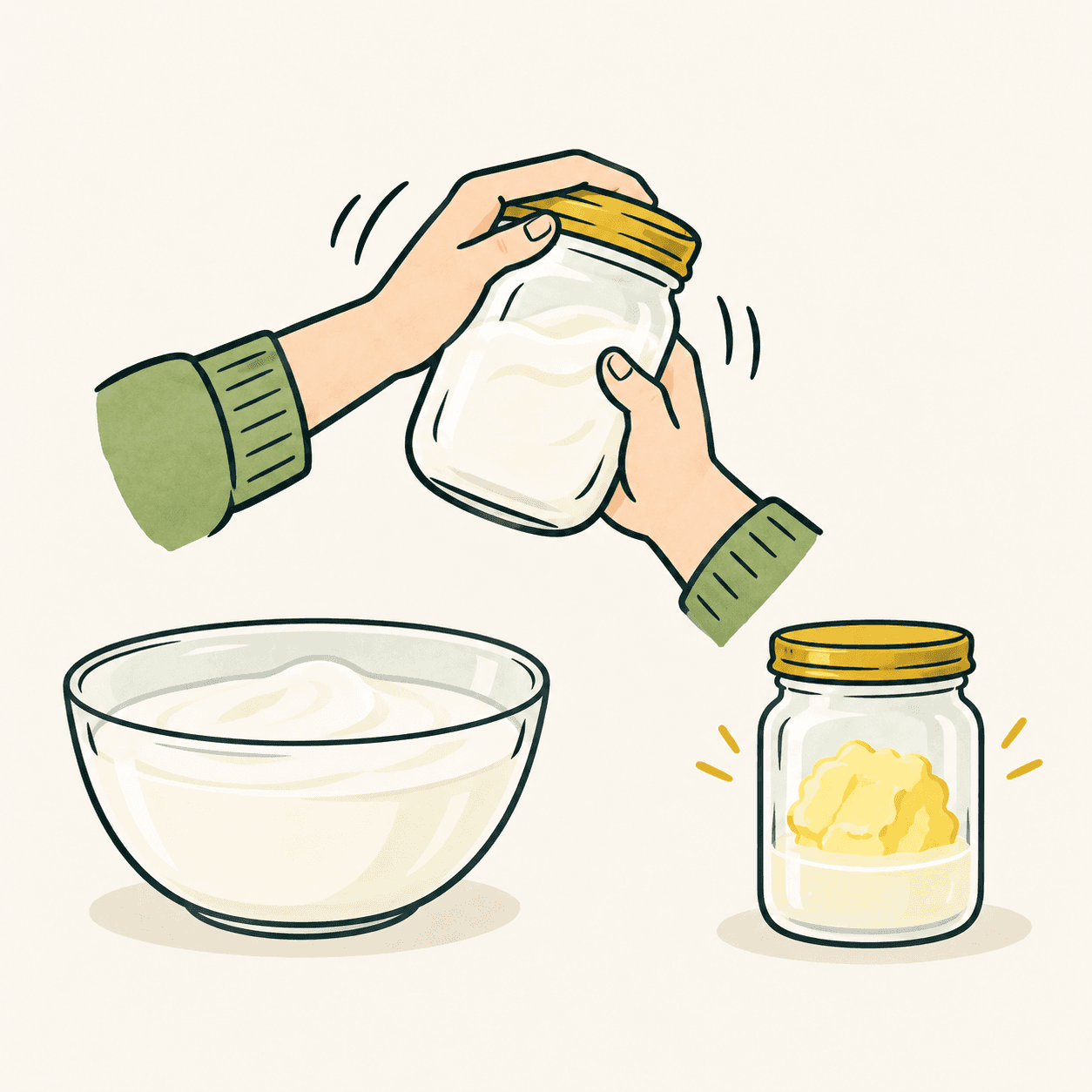
Cream and butter are not simply the same material in a different shape. The Exploratorium’s explanation starts with small fat droplets dispersed in cream’s watery part. Enough agitation disrupts the protection keeping them apart and encourages them to join. Clusters of fat form while some liquid separates: the change concerns how the ingredients are organised, rather than the appearance of a magical new ingredient. [1][3]
The University of Guelph’s dairy science textbook defines butter as a water-in-fat emulsion. An emulsion is a mixture with one liquid dispersed in another. In butter, fat forms the continuous part surrounding small amounts of water. That does not mean the water has vanished, or that the result is a block of pure fat. What mainly changes is what surrounds what. [2]
Science Buddies also describes a recognisable intermediate stage: whipped cream, where air and fat contribute to a foam’s structure. Continuing to agitate it leads to a different organisation. The educational point is not a contest to shake harder, but to distinguish the stages. We are not providing a recipe or storage times here: this is a physical explanation, without instructions for leaving food at room temperature. [3]
Our editorial model: scatter separate yellow circles over a blue sheet. On a second, yellow sheet, draw small blue circles. Decide that yellow represents fat and blue represents water. These colours are drawing conventions, not the colours of droplets seen through a microscope. Comparing the sheets helps name what surrounds and what is dispersed, but it does not reproduce membranes, air or fat crystals. [2][1]
An editorial example: someone looks at the sheets and says, “The water disappeared.” Ask them to point to the blue circles in the second model. Someone else says, “A secret ingredient was added.” Return to the first sheet’s labels. These invented responses help us check what the picture actually shows. They cannot prove the real process by themselves: that requires the sources’ explanation, not the confidence with which we point at a colour. [2]
Finally, prepare a short editorial caption describing the change without promising too much. Try “previously separate fat gathers into a different structure”, adding an arrow towards the separated liquid. Avoid “cream becomes a better food” or “any shaken liquid turns into butter”: neither conclusion follows from this discovery. The curiosity concerns a mixture’s structure, not a ranking of foods or a universal rule for everything that happens in a kitchen. [1][3]
Take this with youRemember: making butter reorganises fat and water; separating some liquid does not mean removing every trace of water.
One idea, in simple words
In cream, tiny fat droplets are separated within a watery part. With enough agitation, they can join into larger groups and some liquid separates. This is how butter forms. No magical ingredient appears: what changes is the way the different parts are arranged together. [3]
In butter, fat surrounds small amounts of water. Try a model invented by our editors: draw yellow circles on blue paper, then blue circles on yellow paper. Let yellow stand for fat and blue for water. The colours help explain what surrounds what, but they are not a photograph of real droplets. Butter still contains water, so saying that every bit of water has disappeared would be incorrect. [2]
A little discovery to keep
What did you discover?
Read the sources (3)
- What's really happening when you churn butter? Exploratorium — Science of Cooking · accessed 1 Oct 2026
- Butter Manufacture University of Guelph — Dairy Science and Technology eBook · accessed 1 Oct 2026
- Shaking for Butter Science Buddies · accessed 1 Oct 2026
Original writing and illustration made with AI assistance. Our editorial method
More in Food