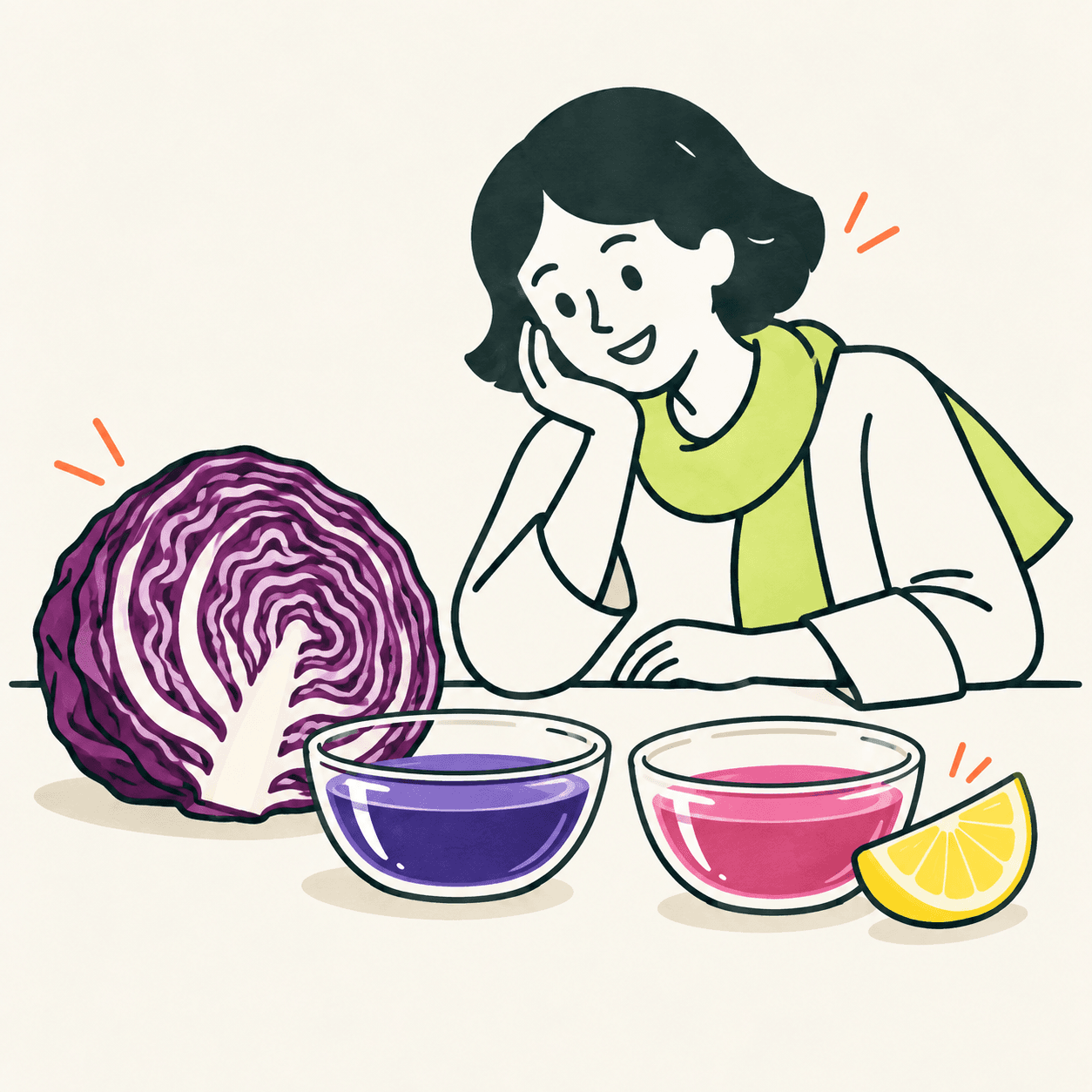
Red cabbage can look purple, and its colour does not always stay the same. The American Chemical Society explains that it contains anthocyanins: pigments whose structure changes with the acidity of their surroundings. An acidic substance such as lemon juice can turn liquid made from cabbage pink or red. Here is the central discovery: a colour can tell us something about a pigment’s surroundings, rather than simply decorate a plate. [1]
The Royal Horticultural Society suggests using this liquid as an indicator. An indicator makes a difference visible: here, it helps distinguish acidic, neutral and alkaline conditions. The pH scale describes this characteristic. However, comparing colours is not automatically the same as taking a precise measurement. Interpreting the result well requires reference points and controlled conditions. Looking at a shade without comparisons is not enough to assign it a reliable number. [2]
Pigment research can go far beyond a demonstration. In 2021, the University of California, Davis reported a study of a blue pigment present in small quantities in red cabbage and an enzymatic method for making more of it. An enzyme is a substance that helps a reaction happen. This was a laboratory finding from that year, not news announced today or a recipe recreated by adding lemon in the kitchen. [3]
For a simple observation, our editors imagine two labelled glasses prepared with an adult: one containing cabbage liquid and another with a small addition of lemon. First, draw the colour you expect; then compare what you see. Liquids used for the activity are not for drinking. Cleaning products are unnecessary. The point is to observe a difference, not to test unknown substances or turn the kitchen into a chemical guessing game. [1]
We can add a third space to our notebook: what we still do not know. For example, we have not precisely measured pH, and cabbage colour cannot establish whether food is safe. Our editors suggest this question to separate observation from conclusion. An interesting demonstration does not answer everything. It becomes more useful when we clearly state what information it offers and which question remains open for another investigation. [2]
Finally, read the illustration as a map of the idea, not a scientific colour chart. The cut cabbage shows the ingredient; the containers beside it invite comparison. Our editors suggest writing a caption containing both a cause and a limit: colour can change with acidity, but the drawing gives no measurement. In this way, a kitchen curiosity becomes a chance to learn how to describe an experiment with honest words. [3]
Take this with youRed cabbage anthocyanins respond to acidity. Observing a colour gives us a useful clue; measuring it and deciding what it means take another step.
One idea, in simple words
Red cabbage contains anthocyanins. These are pigments, substances that give colour. Their appearance changes with acidity, a property of their surroundings. Lemon juice is acidic. Adding it to liquid made from cabbage can turn that liquid pink or red. [1]
To understand the idea, imagine two glasses prepared with an adult. One contains cabbage liquid; the other has lemon added. This is an example suggested by our editors. Compare the colours without drinking the activity liquids. You do not need cleaning products. Colour is a clue, not a precise measurement. On its own, it does not give a reliable number or tell you whether food is safe to eat. A useful discovery begins by recognising these limits too. [2]
A little discovery to keep
What did you discover?
Read the sources (3)
- Red Cabbage Indicator American Chemical Society · accessed 30 Sept 2026
- Red cabbage indicator Royal Horticultural Society · accessed 30 Sept 2026
- New Natural Blue Food Coloring University of California, Davis · accessed 30 Sept 2026
Original writing and illustration made with AI assistance. Our editorial method
More in Food