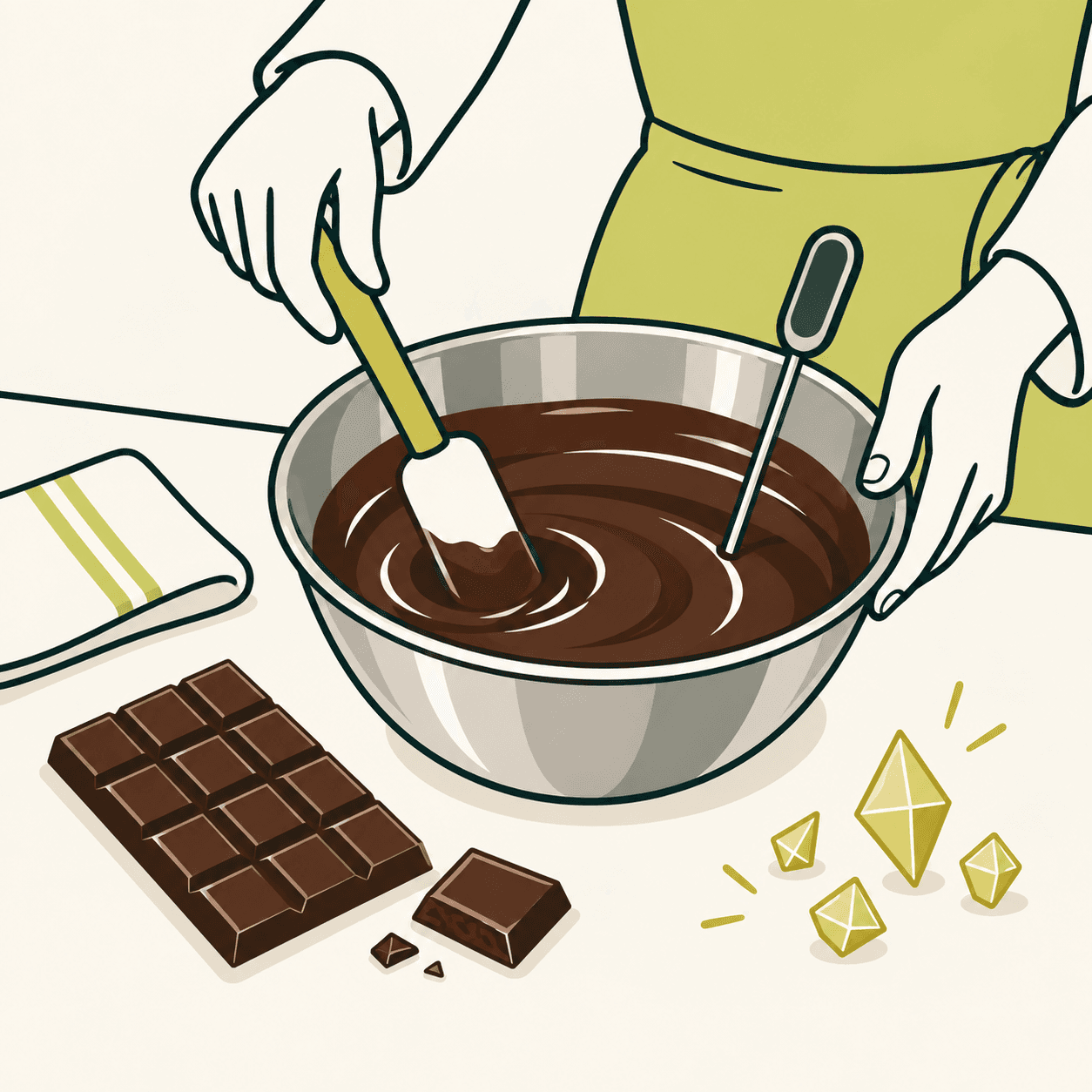
A glossy bar that breaks with a clean snap owes part of its character to structures too small to see with the naked eye. These are crystals in cocoa butter, the fatty component of chocolate. Tempering is a controlled temperature treatment that helps produce the desired structure. Purdue’s guide connects it with an even surface, texture and the way the finished chocolate behaves when it melts. [1]
A crystal does not have to look like a gemstone. Here the word describes an orderly arrangement of molecules. Cocoa butter can solidify into different crystal forms, so identical ingredients do not automatically guarantee identical results. The University of Leeds describes controlled heating and cooling cycles that encourage forms suited to the finished product. Simply leaving a bowl of melted chocolate to cool is therefore not always the same as tempering it well. [2]
Consider a comparison invented by our editors: the same building blocks scattered across a table or joined into a structure. The material stays the same, but its arrangement changes what you can do with it. This illustrates organisation, not the exact molecular structure of cocoa butter. Real processing involves temperature, movement and composition. A chocolate-maker does not select crystals with tweezers; they establish conditions that favour a particular arrangement. [2]
One method is called seeding: a quantity of properly tempered chocolate is added to melted chocolate. The University of Guelph describes this as a way to encourage the appropriate structure to form. Nobody plants a seed or grows a tree in the bowl. Existing small crystals provide a starting point for the process. The technical term borrows an image from plants to describe something happening in a very different material. [3]
An important limit is that temperatures depend on the formulation and method. Purdue specifies that its reference values concern dark chocolate without added milk fat or other fats. We should not turn one table into an identical rule for every bar. Storage matters too: temperature fluctuations can alter the structure previously achieved. This explains food processing; it is not a way to judge food safety solely by looking at the surface. [1]
An editorial activity requiring no stove: inspect two pieces of chocolate and note their gloss, colour and fracture. Then ask what information is missing, such as recipe, temperature and storage history. Looking alone cannot attribute every difference to tempering. Scientific curiosity begins when a sensation, such as “this one breaks differently”, becomes a question we can investigate. If children later try cooking experiments involving heat, they should work with an adult. [2][1]
Take this with youIngredients tell only part of the story. How matter is organised matters too: chocolate offers a small laboratory of structure, temperature and patience.
One idea, in simple words
Chocolate contains cocoa butter, a fatty substance. As it becomes solid, its molecules can arrange themselves into crystals. A crystal is an orderly structure; it does not have to look like a gemstone. Changing that arrangement can change how glossy chocolate looks or how it breaks. [1]
Tempering controls heating and cooling to encourage the desired structure. Here is a comparison from our editors: the same building blocks can form a loose pile or a joined construction. The material stays the same, but the arrangement changes. This is not an exact model of molecules. Working temperatures depend on the kind of chocolate, so one recipe does not fit every product. Observing is enough to understand the principle; experiments involving heat need an adult. [2][1]
A little discovery to keep
What did you discover?
Read the sources (3)
- Cocoa Processing: Tempering — FS-153-W Purdue Extension · Universidad Nacional Agraria La Molina · accessed 23 Sept 2026
- Bringing environmental and economic benefits to the chocolate industry University of Leeds · accessed 23 Sept 2026
- U of G Food Scientists Find Key to Perfectly Smooth Chocolate University of Guelph · accessed 23 Sept 2026
Original writing and illustration made with AI assistance. Our editorial method
More in Food