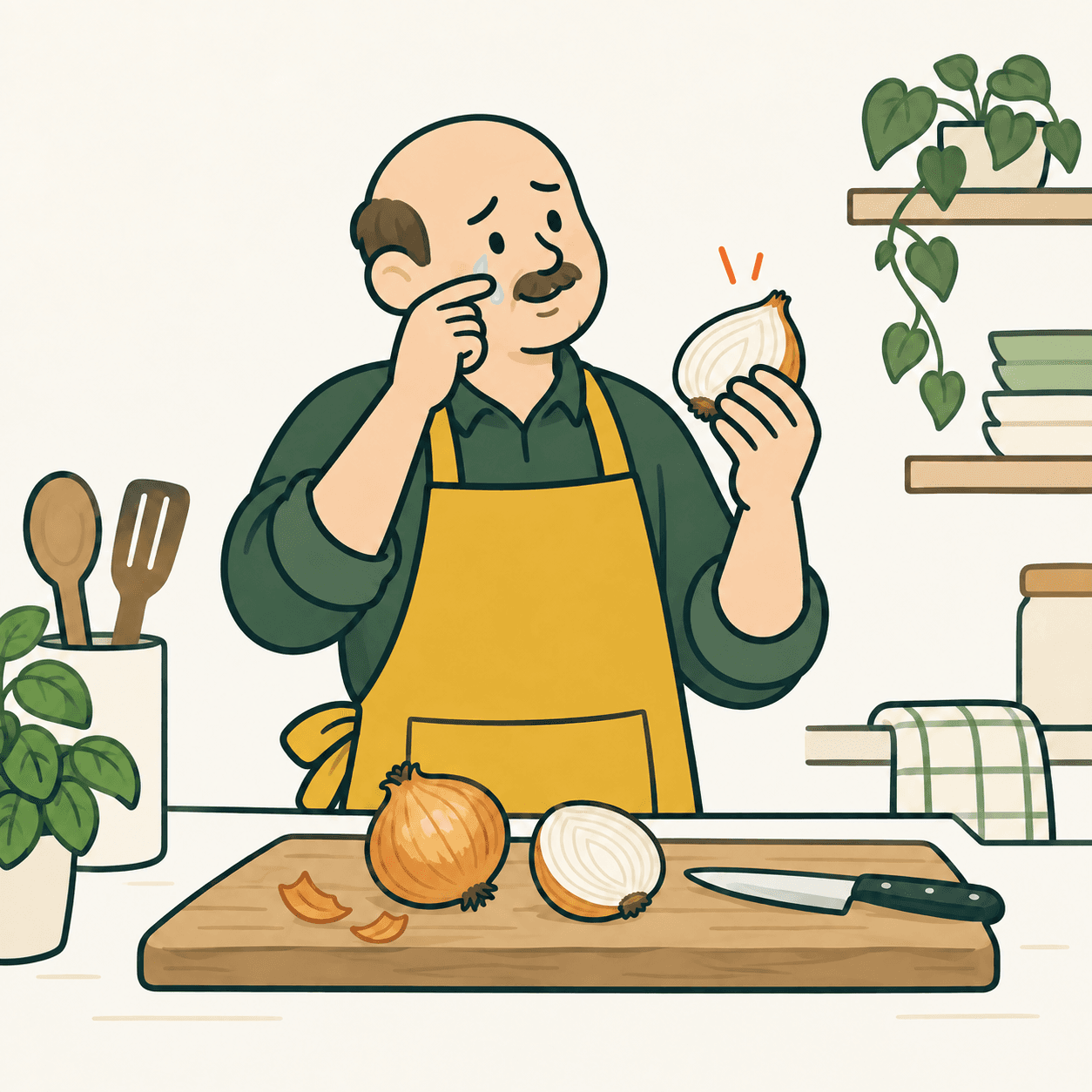
Cutting an onion breaks its cells and starts reactions that release volatile substances, meaning substances able to pass into the air. When the irritant reaches the eyes, it can stimulate the glands that produce tears. Mayo Clinic’s explanation follows this connection between cutting, the air and the eyes’ response. [1]
Draw the sequence as an editorial activity: first a whole onion, then an adult making a cut, and finally an eye some distance away. Use arrows to ask questions, not to draw liquid jumping from the board to somebody’s face. What changes when cutting begins? What can travel without being visible? There is no need to put your nose or eyes close to an onion. Our workshop takes place on paper. [1]
Cutting leads to the formation of the lachrymatory factor, the tear-producing compound. An enzyme, a protein that helps a chemical reaction, takes part in its formation. A 2017 ACS Chemical Biology study analysed the enzyme’s structure to clarify the reaction. [2]
Try an invented model using cards only. Write “cutting”, “change”, “air” and “tears” on four cards. Put them in order and explain the sequence in your own words. A card is not a cell, and arrows do not show the shape of molecules, the tiny units of substances. This model helps us remember a sequence. If someone asks which substance forms, we must return to the scientific explanation instead of inventing a name. Leave an empty space beside the cards for a reader’s question: which step would you like explained more clearly, and which drawing would help you? [2]
The American Chemical Society report explains that the irritant evaporates or breaks down easily. Studying the enzyme’s contact site with another compound helped researchers propose the mechanism. [2]
Our final editorial activity compares two sentences: “I see tears” and “this person is sad”. The first describes something observed; the second proposes an explanation that could be wrong in a kitchen. Invent a short dialogue in which we ask the person how they feel instead of deciding by looking. This is not a diagnosis and does not cover every reason for crying. It simply reminds us that a visible effect may call for one more question. [1]
Take this with youDraw the chain of events, then distinguish the event from your interpretation: a tear does not tell the entire story by itself.
One idea, in simple words
When you cut an onion, you break some cells, the small building blocks making up the plant. Chemical changes begin and an irritating substance passes into the air. If it reaches the eyes, it can make them produce tears. The person cutting is not necessarily sad. [1]
Here is our paper exercise. Draw four boxes: a whole onion, an onion cut by an adult, the air and the eyes. Join the boxes and explain what happens. Do not experiment by bringing an onion close to your face. Then invent a dialogue: someone sees tears and asks, “Are you sad?” The other person explains that they were preparing lunch. The dialogue helps distinguish what we see from an explanation we imagined too quickly. [1]
A little discovery to keep
What did you discover?
Read the sources (2)
- Mayo Clinic Minute: Why do onions make you cry? Mayo Clinic News Network · accessed 22 Sept 2026
- The nitty-gritty behind how onions make you cry American Chemical Society · accessed 22 Sept 2026
Original writing and illustration made with AI assistance. Our editorial method
More in Food