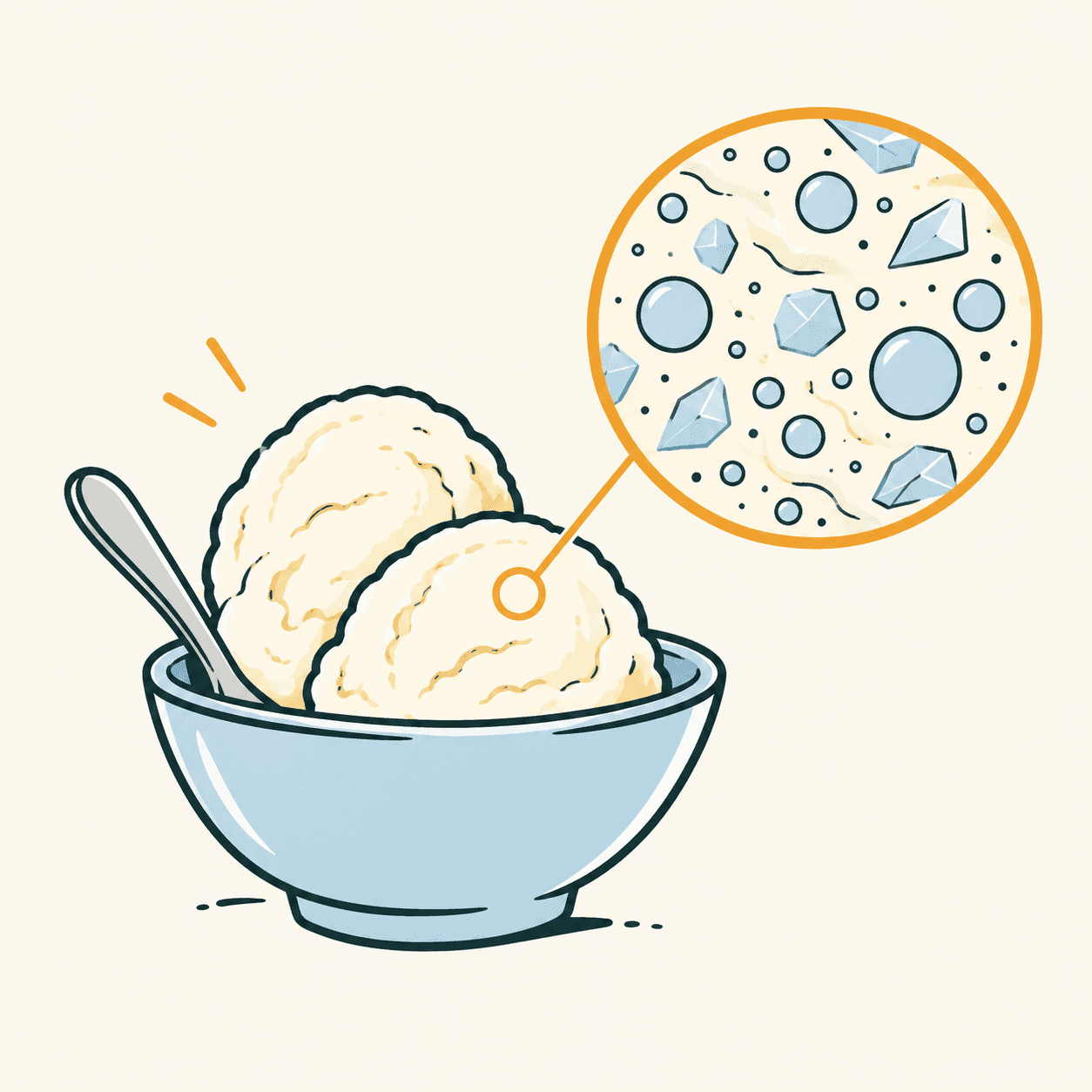
Air incorporated during manufacture contributes to ice cream’s lightness, explains the University of Guelph textbook. [1]
Utah State University’s teaching material presents a structure containing air bubbles, ice crystals and fat. Crystal size also affects how it feels in the mouth: larger crystals can make the texture less smooth. The different parts deserve separate attention. [2]
A University of Guelph interview with food scientist Douglas Goff highlights the product’s complexity. Ingredients, air and structure work together. Saying vanilla or chocolate identifies a flavour, but does not describe everything that makes two spoonfuls of ice cream different. [3]
Our editors suggest an invented example using paper and pencils. Draw two spoonfuls in the same colour. Label the first only with a flavour name; for the second, invent a small internal diagram with distinct symbols. Do not pretend to have a microscope: you are building a model to think with. Decide what each mark represents and write a key. A classmate should be able to understand the drawing without you whispering the answer. If they cannot, change the symbols before adding more details to the page. [2]
Continue our editorial activity with an imaginary comparison. Two characters taste two ice creams and choose different words: one says very dense, the other lighter. Their comments do not measure how much air is present. On our sheet, separate sensations from the measurements needed to explain the difference. We can write it seems to me and leave a question open. We are not ranking shops here: we are practising a more precise vocabulary that describes an experience without immediately turning it into a conclusion about the recipe. [1]
The drawing has a limit too. In our invented diagram, the parts are large, orderly and separate because we want to distinguish them. We are not promising that real ice cream looks like that. Add two lines at the bottom: what the model helps explain and what it does not show. This is an editorial reading activity, not a new laboratory analysis. When discussing food, this small agreement lets us be curious without assigning nutritional qualities, quantities or ingredients to a product we have not examined. [3]
Take this with youFlavour is only one possible question. Try describing texture too, while distinguishing what you feel, what you know from a source and what would require a measurement to find out.
One idea, in simple words
Ice cream also contains tiny air bubbles. During manufacture, the mixture is cooled and air can be incorporated. The bubbles contribute lightness: flavour is not the only thing that matters. [1]
There are ice crystals and fat too. Larger crystals can make it feel less smooth. These parts work together. Here is an exercise invented by our editors: draw a spoonful and an enlarged diagram beside it. Use different symbols for bubbles and crystals. Explain the symbols in a key. Also write that this is not a microscope photograph. A microscope is a tool that magnifies very small objects. Your drawing helps you ask questions about texture. On its own, it cannot tell you how much air is in a shop-bought ice cream. [2][3]
A little discovery to keep
What did you discover?
Read the sources (3)
- Freezing/Whipping of Ice Cream University of Guelph — H. Douglas Goff · accessed 26 Sept 2026
- CDE Ice Cream Science Station Utah State University · accessed 26 Sept 2026
- Ice Cream Stands the Test of Time, Food Science Prof Says University of Guelph · accessed 26 Sept 2026
Original writing and illustration made with AI assistance. Our editorial method
More in Food