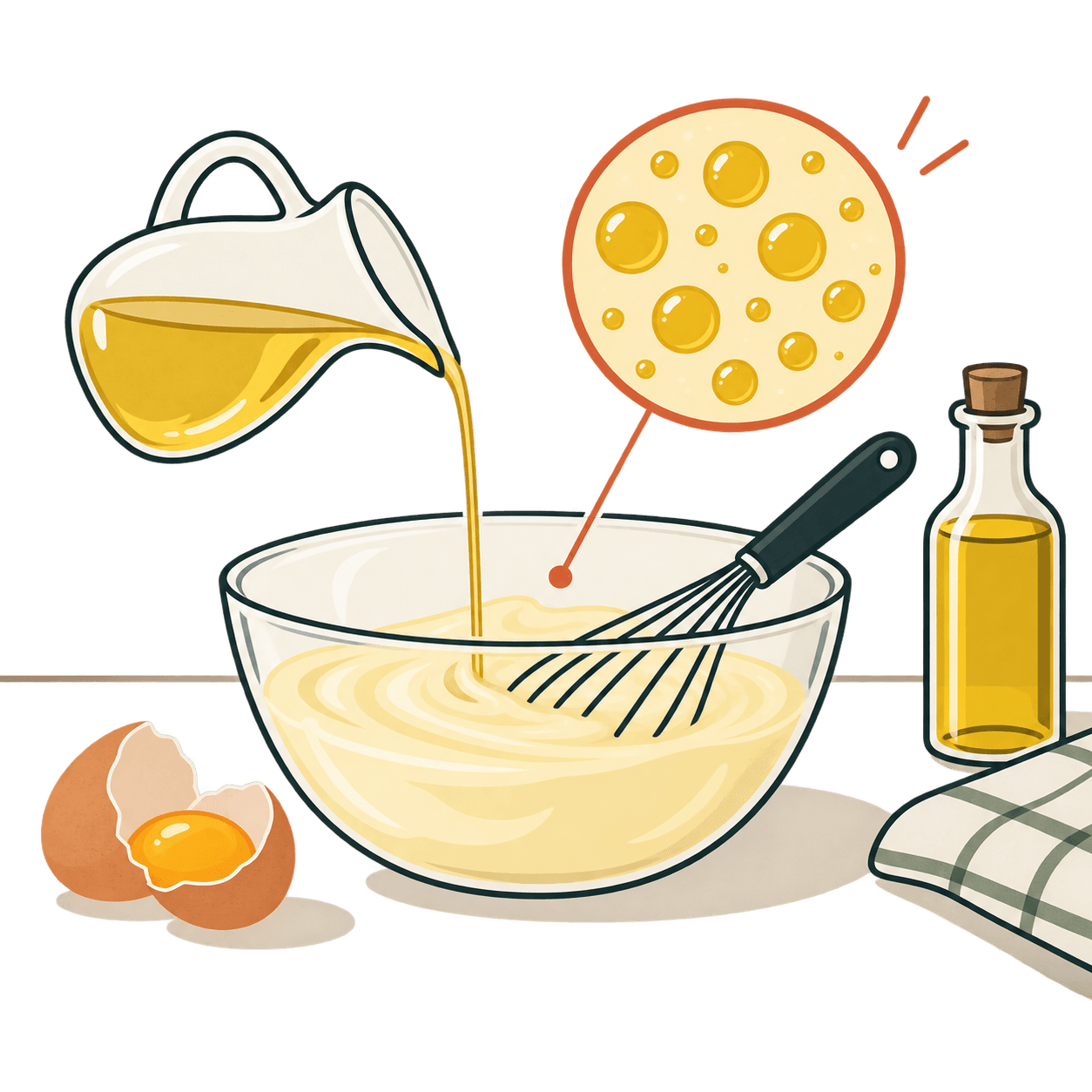
In mayonnaise, small oil droplets are dispersed in a watery part: this is an emulsion. Egg yolk helps stabilise them. The Exploratorium describes this mechanism. Let us start with an editorial question: must something that looks uniform remain so when viewed more closely? We will explore it with an invented drawing, taking care not to mistake that drawing for a photograph of the sauce. [1]
Water and oil tend to separate when left together without help. Mixing can temporarily break them into droplets; an emulsifier helps stabilise the mixture. This is a substance with parts that interact differently with water and fats. The Exploratorium uses this behaviour to explain how a coating around droplets hinders them from joining together again. We do not need to imagine the oil disappearing into the water. [2]
Egg yolk contains lecithin, one of the useful emulsifiers. The Exploratorium’s description of an egg distinguishes the yolk from the white and the other parts. That distinction avoids a shortcut: simply saying the egg holds the sauce together hides the roles of different components. Here we are interested in how the mixture works, rather than assigning special health benefits to mayonnaise. [3]
The way ingredients are handled matters too. Mississippi State University’s teaching laboratory uses mayonnaise as an example, incorporating oil a little at a time while the mixture is worked. The procedure shows why ingredients and process should be considered together. We read the protocol to understand the principle, without turning this page into a recipe or instructions for storing food safely. [4]
To picture the droplets, our editors suggest a drawing. Put many small yellow circles in a blue field and draw a border around each. Yellow represents oil, blue the watery part, and the border the stabilising action. This is a greatly simplified metaphor: the colours are invented, real components are not cardboard circles, and the drawing does not measure the size of the droplets. It helps separate mixing from dissolving. [2]
Now consider the word uniform again. From a distance, our drawing might seem to be one area; close up, its elements become visible. In the example we do not change the ingredients, but the scale at which we look. This editorial exercise invites questions about structure. The explanation of the sauce describes a physical mechanism: it is not a battle between good and bad ingredients, and it does not promise that every mixture will remain stable for ever. [1][4]
Take this with youDraw the difference between two separate layers and many distributed droplets. Say the word emulsion: a technical term becomes easier when you understand the structure it describes.
One idea, in simple words
Mayonnaise is an emulsion: small oil droplets spread through the part containing water. Egg yolk, the yellow part of an egg, helps keep them apart. [1]
Water and oil usually separate. Substances called emulsifiers help keep the droplets apart. Egg yolk contains lecithin, which can do this job. [2][3]
Our editors suggest drawing yellow dots in a blue field. The dots represent oil and the blue represents the watery part. The colours are invented: this is a simple model, not a microscope photograph. Compare it with a friend’s drawing. Did you choose the same number of dots? What did each of you leave out? These questions concern your drawings: neither measures a sauce. Now you can explain what you wanted to represent, without turning this activity into a recipe. [4]
A little discovery to keep
What did you discover?
Read the sources (4)
- The Amazing Multi-Tasking Egg Exploratorium · accessed 21 Sept 2026
- Hollandaise Sauce: What’s Going On? Exploratorium · accessed 21 Sept 2026
- Anatomy of an Egg Exploratorium · accessed 21 Sept 2026
- Experiments in Food Science, Volume 2 — Experiment 8: Emulsions Mississippi State University Extension · accessed 21 Sept 2026
Original writing and illustration made with AI assistance. Our editorial method
More in Food