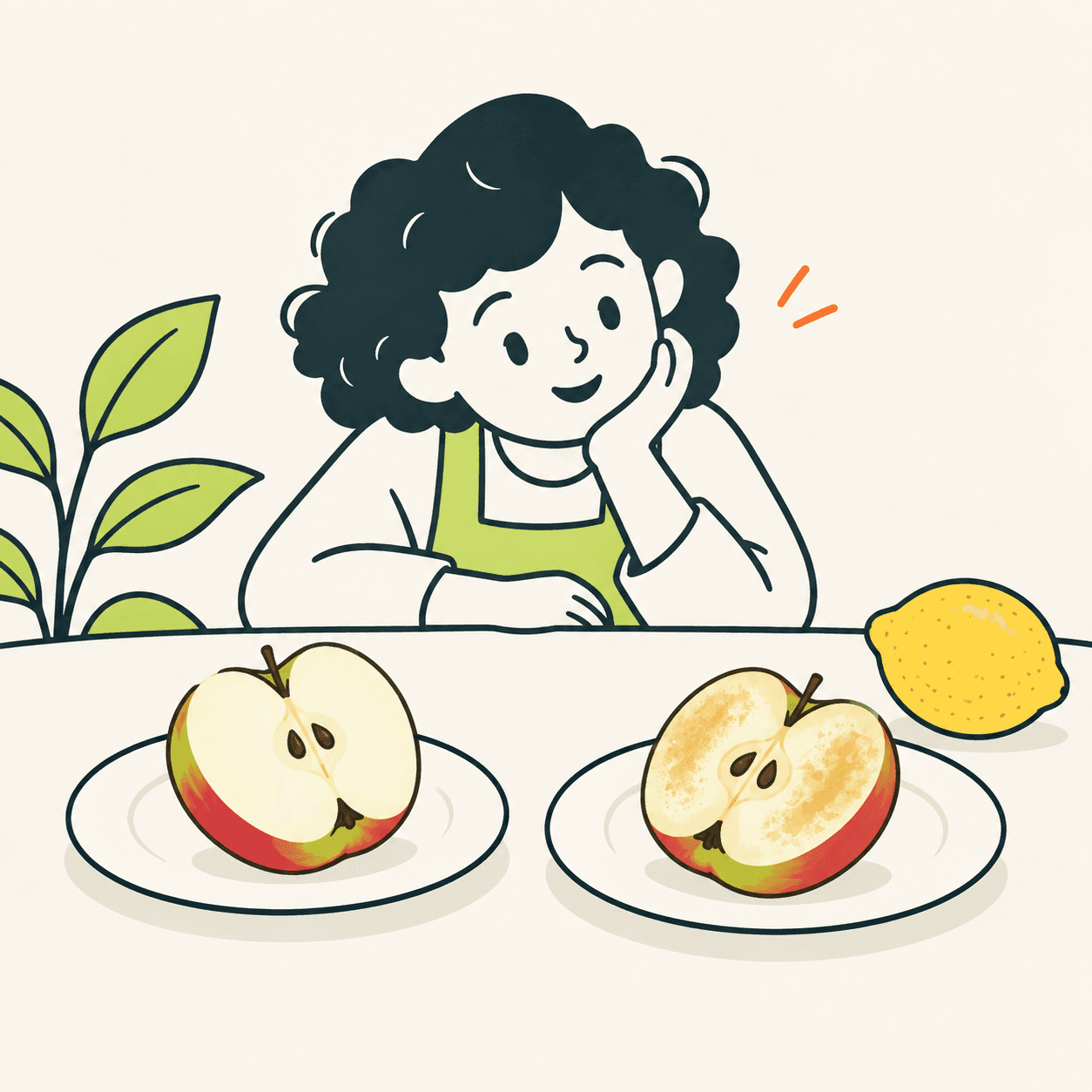
You cut an apple and its pale surface begins to darken. Fruit chemistry is at work in that small change: oxygen from the air takes part in reactions helped by substances already present in the flesh. The American Chemical Society describes the role of an enzyme, a protein that speeds up a reaction. No invisible hand is painting the slice. Substances within the apple are being transformed. [1]
The process is called enzymatic browning. C&EN describes the oxidation and later transformations of phenolic compounds, substances present in the fruit, with the help of an enzyme called polyphenol oxidase. The name is long, but the central idea is simple. Cutting the tissue and exposing it to air allows the reaction’s ingredients to meet more easily. Those transformations produce brown-coloured substances that become visible on the surface. [2][1]
Lemon juice can slow the change. Acidity alters the conditions in which the enzyme works; limiting the arrival of oxygen can also reduce browning. This does not make the apple immune to every kind of change. We are following one reaction and its colour, rather than creating a method for preserving any food. Chemistry helps explain the effect, but the explanation needs to stay within the question it actually answers. [2][3]
Here is an example invented by our editors. Imagine two photographs of the same slice, one taken just after cutting and another later. Saying that it is brown records a result; noting how much time has passed helps describe the change. Now imagine a slice treated with lemon juice too. A useful comparison would require similar conditions and a distinction between our predictions and the colours that really appeared, without adjusting the result to fit our first idea. [1]
Educational activities from the American Chemical Society and the University of Maine use a control sample: an untreated slice for comparison with the others. A control is not a special or superior slice. It provides a reference. If we change many things at once, identifying which change caused a difference becomes harder. A well-described experiment therefore explains what stayed the same as well as what we added to a sample. [1][3]
To begin observing without improvising a food experiment, explore the pictures and activity sheets in the sources. If an adult organises the practical activity, they follow the full instructions, handle cutting and keep the samples separate from snacks: the ACS says not to eat the experimental materials. This article asks one specific question: what changes the speed of browning? The colour alone is not the result of a general check on whether food is safe to eat. [1]
Take this with youA slice reveals a reaction; a comparison reveals an experiment. Careful observation means recording what changes and which conditions stay the same throughout the comparison.
One idea, in simple words
When you cut an apple, its inside meets the air. Oxygen in the air takes part in a reaction that can turn the flesh brown. An enzyme helps this reaction. Enzymes are proteins: here, their job is to make a change happen faster. Lemon juice is acidic and can slow the browning. [1]
Here is an example from our editors. Look at a photograph of a freshly cut slice and another of the same slice later. What differences do you notice? A comparison needs a record of the time passed. A slice with nothing added can be the control: a reference for comparing the others. A practical activity needs the full instructions and an adult to handle cutting. Experimental samples are not a snack and must not be eaten. [1]
A little discovery to keep
What did you discover?
Read the sources (3)
- Activity — Slowing Apple Browning American Chemical Society · accessed 24 Sept 2026
- Periodic Graphics: Kitchen chemistry hacks explained Chemical & Engineering News · American Chemical Society · accessed 24 Sept 2026
- Fruit Science — The Brown Apple Project University of Maine Cooperative Extension · accessed 24 Sept 2026
Original writing and illustration made with AI assistance. Our editorial method
More in Food