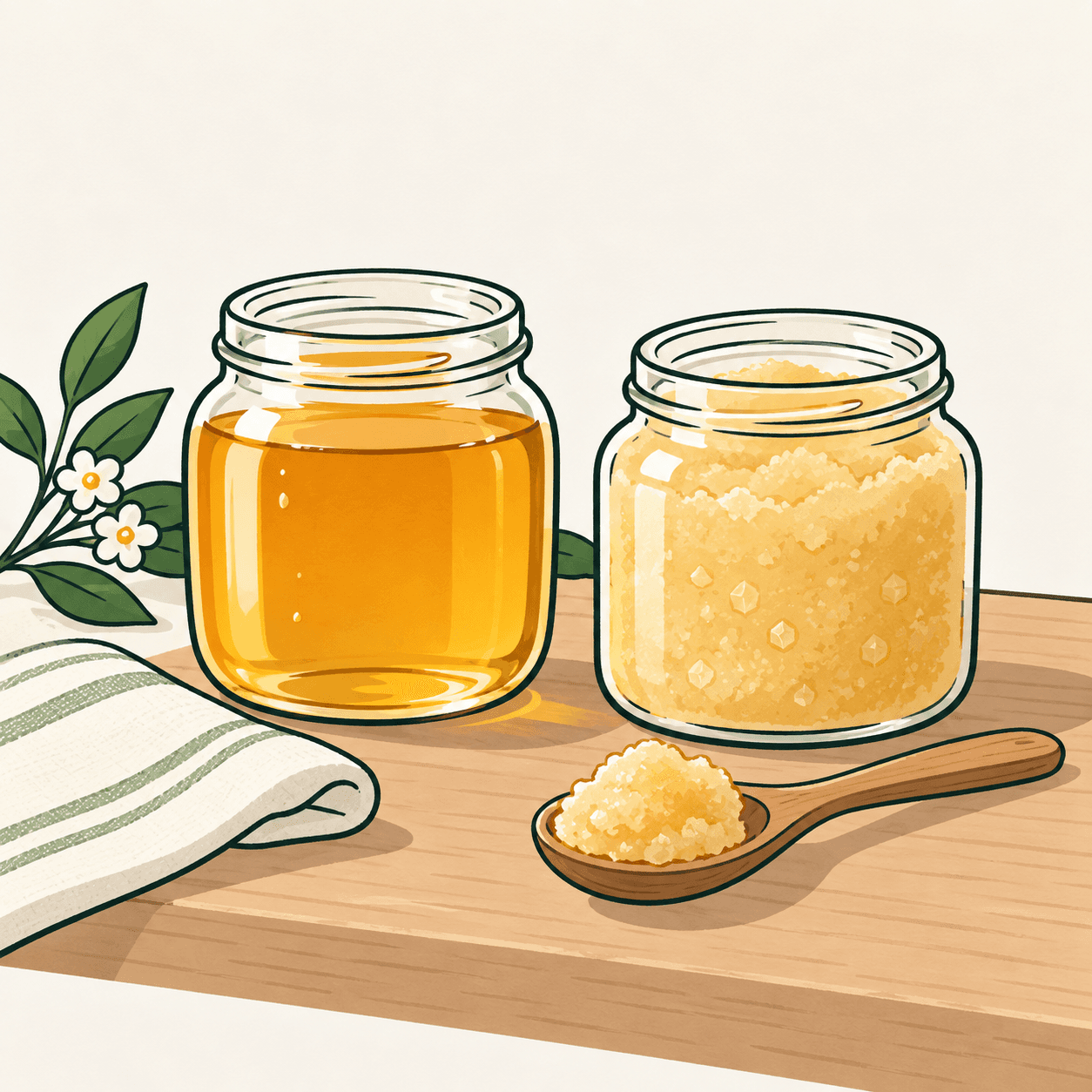
You open a jar and honey that once flowed smoothly now contains little grains. This does not automatically mean it has spoiled. An Ohio State University Extension response describes crystallisation: molecules of glucose, a sugar, arrange themselves into ordered structures. It is a physical change. By itself, it does not establish spoilage, impurity or superior quality. Appearance cannot tell us the product’s entire history. [1][4]
The University of Arkansas explains why different jars change at different speeds. The balance between glucose and fructose, honey’s main sugars, matters, alongside microscopic particles around which crystals can form. Honey relatively rich in glucose tends to crystallise faster. This describes a tendency. It does not let us predict a precise date for every jar merely by looking at its colour, or treat all honey as an identical material. [2]
Purdue Extension also describes creamed honey produced by controlling the formation of small crystals. Texture can therefore be a deliberate production choice. The same source reminds readers that honey should not be given to children under one year old: knowing crystallisation is normal does not remove other food rules. Here we are observing a transformation, rather than certifying an unfamiliar jar’s safety or making health claims for honey. [3]
An example from our editors: imagine two shelves holding the same toy bricks. On the first they are scattered; on the second they are arranged in rows. The comparison suggests a change in arrangement, but does not reproduce sugar’s real structure. Molecules are not giant toy bricks, and honey also contains water and other substances. A model helps when we explain both what it illustrates and what it leaves out. [1]
For an observation suggested by our editors, compare two closed jars from the outside, if they are already available at home. Record only what you see: clarity, colour and any grains. Do not taste unfamiliar products to test ideas about storage. Ask an adult to read the labels with you. If the jars have different origins, this is not a controlled experiment: several conditions differ, so you cannot attribute every visible difference to one cause. [2]
A final editorial question concerns words. Calling honey hard describes a sensation; calling it crystallised offers an explanation that needs to connect with what we know about the material. Try writing the description first, then the mechanism, on two separate lines. This is a small scientific exercise: observing carefully without immediately turning every change into a fault, a miraculous quality or a final judgement. A useful explanation starts by noticing what is actually there. [3]
Take this with youDescribe what you see before looking for the mechanism. Grains and texture may reveal an arrangement, rather than a product going wrong.
One idea, in simple words
Honey contains glucose, a sugar. Its molecules, the tiny parts that make up a substance, can arrange themselves in an orderly pattern and form crystals. Honey becomes thicker and grainy. Crystallisation alone does not mean that the honey has spoiled. [1][4]
Different honeys can change at different speeds. The balance between their sugars matters too. Here is a comparison from our editors: imagine the same toy bricks first scattered around and then lined up in rows. This shows only the idea of arrangement; it is not a real picture of molecules. We can observe a closed jar without tasting it to test guesses. Remember that honey should not be given to children under one year old. A normal transformation does not remove other food-safety rules. [2][3]
A little discovery to keep
What did you discover?
Read the sources (4)
- Question: I have honey... #299672 Ohio State University Extension · Kate Shumaker · accessed 25 Sept 2026
- All About Honey University of Arkansas System · Cooperative Extension Service · accessed 25 Sept 2026
- Honey · FoodLink Purdue University Extension · accessed 25 Sept 2026
- Honey and Its Uses University of Florida · IFAS Extension · accessed 25 Sept 2026
Original writing and illustration made with AI assistance. Our editorial method
More in Food