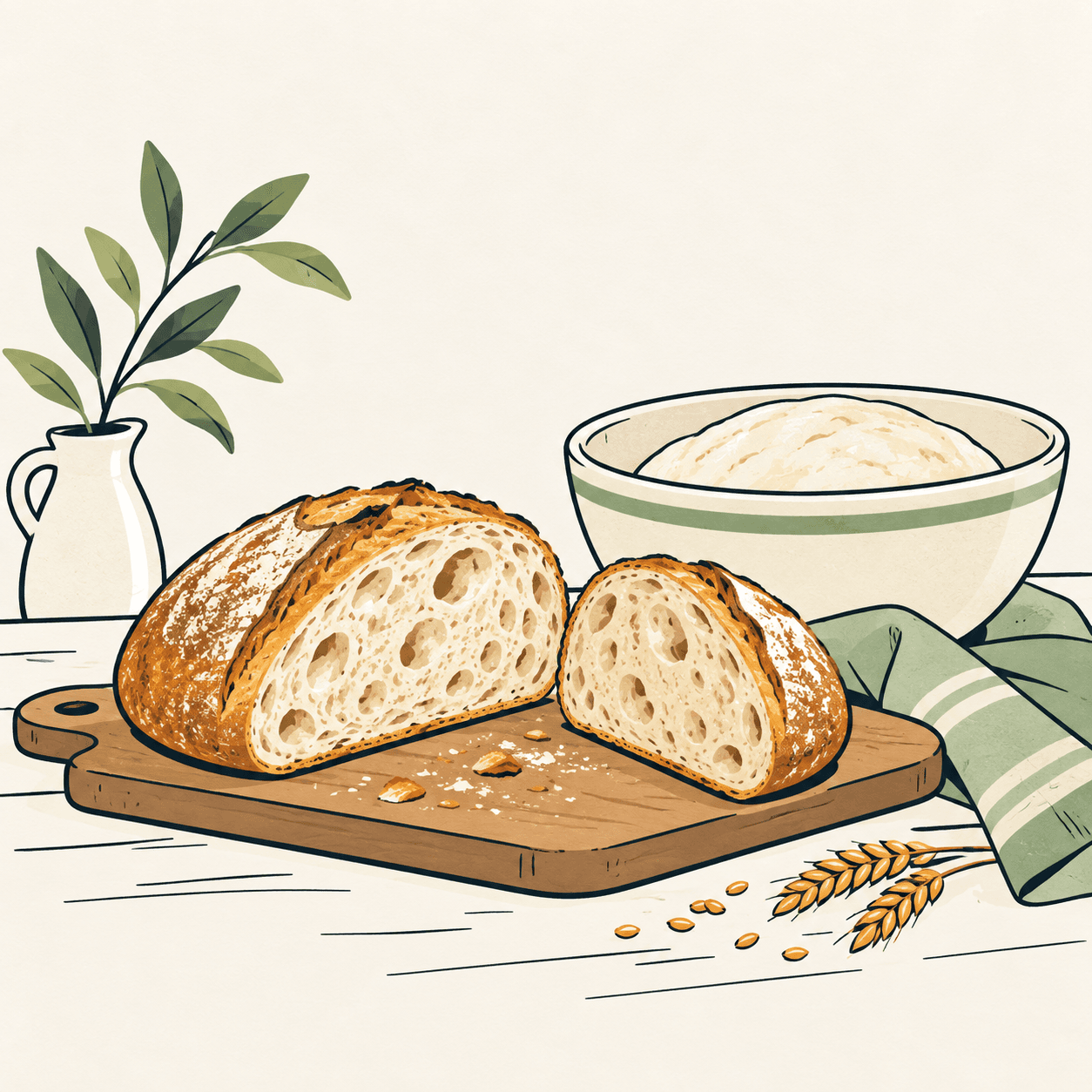
Yeasted bread dough changes volume because a gas is produced inside it: carbon dioxide. Yeast uses sugars and also produces alcohol during fermentation. New Mexico State University’s breadmaking guide points out that its activity depends on conditions: cold slows it down, while excessive heat can kill the cells. Resting dough therefore means allowing time for a biological process, rather than simply waiting for flour to swell by itself. The pause in the recipe is part of the work. [1]
That gas must, however, stay inside the dough. The University of Maine describes a network formed by wheat proteins, gliadins and glutenins, when flour and water are mixed. This structure, gluten, helps dough hold its shape and trap carbon dioxide. Flours do not all behave alike: both the quantity and quality of their proteins matter, and their performance is also assessed through dough tests. Making bubbles and managing to contain them are two different jobs within the same loaf. [2]
This explanation has a specific boundary: it concerns wheat bread raised with biological yeast. The Exploratorium distinguishes that process from chemical leavening, in which baking soda and acidic ingredients can release gas through a reaction. It also notes that some thin breads are unleavened. As risen dough bakes, pockets of gas expand and the structure sets as the temperature increases. The crumb therefore preserves traces of a process we cannot watch directly just by looking at the finished loaf. [3]
Here is a small exercise from our editorial team, without turning the kitchen into a laboratory competition. Take a slice of already baked bread and draw three of its holes: one small, one large and one irregular. Beside your drawing, write two separate questions: where did the gas come from, and what held it in place? Then compare your sketch with the explanations in our sources. Do not use the number of holes to grade the bread or infer health benefits: this observation does not measure either. Its purpose is to change the question from “how much did it rise?” to “how did that happen?” Bread already has enough responsibility when it has to hold the sauce. [2]
Take this with youTry separating what produces a change from what makes that change possible. Drawing a bubble and its boundary can be a useful starting point, even before you switch on the oven.
Read the sources (3)
- Breadmaking — Guide E-206, revisione ottobre 2010 New Mexico State University · accessed 18 Sept 2026
- Understanding Wheat Quality — Bulletin #1019 University of Maine Cooperative Extension · accessed 18 Sept 2026
- Bread Science 101 Exploratorium · accessed 18 Sept 2026
Original writing and illustration made with AI assistance. Our editorial method
More in Food